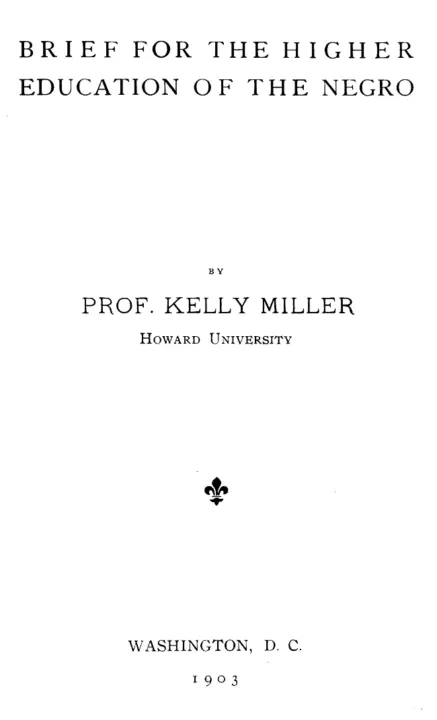
Brief for the higher education of the negro
Kelly Miller
THE CLASSIC COLLECTION · 1897
"A Review of Hoffman's Race Traits and Tendencies of the American Negro" by Kelly Miller is a scientific review published in the late 19th century, specifically in 1897. It critically examines Frederick L. Hoffman's work on the American Negro, focusing on race traits and their supposed tendencies towards physical and moral deterioration. The book addresses significant socio-economic topics within the context of race relations in America during this period. In this review, Miller contests Hoffman's conclusions that the decline of the Negro population is primarily due to inherent racial traits rather than environmental factors. He argues that Hoffman's statistical interpretations are flawed and fail to consider the impact of social circumstances, such as poverty, lack of medical care, and systemic racism. Miller supports his claims by providing counter-evidence and suggesting that the observed decline in the Negro population may be more closely related to socio-economic conditions than to biological determinism. He emphasizes the resilience and progress of the Negro community, advocating for the importance of improving living conditions rather than succumbing to fatalistic theories regarding race.
Introduction adapted from the source catalogue; source summaries may be automatically generated.
Free to read · English · 12,296 words · No account needed
MAKE TIME FOR A GOOD BOOK
On by default. Untick to stop anonymous reading totals. Each page counts after 10 seconds in view. How this works.
Anonymous counting is on unless you have switched it off.
3. Is the death rate, even in the cities, so great as to foreshadow extinction? Nothing is great or small except by comparison. The death rate among the Negroes in the large cities at present is not as great as it was among the whites forty years ago; that is, if we may rely upon the statistics which Mr. Hoffman himself has presented.
Mortality among Whites in Southern Cities.[25]
City. Period. Death rate.
Mobile, Ala. 1852-1855 54.39
Charleston, S. C. 1851-1860 29.79
Savannah, Ga. 1856-1860 37.19
New Orleans, La. 1849-1860 59.60
Under improved sanitary regulations these rates have been lowered until at present they are not at all alarming. May not the same improvement in his environment effect similar changes in the death rate of the Negro?
Let us compare the death rate of the Negro race with that of the Germans as presented in the census of 1880.
Colored
City. death rate. City. Death rate.
Washington 32.60 Konigsberg 31.50 Baltimore 32.81 Munich 33.40 Richmond 28.48 Breslau 31.60 Louisville 30.73 Cologne 27.00 New Orleans 30.42 Strasburg 29.60
This high death rate of the American Negro does not exceed that of the white race in other parts of the civilized globe. If race traits are playing such havoc with the Negroes in America, what direful agent of death, may we ask the author, is at work in the cities of his own fatherland?
4. Does the death rate among Negroes show a tendency to increase? In the District of Columbia there has been a gradual decline in the death rate of the Negro population from 40.78 in 1876 to 29.54 in 1896.[26]
Again, Mr. Hoffman's statistics will show a steady improvement in Southern cities for the last twenty years.
Death rate among Negroes in Southern Cities.[27]
Death Death
City. Periods. rate. Periods. rate.
Mobile, Ala. 1876-1880 39.74 1891-1893 30.91 Charleston, S. C. 1876-1885 43.83 1886-1894 44.06 Savannah, Ga. 1876-1880 51.66 1891-1894 32.26 New Orleans, La. 1880-1884 52.35 1890-1894 39.42
A recent report of the Labor Bureau throws much light on the subject.
Annual Death Rate of the Colored Race for three quinquennial
periods.[28]
City. 1880-1885. 1885-1890. 1890-1895.
Atlanta 37.96 33.41 32.76
Baltimore 36.15 30.52 32.47
Charleston 44.08 46.74 41.43
Memphis 43.01 29.35 21.11
Richmond 40.34 38.83 34.91
This table shows an unmistakable decrease in the death rate for the successive quinquennial periods.
All of which tends to prove that this high death rate is due to condition and is subject to sanitary check and control.
In further confirmation of the fact that the death rate among Negroes is on the decline, the Army records will afford valuable testimony.
Death rate of Colored Soldiers in the U. S. Army.[29]
Average from 1883 to 1892 9.07
Average in 1894 6.26
Average in 1895 5.03
In 1895 it is lower than that of the white soldiers. The same general law of a gradually decreasing death rate is here revealed.
Your reading position is saved on this browser. Take it to another device with a library code. Reading pages adapt to text, rather than matching a printed edition.
BEHIND THE BOOK
This eBook is for the use of anyone anywhere in the United States and most other parts of the world at no cost and with almost no restrictions whatsoever. You may copy it, give it away or re-use it under the terms of the Project Gutenberg License included with this eBook or online at www.gutenberg.org. If you are not located in the United States, you will have to check the laws of the country where you are located before using this eBook. Read the source licence.
The original source file, including credits and licence, is retained by this library. Request an original-format copy at no charge. Please include the book title and Project Gutenberg identifier #31279.
KEEP YOUR CURIOSITY GOING
Cécile Tormay

Moritz Busch
John L. Ransom
Frances Wright
Cécile Tormay

Mabel Potter Daggett