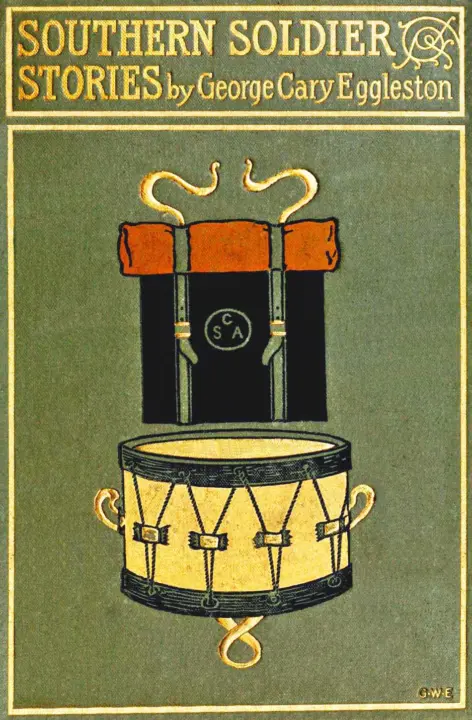
Southern Soldier Stories
George Cary Eggleston
THE CLASSIC COLLECTION · 1905
"A Rebel's Recollections" by George Cary Eggleston is a historical account written in the late 19th century. The work provides a personal perspective on the experiences and sentiments of Southern soldiers during the Civil War, particularly from the viewpoint of Virginia. It captures the complexities of Southern patriotism, highlighting themes of honor, sacrifice, and the struggles faced by the men who fought in the war. The opening of the book sets the stage for Eggleston's recollections by establishing a need for readers to adopt a Southern perspective to fully grasp the events and motivations described. He recounts the initial phases of the Civil War, emphasizing the reluctance of Virginians to secede and the mixture of enthusiasm and trepidation as preparations for conflict began. He paints a picture of the disorganized yet spirited volunteers, who eagerly took up arms despite their lack of military training, and reflects on the conflicting emotions surrounding the concept of honor and the duty to protect their state. The opening serves not only as a historical narrative but also as a contemplation on the nature of loyalty and the deeply rooted beliefs that drove the South to war.
Introduction adapted from the source catalogue; source summaries may be automatically generated.
Free to read · English · 53,075 words · No account needed
MAKE TIME FOR A GOOD BOOK
On by default. Untick to stop anonymous reading totals. Each page counts after 10 seconds in view. How this works.
Anonymous counting is on unless you have switched it off.
The end came, technically, at Appomattox, but of the real difficulties of the war the end was not yet. The trials and the perils of utter disorganization were still to be endured, and as the condition in which many parts of the South were left by the fall of the Confederate government was an anomalous one, some account of it seems necessary to the completeness of this narrative.
Our principal danger was from the lawless bands of marauders who infested the country, and our greatest difficulty in dealing with them lay in the utter absence of constituted authority of any sort. Our country was full of highwaymen--not the picturesque highwaymen of whom fiction and questionable history tell us, those gallant, generous fellows whose purse-cutting proclivities seem mere peccadilloes in the midst of so many virtues; not these, by any means, but plain highwaymen of the most brutal description possible, and destitute even of the merit of presenting a respectable appearance. They were simply the offscourings of the two armies and of the suddenly freed negro population,--deserters from fighting regiments on both sides, and negro desperadoes, who found common ground upon which to fraternize in their common depravity. They moved about in bands, from two to ten strong, cutting horses out of plows, plundering helpless people, and wantonly destroying valuables which they could not carry away. At the house of one of my friends where only ladies lived, a body of these men demanded dinner, which was given them. They then required the mistress of the mansion to fill their canteens with sorghum molasses, which they immediately proceeded to pour over the carpets and furniture of the parlor. Outrages were of every-day enactment, and there was no remedy. There was no State, county, or municipal government in existence among us. We had no courts, no justices of the peace, no sheriffs, no officers of any kind invested with a shadow of authority, and there were not men enough in the community, at first, to resist the marauders, comparatively few of the surrendered soldiers having found their way home as yet. Those districts in which the Federal armies were stationed were peculiarly fortunate. The troops gave protection to the people, and the commandants of posts constituted a government able to enforce order, to which outraged or threatened people could appeal. But these favored sections were only a small part of the whole. The troops were not distributed in detached bodies over the country, but were kept in considerable masses at strategic points, lest a guerrilla war should succeed regular hostilities; and so the greater part of the country was left wholly without law, at a time when law was most imperatively needed. I mention this, not to the discredit of the victorious army or of its officers. They could not wisely have done otherwise. If the disbanded Confederates had seen fit to inaugurate a partisan warfare, as many of the Federal commanders believed they would, they could have annoyed the army of occupation no little; and so long as the temper of the country in this matter was unknown, it would have been in the last degree improper to station small bodies of troops in exposed situations. Common military prudence dictated the massing of the troops, and as soon as it became evident that we had no disposition to resist further, but were disposed rather to render such assistance as we could in restoring and maintaining order, everything was done which could be done to protect us. It is with a good deal of pleasure that I bear witness to the uniform disposition shown by such Federal officers as I came in contact with at this time, to protect all quiet citizens, to restore order, and to forward the interests of the community they were called upon to govern. In one case I went with a fellow-Confederate to the head-quarters nearest me,--eighteen miles away,--and reported the doings of some marauders in my neighborhood, which had been especially outrageous. The general in command at once made a detail of cavalry and instructed its chief to go in pursuit of the highwaymen, and to bring them to him, dead or alive. They were captured, marched at a double-quick to the camp, and shot forthwith, by sentence of a drum-head court-martial, a proceeding which did more than almost anything else could have done, to intimidate other bands of a like kind. At another time I took to the same officer's camp a number of stolen horses which a party of us had managed to recapture from a sleeping band of desperadoes. Some of the horses we recognized as the property of our neighbors, some we did not know at all, and one or two were branded "C. S." and "U. S." The general promptly returned all the identified horses, and lent all the others to farmers in need of them.
Your reading position is saved on this browser. Take it to another device with a library code. Reading pages adapt to text, rather than matching a printed edition.
George Cary Eggleston
George Cary Eggleston
George Cary Eggleston
George Cary Eggleston
BEHIND THE BOOK
This eBook is for the use of anyone anywhere in the United States and most other parts of the world at no cost and with almost no restrictions whatsoever. You may copy it, give it away or re-use it under the terms of the Project Gutenberg License included with this eBook or online at www.gutenberg.org. If you are not located in the United States, you will have to check the laws of the country where you are located before using this eBook. Read the source licence.
The original source file, including credits and licence, is retained by this library. Request an original-format copy at no charge. Please include the book title and Project Gutenberg identifier #51211.
KEEP YOUR CURIOSITY GOING
Cécile Tormay

Moritz Busch
John L. Ransom
Frances Wright
Cécile Tormay

Mabel Potter Daggett