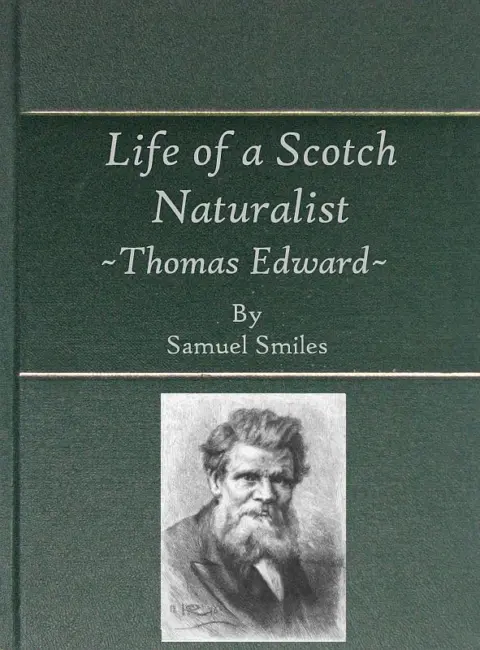
Life of a Scotch Naturalist: Thomas Edward, Associate of the Linnean Society. Fourth Edition
Samuel Smiles
THE CLASSIC COLLECTION · 1891
"A Publisher and His Friends" by Samuel Smiles is a memoir and correspondence detailing the career of John Murray, a significant figure in the publishing industry during the late 18th and early 19th centuries. Written in the early 20th century, the book provides a detailed account of Murray's rise from modest beginnings as he founded and developed his publishing business, which would go on to become highly influential in the literary world, notably in connection with famous authors and literary figures of the time. The opening of the memoir sets the stage by describing John Murray's background, starting with the initial establishment of his publishing house in 1768 after acquiring the business of William Sandby in Fleet Street. It highlights his early struggles, including financial hardships and the need for capital, alongside his interactions with notable contemporaries such as poets and fellow publishers. The letters exchanged with friends and colleagues reveal Murray's ambitions, challenges, and the formative connections he forged, leading to significant contributions to literary history, including the nurturing of authors and the development of influential periodicals like the "Edinburgh Review" and the "Quarterly Review".
Introduction adapted from the source catalogue; source summaries may be automatically generated.
Free to read · English · 152,370 words · No account needed
MAKE TIME FOR A GOOD BOOK
On by default. Untick to stop anonymous reading totals. Each page counts after 10 seconds in view. How this works.
Anonymous counting is on unless you have switched it off.
Another work that excited greater interest than Lord John Russell's anonymous history was Mr. James Morier's "Hajji Baba." Mr. Morier had in his youth travelled through the East, especially in Persia, where he held a post under Sir Gore Ouseley, then English Ambassador. On his return to England, he published accounts of his travels; but his "Hajji Baba" was more read than any other of his works. Sir Walter Scott was especially pleased with it, and remarked that "Hajji Baba" might be termed the Oriental "Gil Bias." Mr. Morier afterwards published "The Adventures of Hajji Baba in England," as well as other works of an Eastern character. The following letter, written by the Persian Envoy in England, Miiza Abul Hassan, shows the impression created by English society on a foreigner in April 1824:
Letter from the Persian Envoy, Mirza Abul Hassan, to the London Gentleman without, who lately wrote letter to him and ask very much to give answer.
April 3, 1824.
When you write to me some time ago to give my thought of what I see good and bad this country, that time I not speak English very well. Now I read, I write much little better. Now I give to you my think. In this country bad not too much, everything very good. But suppose I not tell something little bad, then you say I tell all flattery--therefore I tell most bad thing. I not like such crowd in evening party every night. In cold weather not very good, now hot weather, much too bad. I very much astonish every day now much hot than before, evening parties much crowd than before. Pretty beautiful ladies come sweat, that not very good. I always afraid some old lady in crowd come dead, that not very good, and spoil my happiness. I think old ladies after 85 years not come to evening party, that much better. Why for take so much trouble? Some other thing rather bad. Very beautiful young lady she got ugly fellow for husband, that not very good, very shocking. I ask Sr Gore [Sir Gore Ouseley] why for this. He says me--"perhaps he very good man, not handsome; no matter, perhaps he got too much money, perhaps got title." I say I not like that, all very shocking. This all bad I know. Now I say good. English people all very good people. All very happy. Do what they like, say what like, write in newspaper what like. I love English people very much, they very civil to me. I tell my King English love Persian very much. English King best man in world, he love his people very good much; he speak very kind to me, I love him very much. Queen very best woman I ever saw. Prince of Wales such a fine elegant beautiful man. I not understand English enough proper to praise him, he too great for my language. I respect him same as my own King. I love him much better, his manner all same as talisman and charm. All the Princes very fine men, very handsome men, very sweet words, very affable. I like all too much. I think the ladies and gentlemen this country most high rank, high honour, very rich, except two or three most good, very kind to inferior peoples. This very good. I go to see Chelsea. All old men sit on grass in shade of fine tree, fine river run by, beautiful place, plenty to eat, drink, good coat, everything very good. Sir Gore he tell me King Charles and King Jame. I say Sir Gore, They not Musselman, but I think God love them very much. I think God he love the King very well for keeping up that charity. Then I see one small regiment of children go to dinner, one small boy he say thanks to God for eat, for drink, for clothes, other little boys they all answer Amen. Then I cry a little, my heart too much pleased. This all very good for two things--one thing, God very much please; two things, soldiers fight much better, because see their good King take care of old wounded fathers and little children. Then I go to Greenwich, that too good place, such a fine sight make me a little sick for joy. All old men so happy, eat dinner, so well, fine house, fine beds--all very good. This very good country. English ladies very handsome, very beautiful. I travel great deal. I go Arabia, I go Calcutta, Hyderabad, Poonah, Bombay, Georgia, Armenia, Constantinople, Malta, Gibraltar. I see best Georgia, Circassian, Turkish, Greek ladies, but nothing not so beautiful as English ladies, all very clever, speak French, speak English, speak Italian, play music very well, sing very good. Very glad for me if Persian ladies like them. But English ladies speak such sweet words. I think tell a little story--that not very good.
Your reading position is saved on this browser. Take it to another device with a library code. Reading pages adapt to text, rather than matching a printed edition.
Samuel Smiles
Samuel Smiles
Samuel Smiles
Samuel Smiles
BEHIND THE BOOK
This eBook is for the use of anyone anywhere in the United States and most other parts of the world at no cost and with almost no restrictions whatsoever. You may copy it, give it away or re-use it under the terms of the Project Gutenberg License included with this eBook or online at www.gutenberg.org. If you are not located in the United States, you will have to check the laws of the country where you are located before using this eBook. Read the source licence.
The original source file, including credits and licence, is retained by this library. Request an original-format copy at no charge. Please include the book title and Project Gutenberg identifier #10884.
KEEP YOUR CURIOSITY GOING
Cécile Tormay

Moritz Busch
John L. Ransom
Frances Wright
Cécile Tormay

Mabel Potter Daggett