THE CLASSIC COLLECTION✦A dead man’s diaryCLASSIC FREE BOOKS
A dead man’s diary
Coulson Kernahan
THE CLASSIC COLLECTION · 1904
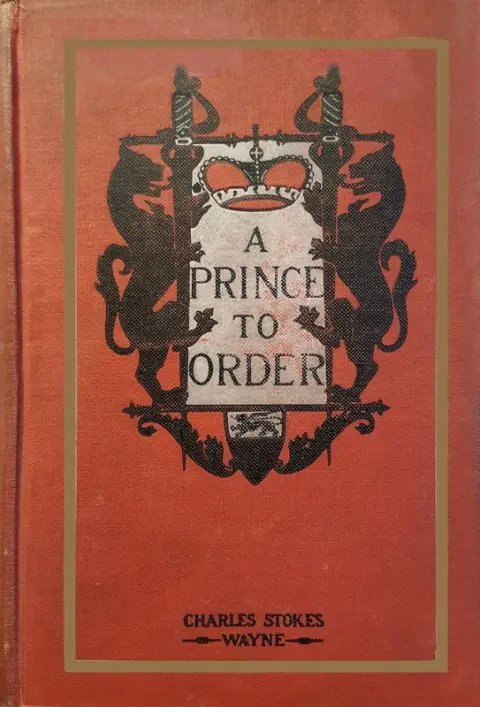
"A Prince to Order" by Charles Stokes Wayne is a novel written in the early 20th century. The story begins with an American man named Carey Grey who wakes up in a Paris hotel, disoriented and with no memory of how he ended up there or what has happened in the last five months. As Grey grapples with his mysterious circumstances and his altered appearance, he uncovers shocking truths about his past and some troubling connections that may link him to a larger, convoluted plot involving his identity and a royal throne. The opening of the novel presents a gripping scenario as Grey struggles to understand his sudden transformation and the mystery of his disappearance. He remembers a night at the opera and visits to clubs and wakes up finding himself in a strange hotel room, transformed and alone. In his quest for answers, he interacts with various figures, including acquaintances who do not recognize him and hint at darker truths regarding his missing identity. Through poignant reflections, Grey realizes he is not only a fugitive but entangled in a royal intrigue, setting the stage for a deeper exploration of themes around identity, loyalty, and the search for truth.
Introduction adapted from the source catalogue; source summaries may be automatically generated.
Free to read · English · 56,887 words · No account needed
MAKE TIME FOR A GOOD BOOK
On by default. Untick to stop anonymous reading totals. Each page counts after 10 seconds in view. How this works.
Anonymous counting is on unless you have switched it off.
The letter dulled, in a measure, the keenness of Grey’s disappointment and reinspired him to the accomplishment of the task that lay before him. After luncheon he had up his trunks from the hotel storeroom and with Baptiste’s assistance accomplished his packing. Already O’Hara had engaged places for three on the train, for Miss von Altdorf’s destination was the same as theirs. She had a married sister living in Kürschdorf, and she was most anxious to join her at the earliest possible moment.
By half-past five everything was in readiness for their departure; Baptiste had retired with a liberal tip, and Grey and O’Hara were making themselves ready for the journey. Just at this juncture there was a knock at the door, and in answer to Grey’s command to enter, it swung open to reveal, bowing on the threshold, the sturdy little figure, pale face, and close-cropped yellow head of Johann.
The two occupants of the room stood astonished, their eyes wide with
surprise.
“Johann!” they exclaimed together.
“Yes, Herr Arndt,” said the lad, bowing again; “it is as you see--I
have come back.”
“Back from where, Johann?” Grey asked.
“I started for Kürschdorf with the Herr Captain Lindenwald; but I am come back from Strasburg.”
“And why?” queried the American, very much puzzled.
“Because, Herr Arndt, I knew it was not right for me to be going with the Herr Captain. I was in your service, and perhaps if you were seized with madness you have all the more need of me.”
“Madness!” repeated Grey, frowning. “What is this? Who said I was mad?”
“The Herr Captain and Lutz,” confessed Johann, stolidly, with scarce a
change of expression.
O’Hara laughed. “Oh, ho!” he shouted, dropping into a chair, “now we have it. You are mad, and so you cannot go to Budavia to claim your own.”
Johann nodded; and Grey, leaning against the edge of the table, was lost for a moment in thought.
“But the Fraülein?” O’Hara questioned. “What did they say of her? Was she to be left with the madman?”
“No, Herr O’Hara; only for a little. The Herr Captain Lindenwald had arranged, Lutz told me, to have Herr Arndt taken to an asylum by the doctors and then the Fraülein was to be brought to Kürschdorf.”
Grey smiled, grimly. “The doctors were the gentlemen you chased out of the window last night, Jack,” he said. And then he asked of Johann: “Did they say anything of Baron von Einhard?”
“No, Herr Arndt.”
“You are quite sure?”
“I have not heard of his name, Herr Arndt.”
Your reading position is saved on this browser. Take it to another device with a library code. Reading pages adapt to text, rather than matching a printed edition.
BEHIND THE BOOK
This eBook is for the use of anyone anywhere in the United States and most other parts of the world at no cost and with almost no restrictions whatsoever. You may copy it, give it away or re-use it under the terms of the Project Gutenberg License included with this eBook or online at www.gutenberg.org. If you are not located in the United States, you will have to check the laws of the country where you are located before using this eBook. Read the source licence.
The original source file, including credits and licence, is retained by this library. Request an original-format copy at no charge. Please include the book title and Project Gutenberg identifier #54916.
KEEP YOUR CURIOSITY GOING
Coulson Kernahan

Maurice Baring
Frances Wright
Cécile Tormay

Frederic Jesup Stimson

W. H. P. (William Henry Pope) Jarvis