THE CLASSIC COLLECTION✦A Terrible TomboyCLASSIC FREE BOOKS
A Terrible Tomboy
Angela Brazil
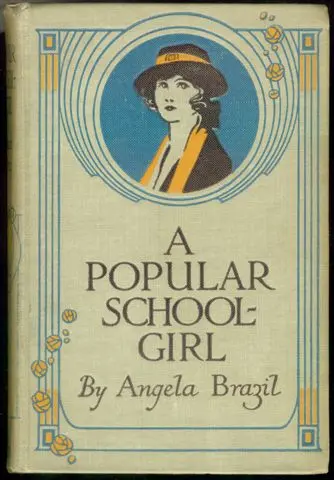
THE CLASSIC COLLECTION · 1920
"A Popular Schoolgirl" by Angela Brazil is a novel set in the early 20th century. The story revolves around Ingred Saxon, a young girl grappling with the transition from carefree holidays back to the realities of school life after the war. Facing changes in her family's circumstances, Ingred must navigate her feelings and relationships at her new school while dealing with the challenges of adolescence. The opening of the novel introduces us to Ingred's world during the end of her summer holidays, showcasing her excitement for family reunions but also hinting at her underlying anxieties about returning to school. As she interacts with her brothers and friends, we see the dynamic of familial affection mixed with the pressures of societal expectations. The gradual reveal of her family's struggles and the significance of Rotherwood—a house filled with memories but now out of reach—sets the stage for Ingred’s journey of self-discovery and adaptation in her new educational environment. The narrative hints at her personality's complexities, including pride and sensitivity, making her relatable to anyone who has experienced the challenges of growing up and seeking one’s place among peers.
Introduction adapted from the source catalogue; source summaries may be automatically generated.
Free to read · English · 64,563 words · No account needed
MAKE TIME FOR A GOOD BOOK
On by default. Untick to stop anonymous reading totals. Each page counts after 10 seconds in view. How this works.
Anonymous counting is on unless you have switched it off.
"It will be far better for the mistresses not to be present at the meeting," she said. "I can trust you, Lispeth, to explain things, and the girls will like it much more if it seems to emanate from the new Council. Talk to them in your own way, and they'll understand you. I want the Society to be an absolutely voluntary one, or it's of no use. Don't let them think they must join merely to please me. I'd rather have a dozen who are in earnest over it than a hundred half-hearted members. Only those who feel enthusiastic need give in their names. I don't mind if it begins in quite a humble way. Indeed, I only expect a small membership at first."
"On the contrary, Miss Burd, I think it will catch on," replied Lispeth.
In consequence of this conversation, the head prefect pinned a paper on the notice-board, convening a general meeting of all girls over twelve years of age, to be held in the big hall on Wednesday afternoon at 3:30 sharp, the last lesson of the day having been remitted by orders from the Study. There was a universal feeling that something important was on foot, so those forms that were eligible trooped in a body to the hall, while the disappointed juniors tried to console themselves with the reflection that they would be able to go home half an hour earlier than their elders. After considerable shuffling about, places were taken. Unwilling to waste further time, Lispeth mounted the platform, and rang the bell for silence.
"Are we all here? Well, I can't wait for anybody else. Those who come in late will have to hear what they can, and you must tell them the rest afterwards. Oh, here they are! Quietly, please! There's plenty of room over there. Violet, will you shut the door? Now that we're all together, I want to have a talk with you. You know I'm what may be called 'Prime Minister' of our School Parliament, and, though your wardens will report all we say in council, I think it is well to have a public meeting sometimes. This term everything seems to have made a fresh start. We're in new buildings, and we have new rules, and our very Parliament is a new institution. You're all in new forms, and I'm the new Head Prefect. It's not only in school that everything's different, but in the outside world as well. This is our first term since peace was signed. I can remember our first term after War was declared. I was only in IIIA. then--quite a youngster! Hetty Hughes, who was the head girl, made a speech, and told us what we ought to do to try to help our country. I think some of us who were here have never forgotten that. We nearly hurrahed the roof off, and we formed a Knitting Club and a Soldiers' Parcel Society on the spot. You know for yourselves how we worked to keep those up. Well, to-day the Empire is at peace, but our country needs our help as much as ever, or even more. It's making a fresh start, and we want the new world to be a better place than the old. Hundreds of thousands of gallant young lives have been gladly given to establish this new world--in this school alone we know to our cost--and we owe it to our heroic dead not to let their sacrifice be in vain. We want a better and purer England to rise up and make a clean sweep of the bad things that disgraced her before. I expect you'll say: 'Oh, that's for politicians, and not for us schoolgirls!' but it isn't. Popular opinion is a mighty thing. The schoolgirls of to-day are the women of to-morrow, and the women of a country have an enormous amount to do with the formation of public opinion--more nowadays than ever before--and their influence will go on increasing with every year that passes. If each of us tries to help the world instead of hindering it, think what an asset each one may be to the country! It's really a tremendous honor to know that we can all take our part in the reconstruction of England. It's like each being allowed to lay a brick in the foundation of a new building. Of course you'll ask me: 'Well, and how are we going to help?' That's just what I want to talk about. We pride ourselves on being practical at the College. Some of us thought we might start a new society, to be called 'The Rainbow League.' It's a sort of 'Guild of Helpers,' and we want to do all kinds of jolly things to help in the town, something like our old 'Knitting Club' and 'Soldiers' Parcel Society,' only of course different. We could give concerts and make clothes for war orphans, and toys for the hospitals, and scrap-books for crippled children. There are heaps of nice things like that you'll just love doing. It's called 'The Rainbow League,' because a rainbow was set in the sky after the Flood, to help people to remember, and we want, in our small way, not to let the Great War be forgotten, but to do our bit to help with the future of the race.
Your reading position is saved on this browser. Take it to another device with a library code. Reading pages adapt to text, rather than matching a printed edition.
Angela Brazil
Angela Brazil
Angela Brazil
Angela Brazil
BEHIND THE BOOK
This eBook is for the use of anyone anywhere in the United States and most other parts of the world at no cost and with almost no restrictions whatsoever. You may copy it, give it away or re-use it under the terms of the Project Gutenberg License included with this eBook or online at www.gutenberg.org. If you are not located in the United States, you will have to check the laws of the country where you are located before using this eBook. Read the source licence.
The original source file, including credits and licence, is retained by this library. Request an original-format copy at no charge. Please include the book title and Project Gutenberg identifier #18505.
KEEP YOUR CURIOSITY GOING
Coulson Kernahan

Maurice Baring
Frances Wright
Cécile Tormay

Frederic Jesup Stimson

W. H. P. (William Henry Pope) Jarvis