THE CLASSIC COLLECTION✦My diaries, being a personal narrative of events 1888-1914, Part 2 (1900-1914)CLASSIC FREE BOOKS
My diaries, being a personal narrative of events 1888-1914, Part 2 (1900-1914)
Wilfrid Scawen Blunt
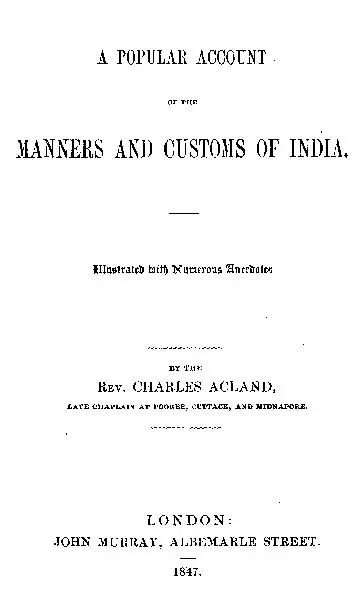
THE CLASSIC COLLECTION · 1847
"A Popular Account of the Manners and Customs of India" by Charles Acland is a historical account written in the mid-19th century. The work provides insights into the daily life, culture, and experiences of Europeans living in India during this period, presenting a unique perspective on the interactions between British expatriates and the Indian population. Acland, a clergyman who served as a chaplain in various regions in India, shares personal anecdotes that highlight the nuances of Indian society as well as the challenges faced by foreigners adapting to a new environment. The opening of the book details Acland's initial voyage from England to India, recounting a tumultuous sea journey marked by storms and calms, and his arrival in Madras. He vividly describes the climate, local flora and fauna, and the interactions with native people that contribute to the vibrant yet unfamiliar culture surrounding him. Notably, Acland's reflections on the use of servants, the etiquette of greetings, and curious local customs begin to paint a picture of the social dynamics in colonial India. Through a blend of observation and personal correspondence, Acland seeks to convey not only the beauty and strangeness of the land but also the emotional ties to his family left behind, making the content both informative and deeply personal.
Introduction adapted from the source catalogue; source summaries may be automatically generated.
Free to read · English · 63,585 words · No account needed
MAKE TIME FOR A GOOD BOOK
On by default. Untick to stop anonymous reading totals. Each page counts after 10 seconds in view. How this works.
Anonymous counting is on unless you have switched it off.
"Very well; and I am sure, if the padre likes it, he is very welcome to have it till Mrs. M. comes back."
Thereupon we adjourned to an adjoining room, where there was a very large upright organ, but, as Mr. M. said, "only a grinder." He puts in the church barrel, and, turning the handle, plays, one after another, several really beautiful psalm-tunes, whilst every one stands serious and attentive. At last dinner is announced. The style is much the same as at the judge's, except that almost all the dishes are silver, and there is a magnificent racing-cup of the same metal in the centre. The eatables, however, are many of them English. There is fresh salmon brought from England, English soups, English potatoes, carrots, oysters, cheese, &c. &c., all brought out in canisters hermetically sealed.
Of course, as everywhere else, the beer, wines, &c., are from England, for so devoid are we of any trading community, that in this splendid climate no attempt has ever yet been made to manufacture wine. Beer we could not make, at least so they say, for want of barley;[4] but I believe that pine-apples, of which we get three or four young juicy ones for a penny, would make splendid wine. England has no pine-apples at all like ours. Then there are preserves and pies made of green-gages, apricots, &c., all from home. Here also, as at the judge's, there is abundance of champagne, or, as we call it here, tokay. After dinner, at all houses, each person takes a small glass of liqueur.
At the commissioner's, being a bachelor's party, we remained in the dining-room. Cigars were introduced, with coffee and brandy-and-water for those who liked it. I will now relate an anecdote I heard there:--
[Sidenote: A TIGER-STORY.]
"Why, B.," said Mr. M., "I heard you had an adventure yesterday. What
was it?"
"Oh! don't ask me; it makes me almost sick to think of it."
"Oh, nonsense!" from all present.
"Well, if I must, here goes." Then drinking off a glass of wine B. began: "I suppose I must make a regular history of it, so I will commence at the beginning. Last evening, in the bright and balmy, or I should say gorgeous, splendour of an oriental sunset, when the brilliant tints of--"
"Bah! B., don't be too absurd," cried some of us; "tell us what it was without all this brilliant balmy nonsense."
Your reading position is saved on this browser. Take it to another device with a library code. Reading pages adapt to text, rather than matching a printed edition.
BEHIND THE BOOK
This eBook is for the use of anyone anywhere in the United States and most other parts of the world at no cost and with almost no restrictions whatsoever. You may copy it, give it away or re-use it under the terms of the Project Gutenberg License included with this eBook or online at www.gutenberg.org. If you are not located in the United States, you will have to check the laws of the country where you are located before using this eBook. Read the source licence.
The original source file, including credits and licence, is retained by this library. Request an original-format copy at no charge. Please include the book title and Project Gutenberg identifier #43586.
KEEP YOUR CURIOSITY GOING
Wilfrid Scawen Blunt
Wilfrid Scawen Blunt

E. W. (Edgar Watson) Howe
Cécile Tormay

Moritz Busch
John L. Ransom