
A Son of Ishmael: A Novel
L. T. Meade
THE CLASSIC COLLECTION · 1900
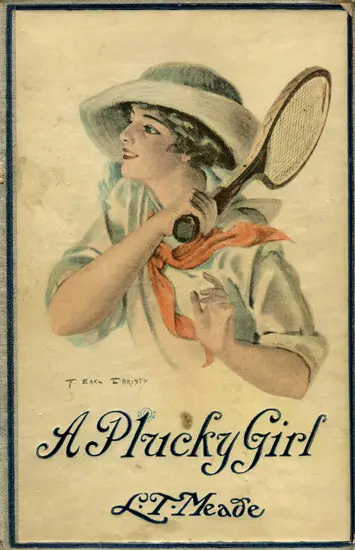
"A Plucky Girl" by L. T. Meade is a novel written in the early 20th century. The book centers around a young woman named Westenra Wickham, who faces a dramatic change in her fortunes following the death of her father and the subsequent loss of her family's wealth. Determined to maintain a sense of dignity and purpose, Westenra proposes to start a boarding house in London to support herself and her mother, reflecting her spirited and ambitious character. At the start of the story, Westenra reflects on her privileged upbringing and her father's heroic legacy, as well as the stark reality that both she and her mother are now nearly penniless. Westenra rejects the idea of retreating to a rural life and instead, outlines a plan to take in paying guests in a house they can furnish with their belongings. Despite her mother’s trepidation and the societal implications of their new venture, Westenra's resolve is evident. She embarks on a quest to secure a suitable house and begins reaching out to friends, challenging their perceptions of her and their willingness to support her new direction. The opening portion sets the stage for themes of courage, the struggle against societal norms, and the pursuit of independence amidst adversity.
Introduction adapted from the source catalogue; source summaries may be automatically generated.
Free to read · English · 91,884 words · No account needed
MAKE TIME FOR A GOOD BOOK
On by default. Untick to stop anonymous reading totals. Each page counts after 10 seconds in view. How this works.
Anonymous counting is on unless you have switched it off.
"But, mother, how can that be? He is not really a friend of Jane Mullins's. Honest little Jane belongs essentially to the people. You have only to look from one face to the other to see what a wide gulf there is between them. He is accustomed to good society; he is a man of the world. Mother, I am certain he is keeping something to himself. I cannot understand why he lives here. Why should he live here?"
"He likes it," answered mother. "He enjoys his many conversations with me. He likes the neighbourhood. He says Bloomsbury is far more healthy than Mayfair."
"Mother, dear, is it likely that such a man would think much about his
health."
"I am sorry you are prejudiced against him," said mother, and a fretful quaver came into her voice. "Well," she added, "I am glad the day is fine, we shall enjoy our little expedition this evening."
"But are you sure it won't be too much for you?"
"Too much! I am so wanting to go," said mother.
"Then that is right, and I am delighted."
"By the way," continued mother, "I had a note this morning from Mr. Randolph; he wants us to dine with him first at the Hotel Cecil."
"Mother!"
"Yes, darling; is there any objection?"
"Oh, I don't like it," I continued; "why should we put ourselves under
an obligation to him?"
"I do not think, Westenra, you need be afraid; if I think it right to go you need have no scruples."
"Of course I understand that," I answered, "and if it were any one else I should not think twice about it. If the Duchess, for instance, asked us to dine with her, and if she took us afterwards to the theatre I should quite rejoice, but I am puzzled about Mr. Randolph."
"Prejudiced, you mean, dear; but never mind, you are young. As long as you have me with you, you need have no scruples. I have written a line to him to say that we will be pleased to dine with him. He is to meet us at the hotel, and is sending a carriage for us here. I own I shall be very glad once in a way to eat at a table where Mrs. Armstrong is not."
"I have always tried to keep Mrs. Armstrong out of your way, mother."
"Yes, darling; but she irritates me all the same. However, she is a good soul, and I must learn to put up with her. Now then, West, what will you wear to-night?"
"Something very quiet," I answered.
"One of your white dresses."
"I have only white silk, that is too much."
Your reading position is saved on this browser. Take it to another device with a library code. Reading pages adapt to text, rather than matching a printed edition.
BEHIND THE BOOK
This eBook is for the use of anyone anywhere in the United States and most other parts of the world at no cost and with almost no restrictions whatsoever. You may copy it, give it away or re-use it under the terms of the Project Gutenberg License included with this eBook or online at www.gutenberg.org. If you are not located in the United States, you will have to check the laws of the country where you are located before using this eBook. Read the source licence.
The original source file, including credits and licence, is retained by this library. Request an original-format copy at no charge. Please include the book title and Project Gutenberg identifier #41136.
KEEP YOUR CURIOSITY GOING
Coulson Kernahan

Maurice Baring
Frances Wright
Cécile Tormay

Frederic Jesup Stimson

W. H. P. (William Henry Pope) Jarvis


