
A Son of Ishmael: A Novel
L. T. Meade
THE CLASSIC COLLECTION · 1900
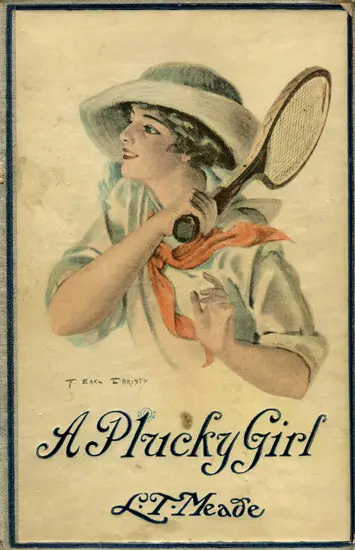
"A Plucky Girl" by L. T. Meade is a novel written in the early 20th century. The book centers around a young woman named Westenra Wickham, who faces a dramatic change in her fortunes following the death of her father and the subsequent loss of her family's wealth. Determined to maintain a sense of dignity and purpose, Westenra proposes to start a boarding house in London to support herself and her mother, reflecting her spirited and ambitious character. At the start of the story, Westenra reflects on her privileged upbringing and her father's heroic legacy, as well as the stark reality that both she and her mother are now nearly penniless. Westenra rejects the idea of retreating to a rural life and instead, outlines a plan to take in paying guests in a house they can furnish with their belongings. Despite her mother’s trepidation and the societal implications of their new venture, Westenra's resolve is evident. She embarks on a quest to secure a suitable house and begins reaching out to friends, challenging their perceptions of her and their willingness to support her new direction. The opening portion sets the stage for themes of courage, the struggle against societal norms, and the pursuit of independence amidst adversity.
Introduction adapted from the source catalogue; source summaries may be automatically generated.
Free to read · English · 91,884 words · No account needed
MAKE TIME FOR A GOOD BOOK
On by default. Untick to stop anonymous reading totals. Each page counts after 10 seconds in view. How this works.
Anonymous counting is on unless you have switched it off.
"Yes," he answered, "or, at least, I want you to drive with me now, and to walk with me afterwards. I have a great desire that we should spend this evening together; and I fancy, somehow, that you won't deny me. I have a carriage outside; I bought it for you, yesterday, a smart little victoria. I will drive you to Richmond, and we can dine there. You will come, won't you, dear?"
I paused to think, then I said, just as gravely as he had addressed
me--
"Yes, I'll come."
"That is nice," he remarked, rubbing his hands, "we'll have a good time, little girl. We won't mind what the Duchess said; we'll have a right, good, jolly time, you and I."
"Of course," I answered. I went up to my room, dressed, and came down
again.
"I am ready now," I said.
He took my hand.
"It is very good of you, Westenra; we shall have a delightful evening; all that thundery feeling has gone out of the air, everything is crisp and fresh, and you'll enjoy your drive."
None of the servants saw us go out, and it was Albert himself who put
me into the victoria. He sat beside me, took the reins, and we were
off.
"Don't you think this is a neat little turn-out?" he said, as we drove down in the soft summer air to Richmond.
I praised the victoria to his heart's content, and then I told him that I thought his taste was much improved.
"It is all owing to you, dear," he replied. "You like things to look gentle somehow. I could not see myself looking at you in a place with loud things. It was only this morning I was saying to myself, early this morning, I mean"--he gave a quick sigh as he uttered these last words--"I was saying to myself, that we would furnish the house at Highgate over again according to your ideas. We would just leave a couple of rooms for mother, according to her tastes, and you and I should have the rest of the house furnished as you like. Liberty, Morris, all the rest, everything soft, and cloudy, and dim, and you walking about in the midst of the pretty things, and I coming home, and--but, never mind, dear, only I would like you always to feel, that there is nothing under the sun I would not do for you, nothing."
"You are very, very kind," I murmured.
Your reading position is saved on this browser. Take it to another device with a library code. Reading pages adapt to text, rather than matching a printed edition.
BEHIND THE BOOK
This eBook is for the use of anyone anywhere in the United States and most other parts of the world at no cost and with almost no restrictions whatsoever. You may copy it, give it away or re-use it under the terms of the Project Gutenberg License included with this eBook or online at www.gutenberg.org. If you are not located in the United States, you will have to check the laws of the country where you are located before using this eBook. Read the source licence.
The original source file, including credits and licence, is retained by this library. Request an original-format copy at no charge. Please include the book title and Project Gutenberg identifier #41136.
KEEP YOUR CURIOSITY GOING
Coulson Kernahan

Maurice Baring
Frances Wright
Cécile Tormay

Frederic Jesup Stimson

W. H. P. (William Henry Pope) Jarvis


