
A Son of Ishmael: A Novel
L. T. Meade
THE CLASSIC COLLECTION · 1900
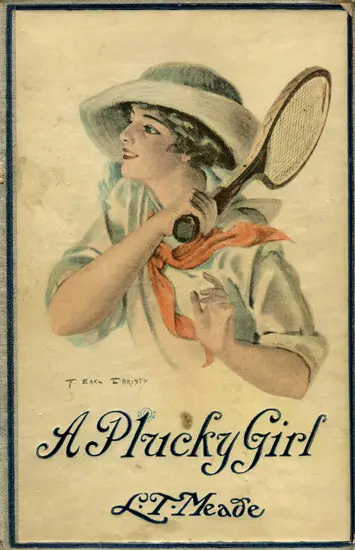
"A Plucky Girl" by L. T. Meade is a novel written in the early 20th century. The book centers around a young woman named Westenra Wickham, who faces a dramatic change in her fortunes following the death of her father and the subsequent loss of her family's wealth. Determined to maintain a sense of dignity and purpose, Westenra proposes to start a boarding house in London to support herself and her mother, reflecting her spirited and ambitious character. At the start of the story, Westenra reflects on her privileged upbringing and her father's heroic legacy, as well as the stark reality that both she and her mother are now nearly penniless. Westenra rejects the idea of retreating to a rural life and instead, outlines a plan to take in paying guests in a house they can furnish with their belongings. Despite her mother’s trepidation and the societal implications of their new venture, Westenra's resolve is evident. She embarks on a quest to secure a suitable house and begins reaching out to friends, challenging their perceptions of her and their willingness to support her new direction. The opening portion sets the stage for themes of courage, the struggle against societal norms, and the pursuit of independence amidst adversity.
Introduction adapted from the source catalogue; source summaries may be automatically generated.
Free to read · English · 91,884 words · No account needed
MAKE TIME FOR A GOOD BOOK
On by default. Untick to stop anonymous reading totals. Each page counts after 10 seconds in view. How this works.
Anonymous counting is on unless you have switched it off.
"To be frank with you," I said, "we wish to secure 17 Graham Square in order to start a boarding-house there."
The man immediately laid down the large book in which he had been
taking my orders.
"That will never do," he said. "We cannot allow business of any sort to be carried on in the house, it would destroy all the rest of the property. It is far too aristocratic for anything of the kind."
"But our house would be practically private," I said; "I mean," I continued, stammering and blushing, and feeling ready to sink through the floor, "that our guests would be extremely nice and well-behaved people."
"Oh, I have no doubt whatever of that," replied the clerk, "but there is a condition in every lease in that special Square, that money is not to be earned on the premises. I presume your guests would not come to you for nothing?"
"Certainly not," I replied. I felt myself turning cold and stiff. All the angry blood of my noble ancestors stirred in my veins. I said a few more words and left the shop.
"Well?" asked mother. She was looking dreary and terribly huddled up in the carriage. It was a warm day, but I think going through those empty houses had chilled her. "Well, Westenra, have you taken No. 17?"
"Alas! no," I answered in some heat; "would you believe it, mother, the agent says the landlord will not let us the house if we make money in it."
"If we make money in it? I do not understand," answered mother. Her blue eyes were fixed on my face in an anxious way.
"Why, mother, darling, don't you know we meant to fill the house with
paying guests."
"Oh, I forgot," said mother. "Home, Jenkins, as fast as possible."
Jenkins whipped up the horses, and we trotted home. Mother looked
distinctly relieved.
"So you have not taken the house?" she said.
"I cannot get it," I answered. "It is more than provoking. What are we to do? I had taken such a fancy to the place."
"It did seem, for that benighted place, fairly cheerful," said my mother, "but, Westenra, there is a Providence guiding our paths. Doubtless Providence does not intend you to wreck your young life attending to lodgers."
"But, mother dear, don't you understand that we must do something for our living? It is disappointing, but we shall get over it somehow."
During the rest of that day mother refused even to discuss the boarding-house scheme. She seemed to think that because we could not get 17 Graham Square, there was no other house available for our purpose.
Your reading position is saved on this browser. Take it to another device with a library code. Reading pages adapt to text, rather than matching a printed edition.
BEHIND THE BOOK
This eBook is for the use of anyone anywhere in the United States and most other parts of the world at no cost and with almost no restrictions whatsoever. You may copy it, give it away or re-use it under the terms of the Project Gutenberg License included with this eBook or online at www.gutenberg.org. If you are not located in the United States, you will have to check the laws of the country where you are located before using this eBook. Read the source licence.
The original source file, including credits and licence, is retained by this library. Request an original-format copy at no charge. Please include the book title and Project Gutenberg identifier #41136.
KEEP YOUR CURIOSITY GOING
Coulson Kernahan

Maurice Baring
Frances Wright
Cécile Tormay

Frederic Jesup Stimson

W. H. P. (William Henry Pope) Jarvis


