
A Son of Ishmael: A Novel
L. T. Meade
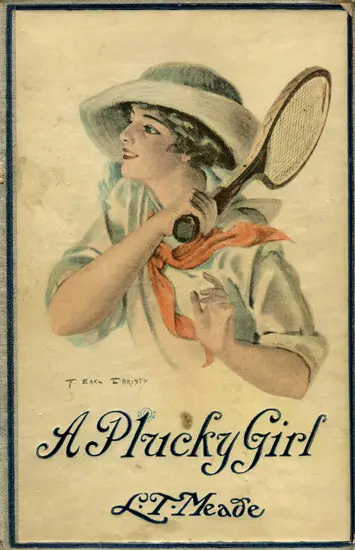
THE CLASSIC COLLECTION · 1900
"A Plucky Girl" by L. T. Meade is a novel written in the early 20th century. The book centers around a young woman named Westenra Wickham, who faces a dramatic change in her fortunes following the death of her father and the subsequent loss of her family's wealth. Determined to maintain a sense of dignity and purpose, Westenra proposes to start a boarding house in London to support herself and her mother, reflecting her spirited and ambitious character. At the start of the story, Westenra reflects on her privileged upbringing and her father's heroic legacy, as well as the stark reality that both she and her mother are now nearly penniless. Westenra rejects the idea of retreating to a rural life and instead, outlines a plan to take in paying guests in a house they can furnish with their belongings. Despite her mother’s trepidation and the societal implications of their new venture, Westenra's resolve is evident. She embarks on a quest to secure a suitable house and begins reaching out to friends, challenging their perceptions of her and their willingness to support her new direction. The opening portion sets the stage for themes of courage, the struggle against societal norms, and the pursuit of independence amidst adversity.
Introduction adapted from the source catalogue; source summaries may be automatically generated.
Free to read · English · 91,884 words · No account needed
MAKE TIME FOR A GOOD BOOK
On by default. Untick to stop anonymous reading totals. Each page counts after 10 seconds in view. How this works.
Anonymous counting is on unless you have switched it off.
"Oh no, darling, just a little weak, but that soon passes. There is nothing to be alarmed about, Westenra. The fact of a person being thoroughly happy does not surely mean that that person is in danger."
"I am so glad you are happy," I said.
"I am wonderfully so; it is the glad presence of God Himself, and also of your dear father. If I have a wish in the world," continued mother then slowly, and she looked at me as she spoke, "it is to see James Randolph. I cannot imagine why he does not write. He has been very good to me, and I like him much. He is a dear fellow, full of courtesy and chivalry; he has a gentle, tender, brave heart; he would make the girl he loves happy, very happy. I should like to see him again, and to thank him."
I did not dare to tell mother what we all now firmly believed with regard to Mr. Randolph. I tried to thread my needle, but there was a mist before my eyes. The needlework nearly fell from my hand. Suddenly, in the midst of our conversation in the quiet drawing-room, I heard a commotion. Some one--two people were coming upstairs--the steps of one were heavy, there was an altercation in the landing, a voice pleaded with another voice, and the strange voice got loud and angry.
I half rose from my seat, and then sat down again.
"What is the matter?" asked mother; "you look very white, Westenra. Is
there anything wrong?"
"I don't want strangers to come here just now," I said.
"But you forget, my dear child, that this is everybody's drawing-room. This cosy corner is my special seat, but we cannot possibly keep our boarders out--it is impossible, my darling."
She had scarcely said the words before the door burst open, and a man with red hair and red whiskers, in a loud check suit, entered.
"Ah," he said, "I thought as much; I thought I'd get to headquarters if I came here. Now, is this lady Mrs. Wickham, and is this young lady Miss Wickham? Now, Miss Mullins, I will see them for myself, please; you cannot keep me back; I am determined to have my rights, and----"
I rushed towards the door. One glance at mother's face was enough. It had turned white, the blue look came round her lips, there was a startled gleam in her eyes.
"What is it?" she said, and she looked at Jane.
"Go to her, Jane; stay with her," I said; "I will manage this man. Go to her, and stay with her."
Your reading position is saved on this browser. Take it to another device with a library code. Reading pages adapt to text, rather than matching a printed edition.
BEHIND THE BOOK
This eBook is for the use of anyone anywhere in the United States and most other parts of the world at no cost and with almost no restrictions whatsoever. You may copy it, give it away or re-use it under the terms of the Project Gutenberg License included with this eBook or online at www.gutenberg.org. If you are not located in the United States, you will have to check the laws of the country where you are located before using this eBook. Read the source licence.
The original source file, including credits and licence, is retained by this library. Request an original-format copy at no charge. Please include the book title and Project Gutenberg identifier #41136.
KEEP YOUR CURIOSITY GOING
Coulson Kernahan

Maurice Baring
Frances Wright
Cécile Tormay

Frederic Jesup Stimson

W. H. P. (William Henry Pope) Jarvis


