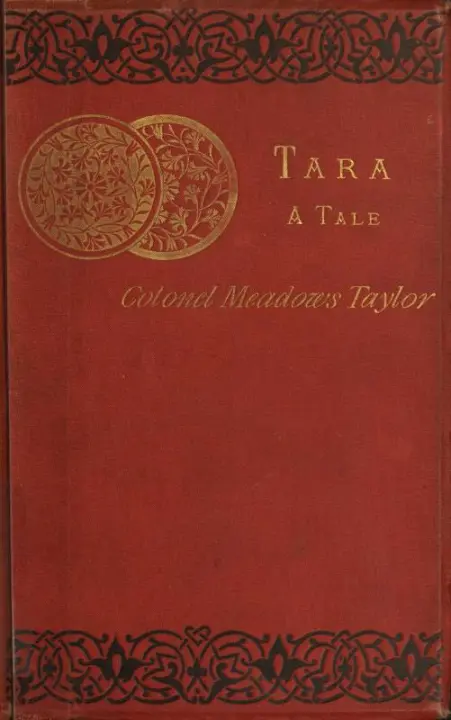
Tara: A Mahratta Tale
Meadows Taylor
THE CLASSIC COLLECTION · 1878
"A Noble Queen: A Romance of Indian History (Volume 2 of 3)" by Meadows Taylor is a historical novel written in the late 19th century. The narrative unfolds in a richly detailed setting during a time marked by political intrigue and personal valor, focusing on the characters navigating the complex socio-political landscape of Indian history. Central to the story is Abbas Khan, a nobleman who faces challenges and adventures while serving the Queen-Regent, illustrating themes of honor, loyalty, and the struggles of love against the backdrop of impending war. The opening of the volume captures the aftermath of a council meeting, filled with vibrant descriptions of the court and the proceedings within the palace. The mood shifts between jubilant celebrations of Abbas Khan’s recent victories and the tension of political maneuvering as the Queen prepares for war. Abbas Khan is shown returning home to affectionate greetings and his mother’s pride, highlighting the personal stakes intertwined with his public actions. Additionally, the narrative introduces the priest, Francis d'Almeida, who, despite cultural tensions, remains focused on his mission of aiding the young Queen, Taj-ool-Nissa, whose health becomes a central concern. The opening sets the stage for the unfolding drama of loyalty, intrigue, and romance, inviting the reader into a world where personal destinies are shaped by the larger forces of history.
Introduction adapted from the source catalogue; source summaries may be automatically generated.
Free to read · English · 71,630 words · No account needed
MAKE TIME FOR A GOOD BOOK
On by default. Untick to stop anonymous reading totals. Each page counts after 10 seconds in view. How this works.
Anonymous counting is on unless you have switched it off.
"I would also ask you," continued the Queen, "to ascertain whether one Dom Diego, the head priest at Moodgul, is still there."
"I think I can answer that question, noble Queen," said the Padré, joining his hands. "When Abbas Khan was ill from his wound, at the village near Talikota, I heard that Dom Diego had left Moodgul for Goa, being succeeded by two humble priests who had taken charge of the mission; and this was confirmed by some of my flock who came to the fair at Talikota, who told me they were satisfied with the new comers until I could return to them."
"And you are a physician, too, sir," cried the Queen, "as well as a master of languages. Oh, that thou wouldst see the real Queen, Taj-ool-Nissa, who languishes sorely, and can obtain no relief, though we have sent even to Beeder for learned men. Will you see her, Padré Sahib? it is not late even now, and she is still awake."
"Before I entered the Church," replied the Padré, "I studied both medicine and surgery in my own country and in Spain, from the Moorish physicians, who are most wise. There I learned somewhat of Arabic also, which, perhaps, led me to the East; and though I joined the Church as a humble servant of God, I was not without hope, like many of its missionaries, I might use my medical skill in its service. Yea, noble Queen, I am ready to use any humble skill I possess in behalf of the Royal Queen, your daughter."
"There is no time like the present," returned the Queen; "our nobles will excuse me while I conduct you to her. Rise, sir, and follow me."
The Peer Sahib could contain himself no longer--
"Astagh-fur-oolla! God forbid! Touba! Touba! Shame! Shame! that I, a humble priest of Alla and his Prophet, whose name be honoured, should see this. Touba! Touba! that an infidel should have honour in the palace of Beejapoor. He a servant of God! He, an eater of pig and bibber of wine! He, an agent of Satan, a disseminator of the abominable doctrines which Mahomed Moostafa, Prophet of God, hath cursed! He who worships images, who----"
It was in vain that Abbas Khan, the Kazee, and others present, strove to stop this tirade, which, as the priest raised his voice, rose into a shriek.
"Be silent!" he cried; "hear the words of the Prophet," and he made a long quotation from the Koran, which we may spare our readers. "I forbid this! I denounce the lying Feringi! I doom him to hell! I----"
Your reading position is saved on this browser. Take it to another device with a library code. Reading pages adapt to text, rather than matching a printed edition.
Meadows Taylor
Meadows Taylor
Meadows Taylor
Meadows Taylor
BEHIND THE BOOK
This eBook is for the use of anyone anywhere in the United States and most other parts of the world at no cost and with almost no restrictions whatsoever. You may copy it, give it away or re-use it under the terms of the Project Gutenberg License included with this eBook or online at www.gutenberg.org. If you are not located in the United States, you will have to check the laws of the country where you are located before using this eBook. Read the source licence.
The original source file, including credits and licence, is retained by this library. Request an original-format copy at no charge. Please include the book title and Project Gutenberg identifier #44583.
KEEP YOUR CURIOSITY GOING
Cécile Tormay

Moritz Busch
Coulson Kernahan
John L. Ransom

Maurice Baring
Frances Wright