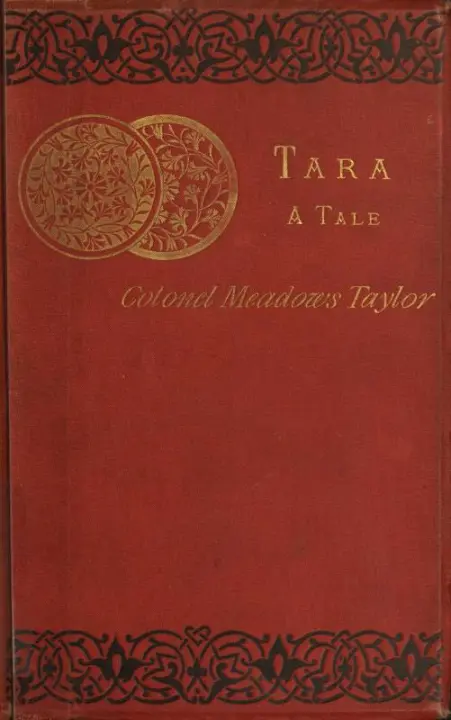
Tara: A Mahratta Tale
Meadows Taylor
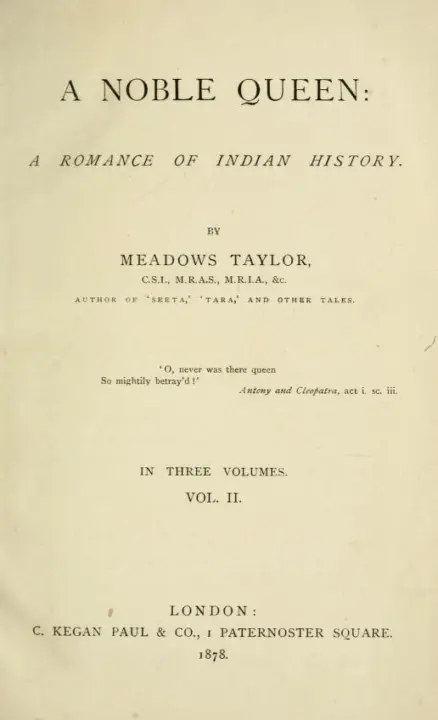
THE CLASSIC COLLECTION · 1878
"A Noble Queen: A Romance of Indian History (Volume 2 of 3)" by Meadows Taylor is a historical novel written in the late 19th century. The narrative unfolds in a richly detailed setting during a time marked by political intrigue and personal valor, focusing on the characters navigating the complex socio-political landscape of Indian history. Central to the story is Abbas Khan, a nobleman who faces challenges and adventures while serving the Queen-Regent, illustrating themes of honor, loyalty, and the struggles of love against the backdrop of impending war. The opening of the volume captures the aftermath of a council meeting, filled with vibrant descriptions of the court and the proceedings within the palace. The mood shifts between jubilant celebrations of Abbas Khan’s recent victories and the tension of political maneuvering as the Queen prepares for war. Abbas Khan is shown returning home to affectionate greetings and his mother’s pride, highlighting the personal stakes intertwined with his public actions. Additionally, the narrative introduces the priest, Francis d'Almeida, who, despite cultural tensions, remains focused on his mission of aiding the young Queen, Taj-ool-Nissa, whose health becomes a central concern. The opening sets the stage for the unfolding drama of loyalty, intrigue, and romance, inviting the reader into a world where personal destinies are shaped by the larger forces of history.
Introduction adapted from the source catalogue; source summaries may be automatically generated.
Free to read · English · 71,630 words · No account needed
MAKE TIME FOR A GOOD BOOK
On by default. Untick to stop anonymous reading totals. Each page counts after 10 seconds in view. How this works.
Anonymous counting is on unless you have switched it off.
If there had been any chance of a skirmish between the two learned authorities, as some hoped who had witnessed such scenes, they were disappointed; for the Kotwal, at a sign from the Queen, ordered Runga to be admitted, and as he entered was shown where to make his obeisance. And he finally stood after his own fashion on one leg, pressing the sole of the other foot against the calf, and with his hands joined in supplication.
"You can speak to him, Abbas Khan," said the head Kazee. "Ask him to tell the Queen who these men are?"
"I represent," humbly returned the Khan, "that I am his commander, and am interested, beside, in what may transpire. Can the interpretation of the Padré Sahib be accepted? else some Brahmin might be sent for."
"The Padré's evidence I could not take," returned the Kazee, "it is not admissible by law; but his interpretation we can accept, my Queen and my lords, if he swear on the Unjeel. Hast thou the book, O Padré?"
"It is here, my lord," returned d'Almeida, taking a small copy from his pocket, and removing the clean white handkerchief in which it was wrapped.
"Place the holy book on thy head, or as thou wilt, and declare that thou wilt interpret truly," was the Kazee's reply.
"Holy book, indeed!" indignantly snorted the chief priest. "Holy book! sacred to Satan! Well, times are changed; a Nazarene priest and a pig-eating Beydur before the Queen, in the Royal palace. What next, I wonder!"
Francis d'Almeida was burning to reply, but he remembered the words of his Brahmin friend, and was silent. "I am ready now," he said, simply, "and I will speak truly."
"Let there be entire silence," cried one of the Court ushers by order of the Queen, and Runga Naik began his history. We know most of it already; but the latter portion, relating his rescue of Zóra, his tracking of the rebel members of Elias Khan's band, the escape of the Abyssinian after a close pursuit, gave a new interest to the narrative. Runga himself, though dazed at first by the beauty of the room and the presence of the Queen, of whom he had heard so much, was now assured; and the story was told with a simple modesty and confidence which, to every hearer present, conveyed an assurance of truth and reality. Elias Khan had endeavoured to tempt him into disloyalty; he had promised him money and an estate if he would cut off all the Royal outposts on the north bank of the Krishna. "But I did not do that, mother," he cried to the Queen in his homely speech, and stretching forth his hands; "my people have been faithful to Beejapoor since it was a kingdom, and was I to turn traitor for villains like Eyn-ool-Moolk and Elias? Meeah, there, and I were old friends, and he was my superior. I went to him as fast as I could, and three hundred of my people were to follow on foot, but they were too late; for the day after I reached him was that of the fight in which he slew Elias, and was well nigh slain himself. I have heard it whispered he was a coward, but who dare say that now? I could not bear it, and hunted down most of the men who deserted him, but some have escaped. Let the Kotwal Sahib tell what they have said to him."
Your reading position is saved on this browser. Take it to another device with a library code. Reading pages adapt to text, rather than matching a printed edition.
Meadows Taylor
Meadows Taylor
Meadows Taylor
Meadows Taylor
BEHIND THE BOOK
This eBook is for the use of anyone anywhere in the United States and most other parts of the world at no cost and with almost no restrictions whatsoever. You may copy it, give it away or re-use it under the terms of the Project Gutenberg License included with this eBook or online at www.gutenberg.org. If you are not located in the United States, you will have to check the laws of the country where you are located before using this eBook. Read the source licence.
The original source file, including credits and licence, is retained by this library. Request an original-format copy at no charge. Please include the book title and Project Gutenberg identifier #44583.
KEEP YOUR CURIOSITY GOING
Cécile Tormay

Moritz Busch
Coulson Kernahan
John L. Ransom

Maurice Baring
Frances Wright