
The Writing of News A Handbook with Chapters on Newspaper Correspondence and Copy Reading
Charles G. (Charles Griffith) Ross
THE CLASSIC COLLECTION · 1754
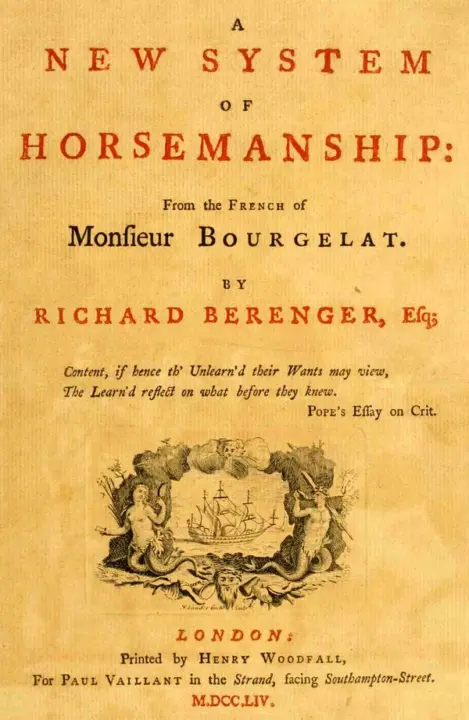
"A New System of Horsemanship" by Claude Bourgelat is a treatise on equestrian techniques written in the mid-18th century. This work seeks to refine the practice of horsemanship by establishing a systematic approach to riding, guiding, and training horses, drawing from the author's insights as well as historical practices. The focus is on achieving a balance between utility and elegance in riding, emphasizing the importance of posture, handling techniques, and the relationship between horse and rider. The beginning of the work introduces the reader to the fundamentals of horsemanship, particularly the correct positioning of the horseman in the saddle, referred to as "the Horseman's Seat." The text notes the contrasting styles adopted by different cultures and aims to provide a cohesive methodology based on sound principles. Bourgelat emphasizes the significance of maintaining a natural posture to achieve grace and control while riding. The opening chapters also touch upon the importance of understanding the horse's anatomy and behavior, setting the stage for more detailed instructions on training and managing horses effectively.
Introduction adapted from the source catalogue; source summaries may be automatically generated.
Free to read · English · 39,564 words · No account needed
MAKE TIME FOR A GOOD BOOK
On by default. Untick to stop anonymous reading totals. Each page counts after 10 seconds in view. How this works.
Anonymous counting is on unless you have switched it off.
IN effect, after having placed his Head, draw it in, and you will lengthen his Croupe, you raise him higher before than behind, his Legs come under his Belly, and consequently he bends his Haunches. It is the same as when he comes down Hill, his Croupe, being higher than his Fore-parts, is pushed under him, and the Horse is upon his Haunches; since it is evident that the Hinder support all the Fore-parts, therefore in going along the Side of the Wall, by the means of the inner Rein, I put together and unite my Horse.
BEHOLD then, in short, the most certain Methods of enabling yourself to give to a Horse this Union, this Freedom and Ease, by which learning how to ballance his Weight equally and with Art, and distributing his Strength with Exactness to all his Limbs, he becomes able to undertake and execute with Justness and Grace, whatever the Horseman demands of him, conformable to his Strength and Disposition.
Of the Pillars.
IT is the same with respect to the Pillars, as with all other Lessons which you must teach a Horse, in order to make him perfect in his Air. Excellent in itself, it becomes pernicious and destructive under the Direction of the Ignorant, and is not only capable to dishearten any Horse, but to strain and ruin him entirely.
THE Pillar partly owes its Origin to the famous Pignatelli[1]. Mess. de la Broue and Pluvinel, who were his Scholars, brought it first into France; the first indeed made little use of it, and seem'd to be very well appriz'd of its Inconveniencies and Dangers; as for the other, one may say, that he knew not a better or shorter Method of dressing and adjusting a Horse. In effect, according to his Notions, working a Horse round a single Pillar could never fail of setting him upon his Haunches, making him advance, suppling and teaching him to turn roundly and exactly; and by putting him between two Pillars, provided he had Vigour, he was taught to obey the Heels readily, to unite himself, and acquire in a shorter time a good Apuy in making Curvets. If he wanted to settle his Horse's Head in a short time, the Pillars were very efficacious. He tied the Horse between them to the Cords of the Snaffle which he had in his Mouth, instead of the Bridle. There he work'd his Horse without a Saddle, and maintain'd, that if the Horse tossed or shook his Head, bore too much, or too little upon his Bridle, he punish'd himself in such a manner, that (as he imagin'd) the Horse was compell'd to put himself upon his Haunches, and to take a good Apuy; especially as the Fear of the Chambriere or Whip, always ready behind him, kept him in awe. The Horse was often taken out of the two Pillars, in order to be put to the single Pillar, with a Cord tied to the Banquet of the Bit as a false Rein; here he was work'd by being made to rise before, and driven round the Pillar, with a design and in hopes of making him step out and embrace, or cover well the Ground he went round, as well as to give him Resolution in his Work, and to cure him of Dullness and Sloth, if he had it in his Temper. We don't know whether Mr. Pluvinel designed any real Advantages from this Method or no; but be that as it will, it prevails no longer among us.--It must be owned, that the two Pillars of his inventing are still preserved, and that no Manage is without them; but at least we have suppress'd the single Pillar, which serves only to fatigue and harrass a Horse: Learn never to put a Horse between the two Pillars till he is well suppled, and you have given him the first Principles of the Union between the Legs, which are the natural Pillars that every Horseman should employ. We must take care to work the Horse with great Prudence at first, and as gently as possible; for a Horse being in this Lesson very much confined and forced, and not able to escape, nor to go forward nor backward, he oftentimes grows quite furious, and abandons himself to every Motion that Rage and Resentment can suggest. Begin then this Lesson in the plainest Manner, contenting yourself with only making him go from side to side, by means of the Switch, or from fear of the Chambriere. At the End of some Days, the Horse, thus become obedient, and accustomed to the Subjection of the Pillars; try to make him insensibly go into the Cords, which when he will do readily, endeavour to get a Step or two exact and in time of the Passage or Piaffer.
Your reading position is saved on this browser. Take it to another device with a library code. Reading pages adapt to text, rather than matching a printed edition.
BEHIND THE BOOK
This eBook is for the use of anyone anywhere in the United States and most other parts of the world at no cost and with almost no restrictions whatsoever. You may copy it, give it away or re-use it under the terms of the Project Gutenberg License included with this eBook or online at www.gutenberg.org. If you are not located in the United States, you will have to check the laws of the country where you are located before using this eBook. Read the source licence.
The original source file, including credits and licence, is retained by this library. Request an original-format copy at no charge. Please include the book title and Project Gutenberg identifier #46696.
KEEP YOUR CURIOSITY GOING
Charles G. (Charles Griffith) Ross
Hannah Webster Foster

Emily Lawless
Edwin Hamlin Carr

Charles De Lano Hine
Andrew Ure