THE CLASSIC COLLECTION✦Shadows and sunbeams: Being a second series of Fern leaves from Fanny’s portfolioCLASSIC FREE BOOKS
Shadows and sunbeams: Being a second series of Fern leaves from Fanny’s portfolio
Fanny Fern
THE CLASSIC COLLECTION · 1864
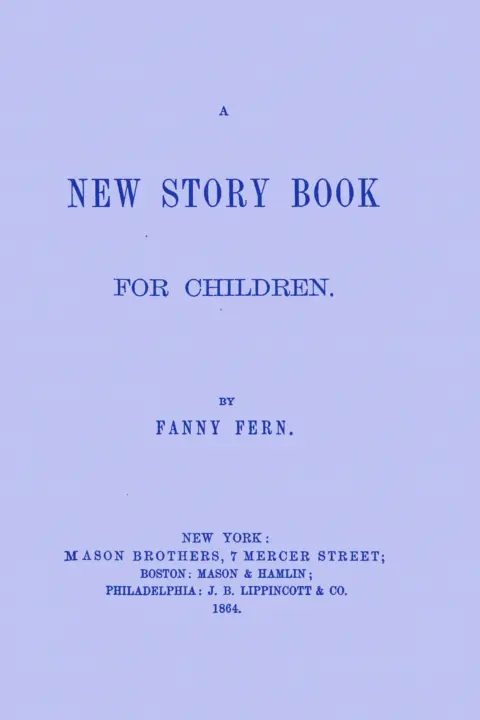
"A New Story Book for Children" by Fanny Fern is a collection of children's stories written in the mid-19th century. The book presents various tales, touching upon themes such as childhood experiences, moral lessons, and the virtues of kindness and courage. Each story likely features a range of characters, some of whom appear to be based on real-life figures or historical events, aiming to entertain and educate young readers. The opening of this collection introduces readers to the author's reminiscences of her childhood and her mother, who is depicted as a kind and patient figure. Fanny Fern reflects on her early experiences as a struggling writer, evoking nostalgia for her mother's influence on her life and writing. The narrative highlights the emotional depth of her relationship with her mother, illustrating themes of love, aspiration, and resilience amid challenges. Through poignant memories and heartfelt observations, the opening establishes the tone of warmth and compassion that likely permeates the subsequent stories.
Introduction adapted from the source catalogue; source summaries may be automatically generated.
Free to read · English · 61,605 words · No account needed
MAKE TIME FOR A GOOD BOOK
On by default. Untick to stop anonymous reading totals. Each page counts after 10 seconds in view. How this works.
Anonymous counting is on unless you have switched it off.
Dear me! I suppose you are very impatient to know what became of poor Frank, when he was left alone? Well, soon after Henri died, the wretches who imprisoned the two innocent children died also; and then Frank was taken from his dungeon, and set at liberty. Oh! how glad he must have been to see the blue sky, and the green fields, and the sweet flowers, and, better than all, to find his dear mother.
What a sorrowful story he had to tell her! and how many times they wept, to think of poor Henri, and how the mother wept at night, over little Frank, while he was sleeping, whose dungeon tortures had made him a cripple for life. Ah! it is not well to be a little prince.
Let me tell you another story, of a child who was born of a noble family in France. His father and grandfather were both great generals; they had been in many battles, and were considered very brave men; but war is such a terrible, terrible thing, is it not? husbands, fathers, and brothers falling to the ground, like grass before the mower’s scythe; but in those days war was not spoken of in this way. Dead men were thought no more of than dead sheep; unless, indeed, it might be some great commander or general. As if a soul wasn’t a soul, no matter whether it lodged in the body of a common soldier or his officer. As if a common soldier’s relatives would not grieve at his loss as much as the relatives of his commanding officer for him. As if sorrow did not sit down in the hovel, as well as in the hall. As if an orphan were not an orphan, and a widow a widow, in every rank of life. But, as I tell you, people did not think this way when this lad lived, of whom I am about to tell you. It was all glory and epaulettes. Little Paul had guns and swords, and flags and drums, put into his hands almost as soon as he was born, by his father and grandfather, who wished to train him up for a great hero. When he was a very good boy, his reward was to play battle with his grandfather, with a set of pasteboard soldiers, to teach him how to manage the enemy in difficult positions; and all this boy’s dreams, by day and night, were of such things. When he was only ten years old, his father was commanded to join the army, for there was to be a great battle, a real battle. So he told his wife, who cried very much, that he was going to leave her, perhaps for ever; and then he took his little boy in his arms, to bid him good by. Paul did not cry, but he looked his father in the face very steadily, and said, “Papa, I must go too. I must fight by your side in that battle!” This pleased his father and grandfather very much; and his mother began to be frightened, for fear that they would really consent to the child’s going; and sure enough they did, and little Paul was half beside himself with joy, that he was to take part, with real swords and real men, in a real battle. Perhaps you say, Oh, of course, his father took care that he should not be in any danger, and made everything easy for him. Not at all, as you shall hear; for little Paul insisted, as soon as he joined the army, that no favor should be shown him because he was so young, and because he had been born of a noble family, and brought up tenderly; he insisted upon sharing all the fatigue and danger, and felt quite insulted, if any of the old men in the army seemed to fear for him, or not think him capable of his duty. He wanted to do just as the common soldiers did; sleep on the bare ground, and eat of their common food. A week after he had joined the army, he had proved himself so brave, that they made him ensign, and gave him the colors to carry. Perhaps you say, Of course, his father did that! No; the whole regiment were quite proud of him, and said that the little fellow deserved it. You must not think that he forgot his mother, who was so anxious about her boy. He wrote her a little letter, which was a funny mixture of childishness and manliness, telling her that he had a wound in his right arm from the enemy, who wished to seize his pretty flag. “That would have been fine, indeed!” wrote little Paul, “when I had just had it given me to defend!” Then he tells her, that his new hat was spoilt, but that he can get another, and that once he fell off his horse, when the enemy rushed at them, but soon was up again, firing his pistols after them. Three months the child was there, in the army, and often suffered much from cold and other causes; but he never complained; and when not engaged in fighting, used to laugh as merrily as any other child of ten years old, and at as trifling things.
Your reading position is saved on this browser. Take it to another device with a library code. Reading pages adapt to text, rather than matching a printed edition.
Fanny Fern

Fanny Fern
Fanny Fern
Fanny Fern
BEHIND THE BOOK
This eBook is for the use of anyone anywhere in the United States and most other parts of the world at no cost and with almost no restrictions whatsoever. You may copy it, give it away or re-use it under the terms of the Project Gutenberg License included with this eBook or online at www.gutenberg.org. If you are not located in the United States, you will have to check the laws of the country where you are located before using this eBook. Read the source licence.
The original source file, including credits and licence, is retained by this library. Request an original-format copy at no charge. Please include the book title and Project Gutenberg identifier #66655.
KEEP YOUR CURIOSITY GOING
Coulson Kernahan

Maurice Baring
Frances Wright
Cécile Tormay

Frederic Jesup Stimson

W. H. P. (William Henry Pope) Jarvis