THE CLASSIC COLLECTION✦Shadows and sunbeams: Being a second series of Fern leaves from Fanny’s portfolioCLASSIC FREE BOOKS
Shadows and sunbeams: Being a second series of Fern leaves from Fanny’s portfolio
Fanny Fern
THE CLASSIC COLLECTION · 1864
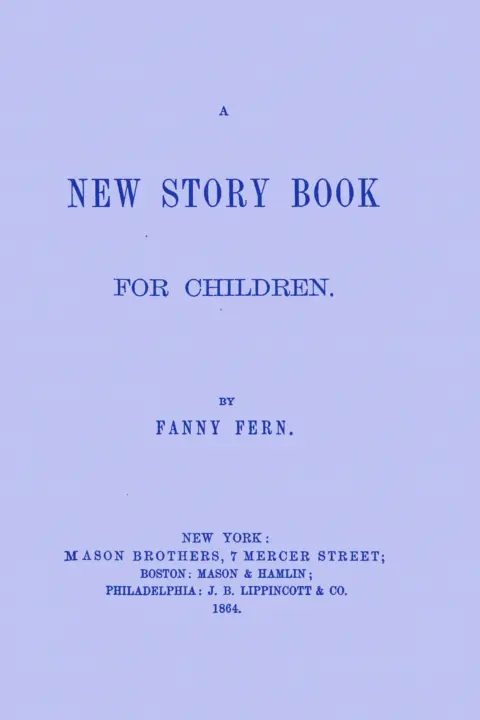
"A New Story Book for Children" by Fanny Fern is a collection of children's stories written in the mid-19th century. The book presents various tales, touching upon themes such as childhood experiences, moral lessons, and the virtues of kindness and courage. Each story likely features a range of characters, some of whom appear to be based on real-life figures or historical events, aiming to entertain and educate young readers. The opening of this collection introduces readers to the author's reminiscences of her childhood and her mother, who is depicted as a kind and patient figure. Fanny Fern reflects on her early experiences as a struggling writer, evoking nostalgia for her mother's influence on her life and writing. The narrative highlights the emotional depth of her relationship with her mother, illustrating themes of love, aspiration, and resilience amid challenges. Through poignant memories and heartfelt observations, the opening establishes the tone of warmth and compassion that likely permeates the subsequent stories.
Introduction adapted from the source catalogue; source summaries may be automatically generated.
Free to read · English · 61,605 words · No account needed
MAKE TIME FOR A GOOD BOOK
On by default. Untick to stop anonymous reading totals. Each page counts after 10 seconds in view. How this works.
Anonymous counting is on unless you have switched it off.
At length, on account of want of money, it became necessary for some one of the family to go out into the world to earn it. Who should it be? One would have naturally supposed the brother, as being a sturdy, healthy fellow, better able to fight his way than his delicate sisters, who shrank timidly from the sight of strange faces and strange voices. It seemed not the thing for them to go out into the wilderness, to make the path easy for his feet? If so, which of the sisters should do this? Emily? Anne? or Charlotte? Emily grew homesick to that degree when away, that her life was in danger, and was obliged to be recalled for that reason. So, whoever was sent, she must not go; for were there not two sisters already in the churchyard? Anne was too young. Charlotte, then, was, as usual, to buckle on the armor of duty over her brave heart, and stagger forth with what strength she might, to face the world. She was to be a governess! Imagine, if you can, the most torturing situation in which to place such a nature as hers; and the daily trial of it, could not come up to that included to her in the little word “governess.” Fortunately, her first experiment was with Miss Woolen, her old teacher—her scholars being younger sisters of her own playmates. Whatever she did, she did with her might; therefore, so zealous was she to make herself useful in her new situation, and so conscientious in the discharge of duties which a less noble girl would have dodged, or evaded sufficiently, at least, to make the position bearable, that we soon hear of the breaking down of her feeble body, so that she almost became crazy.
She had frightful thoughts and gloomy ideas about religious things; anxiety about her sister Emily, who, resolving not to burden her father with her support, had concluded to go forth likewise. Then she was troubled, too, about the home affairs, which, as the elder sister, she could not, even at a distance, shake off; and thus, leaving childhood, which had been but childhood in name to her, we find Charlotte a woman, brave yet fearful; timid but courageous; the lion’s heart in the humming bird’s body. I meant only to have told you about her childhood; and yet you may ask me, was Charlotte never again comfortable, light-hearted, and happy? Did nobody but her sisters ever love her very dearly? Did nobody else find out what a good, intelligent, gifted girl she was? Oh yes, at last! At last came fame and honor to the little, quiet Charlotte. Great men and great women wanted to know her, because she wrote so beautifully, or, as they said, was “a genius;” and she had plenty of complimentary letters and invitations to visit, and all the publishers wanted to publish her books; and she earned money enough to put a great many pretty things in the little dull parlor at home, so that she hardly knew it to be the same room; but, dear me! by that time all her sisters lay in the little churchyard with her mother; and poor Charlotte looked about at all these pretty things, and great tears came into her eyes, as she thought, Oh, why didn’t all my money and my friends come while they were alive, and could have been made comfortable and happy by them, so that we could all have lived at home together, and not been separated, to go away and teach school? Why? Poor Charlotte could not find out that why, as she sat in that little parlor, looking, with tearful eyes, at all the pretty things her money had bought. Perhaps you ask what her father said now to his good, gifted daughter. Oh, he sat up alone in his room, and was very proud of her; but that didn’t warm her heart any, you know. By and by a gentleman came along and asked her to be his wife. And after a while she said, Yes, I will. I suppose she thought, I want to be loved, more than anything in this world. It is very well, perhaps, to be “a genius,” and to be admired; but my heart aches all the same. Yes, I will be loved; and then I shall be happy; for, after all, the brightest world is cold and chilly, without love to warm it. I am glad she was married; because her husband was good and kind to her, and she began to smile, and look so bright you would not have known her. She was happier than she had ever been in all her life. But one day, not long after she was married, she caught a very bad cold, and everybody saw that she was going to die; she had suffered very much in her life, and she was not strong enough to struggle any more. Now, don’t say, “What a pity!” when I tell you that she really died. It is never a pity, when the loving and the tender-hearted go where there is no more grieving.
Your reading position is saved on this browser. Take it to another device with a library code. Reading pages adapt to text, rather than matching a printed edition.
Fanny Fern

Fanny Fern
Fanny Fern
Fanny Fern
BEHIND THE BOOK
This eBook is for the use of anyone anywhere in the United States and most other parts of the world at no cost and with almost no restrictions whatsoever. You may copy it, give it away or re-use it under the terms of the Project Gutenberg License included with this eBook or online at www.gutenberg.org. If you are not located in the United States, you will have to check the laws of the country where you are located before using this eBook. Read the source licence.
The original source file, including credits and licence, is retained by this library. Request an original-format copy at no charge. Please include the book title and Project Gutenberg identifier #66655.
KEEP YOUR CURIOSITY GOING
Coulson Kernahan

Maurice Baring
Frances Wright
Cécile Tormay

Frederic Jesup Stimson

W. H. P. (William Henry Pope) Jarvis