THE CLASSIC COLLECTION✦Shadows and sunbeams: Being a second series of Fern leaves from Fanny’s portfolioCLASSIC FREE BOOKS
Shadows and sunbeams: Being a second series of Fern leaves from Fanny’s portfolio
Fanny Fern
THE CLASSIC COLLECTION · 1864
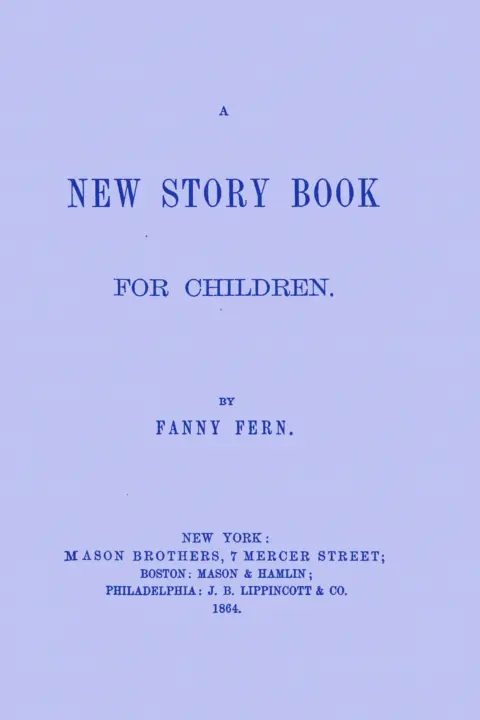
"A New Story Book for Children" by Fanny Fern is a collection of children's stories written in the mid-19th century. The book presents various tales, touching upon themes such as childhood experiences, moral lessons, and the virtues of kindness and courage. Each story likely features a range of characters, some of whom appear to be based on real-life figures or historical events, aiming to entertain and educate young readers. The opening of this collection introduces readers to the author's reminiscences of her childhood and her mother, who is depicted as a kind and patient figure. Fanny Fern reflects on her early experiences as a struggling writer, evoking nostalgia for her mother's influence on her life and writing. The narrative highlights the emotional depth of her relationship with her mother, illustrating themes of love, aspiration, and resilience amid challenges. Through poignant memories and heartfelt observations, the opening establishes the tone of warmth and compassion that likely permeates the subsequent stories.
Introduction adapted from the source catalogue; source summaries may be automatically generated.
Free to read · English · 61,605 words · No account needed
MAKE TIME FOR A GOOD BOOK
On by default. Untick to stop anonymous reading totals. Each page counts after 10 seconds in view. How this works.
Anonymous counting is on unless you have switched it off.
After a while, an aunt came to their house, to take charge of them. I was glad of that. I hoped she would make them play dolls, and run, and jump about; I hoped she would make the fires and lamps burn cheerily, and go round the house shedding brightness from her finger tips, as only a woman knows how. I hoped she would go out to walk with the little orphans, and when they came home to supper, sit down with them at the table, and say funny things to make them laugh; and good things to make them happy and glad. I hoped she would tie on their little night dresses with her own hands, and kiss them down on their pillows, and say, God bless you, my little darlings! It was such a pity she didn’t. I am sure a woman ought to understand little children better than she seemed to. But she just shut herself up in her room, the same way their father did, and took all her meals alone. I have no patience with her. I wish I had lived near them; they should have eaten and drank with me, poor little souls! Well, they had a kitchen, and a good old servant, named Tabby, in it, and, from what I can find out, she was more of a mother to them, in her rough fashion, than anybody else. I told you these children had no toys; and, what was worse, they did not want any; they used to read newspapers and talk politics, just as your father and his gentleman friends might, in your parlor. As to “Mother Goose,” I am sure they never heard of her, though they read many books that are considered much wiser, and which were just as much out of place in a nursery, as a joint of roast beef would be to set before your little month-old baby, for its dinner. But how should they know that? Nobody about them seemed to think that childhood comes but once; or, in fact, was intended to come at all for them. “Milk for babes” was not the fashion at Haworth parsonage. Well, time passed on, till their father concluded to send Charlotte away to school, with her sisters. So they were put into a little covered cart with their things, and jolted along. I hope their father kissed them when they went away, but I am not at all sure of it. I am afraid he was too dignified. It is hard enough for a child to go away to school with a warm kiss on the lips, and a trunk full of comfortable clothes, in every stitch of which is woven a mother’s blessing. It is hard enough for a healthy, romping child, who is able to ask for what it wants everywhere, and on all occasions, to leave home, and go a long distance to a strange school, even though it may have letters often, and plum cakes often, and all sorts of little love-tokens, which home delights to send to the absent one. But to these little timid ones, who had never played with children, and were as much afraid of them as of strange, grown people; who had come up, shy and awkward and old-fashioned, and were painfully conscious of it, as soon as it was brought to their notice by contrast with those children, who had come from their warm firesides like some graceful house-plants, full of blossoms and verdure—ah! it was very sad for the poor little Brontë girls. What could they do when they got there, but stand at the window, and cry, as they looked out upon the snowy landscape? And when the girls urged them to play ball, and other such healthful games, they had no heart for it—no physical strength for it, either; they would have been tumbled over forty times in a minute, by their playmates, like so many ninepins, with a great, thumping ball. Well, they had a bad time of it, any way, at this school—bad food, bad air, and exposure. I suppose, too, their clothes were not warm enough, for the hand was cold that would have made the warm garment for those bloodless, shrunken limbs. It is “mother’s” fingers that fit the cloak close to the little neck, so that through no treacherous crevice the cruel “croup” may creep; it is “mother’s” fingers that quilt the little winter skirt with the soft, warm wool, and furnish the thick stocking, and comfortable hood. It is “mother’s” eye which sees just the thing that is needed to meet all weathers. We can imagine how they went shivering along, half clad, to the church on Sunday, where never a fire was lighted; how blue were their fingers; how cold their little feet! No wonder they grew sick. Little Maria Brontë, who was delicate under the remains of the whooping cough, suffered most severely from cold, and want of nourishing food. A blister was applied to her side for her relief, and the poor, weak child, happening to linger in bed one morning later than the usual hour for rising, was harshly dragged in this state into the middle of the room, and then punished, because she had not strength enough to dress herself in time to appear with the other scholars. This must have been very hard to bear. Perhaps you ask, Why didn’t Charlotte Brontë write home about it? She had two reasons: one was, that both she and her sisters were most anxious to learn everything that they could learn at this school; and in the next place, they had been so accustomed to keep all their childish troubles to themselves, although their hearts were nearly breaking, that I don’t suppose they once imagined, if they thought of it, that it would do any good to complain. So they shivered in the cold, and tried to swallow the bad food that was given them, when they grew so hungry they could not do without it, until poor little Maria grew so very bad, that her father had to be sent for. God pitied the poor child, and took her to heaven, to be with her mother. She died a few days after reaching home. Charlotte and Emily, the two remaining sisters, did not long stay in the school after their sister’s death. I think their father at last woke up to the thought, that they might die too, and nobody might be left at the old, gloomy parsonage, to send up his meals, or wait upon him, or read to him, or mend his clothes. So he brought them home too. I believe all children are fond of being in the kitchen. They are active, and like to see what is going on; they like to watch the cooking, and ask questions about it—often, much better than the cook likes to answer. The little Brontë girls’ cook was named Tabby, and a funny old woman she was. She was very kind to them, but she would have her own way, and made them do as she said; still, I have no doubt, from what I know of her, that she put by many a nice little bit for their hungry mouths, and told them a great many fairy stories, as they cuddled round the old kitchen fire, when her work was done; but I think they had to be very careful not to meddle with anything without leave, or get in her way, when she was hurried or busy; and that was all right enough, for the poor old thing must have elbow-room, you know; besides, it is a good thing for a child to be taught that it may not order about a good, faithful servant, old enough to be its mother, merely because she is a servant.
Your reading position is saved on this browser. Take it to another device with a library code. Reading pages adapt to text, rather than matching a printed edition.
Fanny Fern

Fanny Fern
Fanny Fern
Fanny Fern
BEHIND THE BOOK
This eBook is for the use of anyone anywhere in the United States and most other parts of the world at no cost and with almost no restrictions whatsoever. You may copy it, give it away or re-use it under the terms of the Project Gutenberg License included with this eBook or online at www.gutenberg.org. If you are not located in the United States, you will have to check the laws of the country where you are located before using this eBook. Read the source licence.
The original source file, including credits and licence, is retained by this library. Request an original-format copy at no charge. Please include the book title and Project Gutenberg identifier #66655.
KEEP YOUR CURIOSITY GOING
Coulson Kernahan

Maurice Baring
Frances Wright
Cécile Tormay

Frederic Jesup Stimson

W. H. P. (William Henry Pope) Jarvis