THE CLASSIC COLLECTION✦My diaries, being a personal narrative of events 1888-1914, Part 2 (1900-1914)CLASSIC FREE BOOKS
My diaries, being a personal narrative of events 1888-1914, Part 2 (1900-1914)
Wilfrid Scawen Blunt
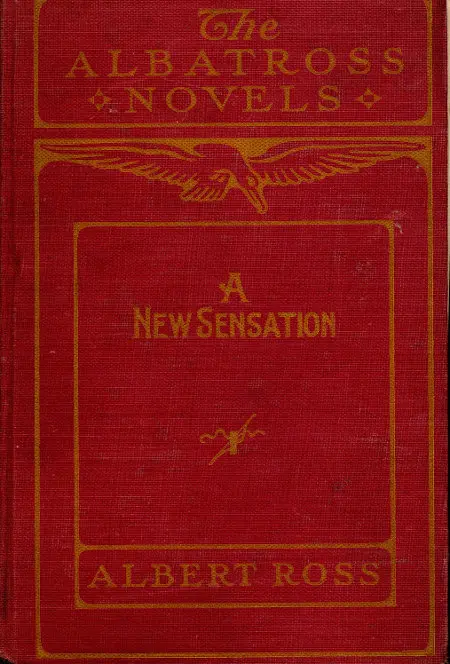
THE CLASSIC COLLECTION · 1898
"A New Sensation" by Albert Ross is a novel written in the late 19th century. The story revolves around the main character, Donald Camran, who is recovering from an illness and contemplating a journey to the Caribbean. Seeking company, he decides to hire a female typewriter to assist with his writing and serve as a traveling companion, leading him to navigate the complexities of personal relationships and societal expectations. At the start of the novel, Donald is engaged in a conversation with his friends, who suggest he needs a "new sensation" to rejuvenate his spirit. After a failed marriage proposal, he resolves to take a trip and advertise for a typewriter to accompany him. The opening portion introduces his humorous and candid determination to embark on this unconventional journey while setting the stage for the exploration of his interactions with women, specifically the potential companions responding to his advertisement, including the intriguing letters he receives. The narrative establishes a blend of light-heartedness and introspection as Donald grapples with his past and the uncertainties of the impending journey.
Introduction adapted from the source catalogue; source summaries may be automatically generated.
Free to read · English · 81,766 words · No account needed
MAKE TIME FOR A GOOD BOOK
On by default. Untick to stop anonymous reading totals. Each page counts after 10 seconds in view. How this works.
Anonymous counting is on unless you have switched it off.
She said there was no need of haste, that she did not wish to meet the passengers any more than was absolutely necessary; when we went to the table would be quite time enough.
"Mr. Camwell," she added, after a pause, "you can't imagine how I feel. If I had dreamed I should experience such sensations I never would have come."
"What sensations?" I asked, rather shortly, for I thought she might consider my feelings a little.
"The sensation of being a deceiver of those about me; the shame of
passing for what I am not; the dread of somehow being exposed for what I
am."
I grew angrier as she proceeded.
"If you were not ill," I said, "I should be out of patience with you. What awful crime have you committed? You are travelling in a perfectly respectable way, with a respectable party of people; occupying a room with a lady; acting in a rational manner except for these vagaries, which I must ask you to suppress. To be sure the name assigned you on the passenger list is not your own, but plenty of people travel incognito, even princes and dukes, for that matter. You make a mountain out of a molehill. Your whole journey will be ruined--and mine, if you care anything about that--if you go on as you have begun."
She begged my pardon humbly, saying she would do her best to amend her conduct in the future. And, as usual, the moment she took this attitude, I repented of my hard words and assured her I had no intention of being too critical.
"The lady who occupies the room with me is very agreeable," was her next observation. "She offered to do anything she could to relieve my head last night, and this morning she bathed it with cologne for half an hour."
"She sits opposite us at the table," I said. "With her uncle."
"I am glad of that. I feel quite acquainted with her now."
Then she assayed a question of the sort that eminate from women.
"Don't you think her very handsome?"
"She's not bad looking," I admitted.
"I call her magnificent. Such a face and form do not often go together."
I wanted to reply, "So she said in her advertisement," but I merely
nodded.
"There is another woman on this boat that I would not exchange for a thousand of her," I said, presently, in a low voice.
"Point her out to me," said Miss May. "I would like to know what your
ideal is."
"Look in your mirror," I responded.
"Why do you think it necessary," she asked, frowning, "to pay me that
kind of compliment?"
Your reading position is saved on this browser. Take it to another device with a library code. Reading pages adapt to text, rather than matching a printed edition.
BEHIND THE BOOK
This eBook is for the use of anyone anywhere in the United States and most other parts of the world at no cost and with almost no restrictions whatsoever. You may copy it, give it away or re-use it under the terms of the Project Gutenberg License included with this eBook or online at www.gutenberg.org. If you are not located in the United States, you will have to check the laws of the country where you are located before using this eBook. Read the source licence.
The original source file, including credits and licence, is retained by this library. Request an original-format copy at no charge. Please include the book title and Project Gutenberg identifier #40937.
KEEP YOUR CURIOSITY GOING
Wilfrid Scawen Blunt
Wilfrid Scawen Blunt

E. W. (Edgar Watson) Howe
Coulson Kernahan

Maurice Baring
Frances Wright