THE CLASSIC COLLECTION✦My diaries, being a personal narrative of events 1888-1914, Part 2 (1900-1914)CLASSIC FREE BOOKS
My diaries, being a personal narrative of events 1888-1914, Part 2 (1900-1914)
Wilfrid Scawen Blunt
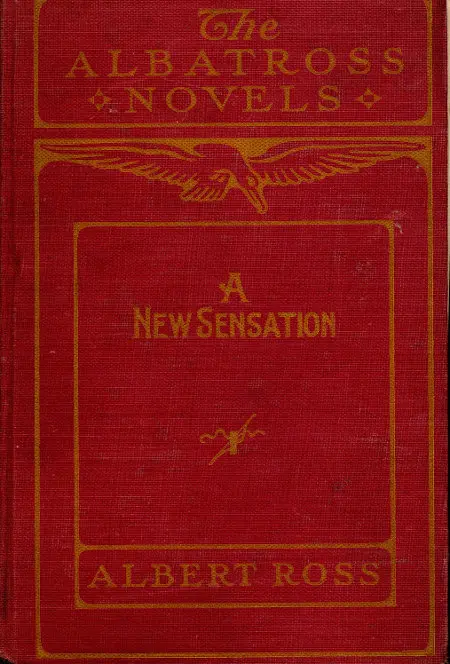
THE CLASSIC COLLECTION · 1898
"A New Sensation" by Albert Ross is a novel written in the late 19th century. The story revolves around the main character, Donald Camran, who is recovering from an illness and contemplating a journey to the Caribbean. Seeking company, he decides to hire a female typewriter to assist with his writing and serve as a traveling companion, leading him to navigate the complexities of personal relationships and societal expectations. At the start of the novel, Donald is engaged in a conversation with his friends, who suggest he needs a "new sensation" to rejuvenate his spirit. After a failed marriage proposal, he resolves to take a trip and advertise for a typewriter to accompany him. The opening portion introduces his humorous and candid determination to embark on this unconventional journey while setting the stage for the exploration of his interactions with women, specifically the potential companions responding to his advertisement, including the intriguing letters he receives. The narrative establishes a blend of light-heartedness and introspection as Donald grapples with his past and the uncertainties of the impending journey.
Introduction adapted from the source catalogue; source summaries may be automatically generated.
Free to read · English · 81,766 words · No account needed
MAKE TIME FOR A GOOD BOOK
On by default. Untick to stop anonymous reading totals. Each page counts after 10 seconds in view. How this works.
Anonymous counting is on unless you have switched it off.
"That thought would spoil the pleasure of life itself," I said, much mollified nevertheless. "I would advise you not to become a monomaniac. Take some of these papers and get into touch again with the planet on which we used to live."
She looked them all over, scanning the dates.
"Why, who sent you these ancient things?" she said. "The very latest is
dated January 18th."
"Well, did you expect yesterday morning's?" I asked. "Have you forgotten that we are some little distance from Manhattan Island?"
She smiled at last, as the recollection of our situation with regard to news came over her, and thanking me, began to look over the papers, beginning with the day after we left. I took the next one and for some time this occupied us. When either encountered anything of general interest there was an interruption, followed by prolonged silence.
"Are you going to answer that letter of Miss Brazier's?" Miss May asked,
all of a sudden.
"Why? Would you?"
"Yes; in a very formal way."
Was she attacked with incipient jealousy of this unknown one, even while she approved of her counsel?
"All right," I said. "I will let you dictate the words."
"What other letters did you get?" she inquired.
I showed them to her. She wanted to know what each contained; and when I spoke of Statia, though I did not mention her name, the same smouldering fire flashed up slightly as in Miss Brazier's case.
"Who is that lady?" she asked.
"The sister of my dearest masculine friend."
"Why does she write to you?"
"For the same reason as the other girl, to give me good advice."
She had to ask the next question.
"Is there no love affair between you?"
"Not the slightest. I did not think she would even condescend to write a
line."
Miss May drew a long breath, and then, as if ashamed of the interest she had shown, buried her face in the newspaper.
"If you have finished with your cross-questionings," I remarked, "I will take a hand. Who are your letters from?"
She clung to the envelopes as if she feared I would try to wrest them
from her.
"A friend," she answered, frigidly.
"Two friends, at least. One is directed in the handwriting of a man. Now, Marjorie, I am not going to permit that sort of thing. I draw the line at male correspondents while you are travelling with me."
Hesitating an instant she laid the envelope of which I spoke in my lap.
"Read it," she said, looking me full in the eyes.
"Not unless you wish me to," I answered.
"I do wish it."
"Really?"
"Yes."
Your reading position is saved on this browser. Take it to another device with a library code. Reading pages adapt to text, rather than matching a printed edition.
BEHIND THE BOOK
This eBook is for the use of anyone anywhere in the United States and most other parts of the world at no cost and with almost no restrictions whatsoever. You may copy it, give it away or re-use it under the terms of the Project Gutenberg License included with this eBook or online at www.gutenberg.org. If you are not located in the United States, you will have to check the laws of the country where you are located before using this eBook. Read the source licence.
The original source file, including credits and licence, is retained by this library. Request an original-format copy at no charge. Please include the book title and Project Gutenberg identifier #40937.
KEEP YOUR CURIOSITY GOING
Wilfrid Scawen Blunt
Wilfrid Scawen Blunt

E. W. (Edgar Watson) Howe
Coulson Kernahan

Maurice Baring
Frances Wright