THE CLASSIC COLLECTION✦A dead man’s diaryCLASSIC FREE BOOKS
A dead man’s diary
Coulson Kernahan
THE CLASSIC COLLECTION · 1906
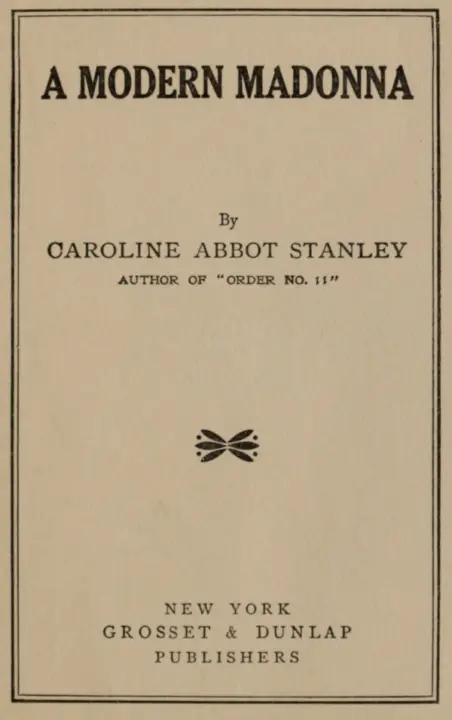
"A Modern Madonna" by Caroline Abbot Stanley is a novel written in the early 20th century. The story revolves around Margaret De Jarnette, who faces the challenges of love, loss, and motherhood after her troubled marriage to Victor De Jarnette. As she navigates her feelings of betrayal and independence, the novel explores themes of fidelity, trust, and the complexities of familial relationships. The opening of the novel introduces readers to Margaret's wedding day, marked by a sense of anticipation and emotional weight as she is given away by Judge Kirtley, her guardian. The scene captures the joy and tension surrounding the nuptials, particularly through the perspective of the judge, who worries about Victor's ability to care for Margaret. This day is intertwined with a foreshadowing of future conflicts, hinted by the presence of Victor’s elder brother Richard, who has reservations about Victor’s readiness for marriage. As the story unfolds, Margaret’s initial happiness turns into a profound struggle with Victor’s infidelity and desertion, setting the stage for her journey toward self-discovery and resilience as she embraces her role as a mother.
Introduction adapted from the source catalogue; source summaries may be automatically generated.
Free to read · English · 114,282 words · No account needed
MAKE TIME FOR A GOOD BOOK
On by default. Untick to stop anonymous reading totals. Each page counts after 10 seconds in view. How this works.
Anonymous counting is on unless you have switched it off.
Margaret De Jarnette, who had been leaning over the railing watching the child at play on the lawn below, looked up. She was older, but her face had not lost its beautiful contour, and she had the same queenly way of lifting her head, upon which lay great masses of golden brown hair. The glint on it where it was touched by the sun hinted that it might once have been like the burnished gold of the child's long curls. Her eyes matched her hair.
"I should like to go. 'We-que-ton-sing,' with all its breaks and musical repetitions, has an attractive sound. It seems as if we might be likely to drop into a community of wigwams there."
"That wouldn't be strange," said the young man, "for here we are very
close to
'The land of the Ojibways,
To the land of--'
Mrs. Osborne," Harcourt broke in suddenly, "that girl of yours throws exactly like a boy. Look at her now!"
"Well, this isn't settling the question," said Mrs. Pennybacker, hastily. "Mr. Harcourt, tell us some of the points of this inland trip."
John Harcourt was doing this very enthusiastically when Bess, catching sight of the returning vehicles, cried out, "Wait a minute! There come the carriages. Now let's watch."
"All right. First carriage--Mission House--empty, please note! Half a dollar, if you please. I never smoke less than fifty cent cigars on a wager."
"Well, you can just get me a pound of caramels any way," pouted the girl, "for the Island House has just one lone man."
"Oh, come! that's a hundred per cent, more than your house has."
The one lone man was the object of their most interested scrutiny as the carriage drew up. From their seats they could see without themselves being observed.
"Why--y!" said Harcourt in surprise. "Isn't that queer! I've seen that
man--in Washington."
"Who is he?" asked Mrs. Pennybacker, abruptly.
"His name is Smeltzer. He is on the detective force there, or he was
when I knew him."
"Does he know you?"
"I doubt if he would remember me. Still, you can't tell. It is a part of a detective's stock in trade to remember faces.... Why, he did some work for a friend of mine once, and I used to see him sometimes."
Margaret De Jarnette leaned over the piazza rail and spoke quietly to
the child playing below.
"Dearest! Come to mama now."
"Not yet, mama!" pleaded the child.
"Yes--now!"
She had been gone but a few minutes when Mrs. Pennybacker followed her to her room. She found the door locked and the young woman in the act of packing a suit case.
"What are you doing, Margaret?"
Your reading position is saved on this browser. Take it to another device with a library code. Reading pages adapt to text, rather than matching a printed edition.
BEHIND THE BOOK
This eBook is for the use of anyone anywhere in the United States and most other parts of the world at no cost and with almost no restrictions whatsoever. You may copy it, give it away or re-use it under the terms of the Project Gutenberg License included with this eBook or online at www.gutenberg.org. If you are not located in the United States, you will have to check the laws of the country where you are located before using this eBook. Read the source licence.
The original source file, including credits and licence, is retained by this library. Request an original-format copy at no charge. Please include the book title and Project Gutenberg identifier #57418.
KEEP YOUR CURIOSITY GOING
Coulson Kernahan

Maurice Baring
Frances Wright
Cécile Tormay

Frederic Jesup Stimson

W. H. P. (William Henry Pope) Jarvis