THE CLASSIC COLLECTION✦A dead man’s diaryCLASSIC FREE BOOKS
A dead man’s diary
Coulson Kernahan
THE CLASSIC COLLECTION · 1906
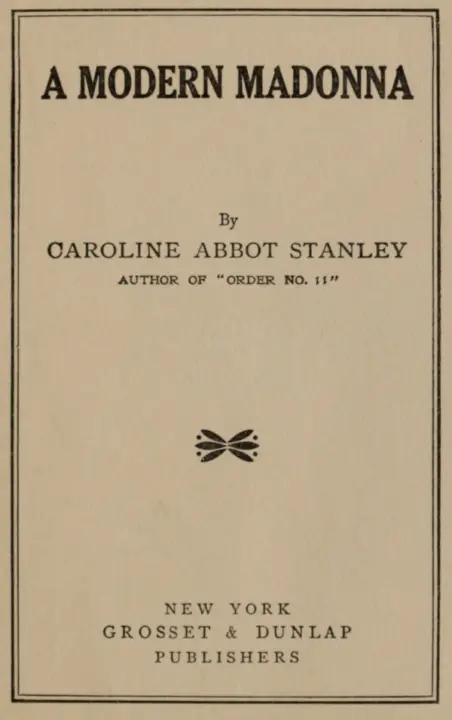
"A Modern Madonna" by Caroline Abbot Stanley is a novel written in the early 20th century. The story revolves around Margaret De Jarnette, who faces the challenges of love, loss, and motherhood after her troubled marriage to Victor De Jarnette. As she navigates her feelings of betrayal and independence, the novel explores themes of fidelity, trust, and the complexities of familial relationships. The opening of the novel introduces readers to Margaret's wedding day, marked by a sense of anticipation and emotional weight as she is given away by Judge Kirtley, her guardian. The scene captures the joy and tension surrounding the nuptials, particularly through the perspective of the judge, who worries about Victor's ability to care for Margaret. This day is intertwined with a foreshadowing of future conflicts, hinted by the presence of Victor’s elder brother Richard, who has reservations about Victor’s readiness for marriage. As the story unfolds, Margaret’s initial happiness turns into a profound struggle with Victor’s infidelity and desertion, setting the stage for her journey toward self-discovery and resilience as she embraces her role as a mother.
Introduction adapted from the source catalogue; source summaries may be automatically generated.
Free to read · English · 114,282 words · No account needed
MAKE TIME FOR A GOOD BOOK
On by default. Untick to stop anonymous reading totals. Each page counts after 10 seconds in view. How this works.
Anonymous counting is on unless you have switched it off.
"Well? That's the end."
Philip became limp.
"My mama always jumps at me, and kisses me, and eats me up," he announced in a dignified manner. He felt distinctly defrauded. "The end is always the best part of my mama's stories."
What merciless critics children are! How by instinct they see the weak point and how unerringly they strike for it!
They rocked in silence for a while and then Philip asked in a polite tone in which there was still a note of hope,
"Do you know Bible stories any better than you do this kind, Unker Wichard?" He was willing to give his uncle another chance.
But that humiliated gentleman was forced to acknowledge that he knew even less about Bible stories than the kind he had been relating.
"Then I guess I'll go to sleep," his nephew decided, with unflattering
renunciation.
But sleep was hard to woo to-night.
"I do shut 'em tight and tight and tight. But they fly open." Then after a further trial, "Unker Wichard, I can't never go to sleep without kissing mama."
"Philip, suppose you tell me a Bible story," suggested Mr. De Jarnette, hurriedly. "What do you know?"
Philip reflected. A story of his telling would keep his uncle there just
the same.
"I know 'Moses in the Bulwushes.'"
"That will do nicely. Wait a minute. Let me turn down the light. Now I'll rock you while you tell it. Go on."
"Well--Once there was a little boy named Moses. And he looked thes like
me."
"Oughtn't you to say, 'Once upon a time'?" suggested his uncle,
maliciously.
"Why, no, sir! Not with Bible stories."
"Oh!"
"You have to say, 'Once there was a little boy named Moses.' And my mama says he looked thes like me. He was so sweet--and so sweet--and so sweet! His mama used ter kiss him and kiss him and kiss him and kiss him and kiss him and kiss him and--"
"There! she's kissed him enough now. Go on."
"Well, there was a wicked man in that country and he was going to take all the little chilwuns from their mamas."
"Where was that country?"
"I don't know, sir. I asked mama where it was and she said she guessed
it was Washington."
"Humph!"
"But I don't believe it was, though, 'cause Gwandma Pennybacker thes laughed the way she does when mama is fooling. But anyway he was a' awful bad man, 'cause he wanted to take the chilwuns from their mamas." He waited a moment for indorsement of this sentiment, and receiving none, asked, "Ain't that wicked, Unker Wichard?"
"Supposed to be--yes."
Your reading position is saved on this browser. Take it to another device with a library code. Reading pages adapt to text, rather than matching a printed edition.
BEHIND THE BOOK
This eBook is for the use of anyone anywhere in the United States and most other parts of the world at no cost and with almost no restrictions whatsoever. You may copy it, give it away or re-use it under the terms of the Project Gutenberg License included with this eBook or online at www.gutenberg.org. If you are not located in the United States, you will have to check the laws of the country where you are located before using this eBook. Read the source licence.
The original source file, including credits and licence, is retained by this library. Request an original-format copy at no charge. Please include the book title and Project Gutenberg identifier #57418.
KEEP YOUR CURIOSITY GOING
Coulson Kernahan

Maurice Baring
Frances Wright
Cécile Tormay

Frederic Jesup Stimson

W. H. P. (William Henry Pope) Jarvis