THE CLASSIC COLLECTION✦A dead man’s diaryCLASSIC FREE BOOKS
A dead man’s diary
Coulson Kernahan
THE CLASSIC COLLECTION · 1906
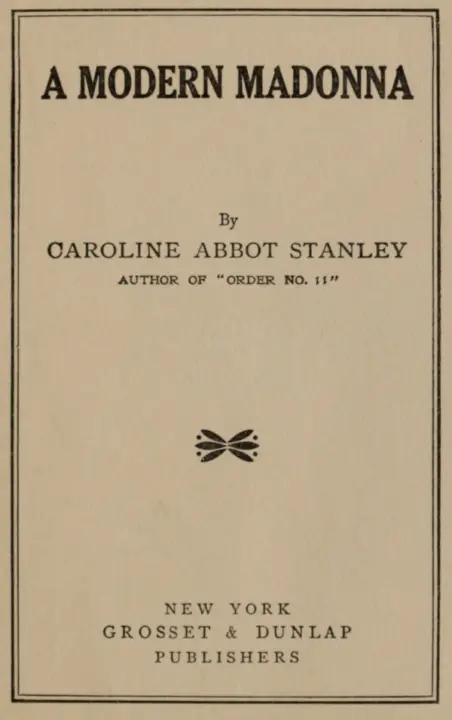
"A Modern Madonna" by Caroline Abbot Stanley is a novel written in the early 20th century. The story revolves around Margaret De Jarnette, who faces the challenges of love, loss, and motherhood after her troubled marriage to Victor De Jarnette. As she navigates her feelings of betrayal and independence, the novel explores themes of fidelity, trust, and the complexities of familial relationships. The opening of the novel introduces readers to Margaret's wedding day, marked by a sense of anticipation and emotional weight as she is given away by Judge Kirtley, her guardian. The scene captures the joy and tension surrounding the nuptials, particularly through the perspective of the judge, who worries about Victor's ability to care for Margaret. This day is intertwined with a foreshadowing of future conflicts, hinted by the presence of Victor’s elder brother Richard, who has reservations about Victor’s readiness for marriage. As the story unfolds, Margaret’s initial happiness turns into a profound struggle with Victor’s infidelity and desertion, setting the stage for her journey toward self-discovery and resilience as she embraces her role as a mother.
Introduction adapted from the source catalogue; source summaries may be automatically generated.
Free to read · English · 114,282 words · No account needed
MAKE TIME FOR A GOOD BOOK
On by default. Untick to stop anonymous reading totals. Each page counts after 10 seconds in view. How this works.
Anonymous counting is on unless you have switched it off.
"Yes, sir. My mama told me--I must be bwave, but--" one little hand covered his lips in a futile attempt to shut off a sob--"I'm afraid I--can't--be--ver-r-ry bwave!"
Richard De Jarnette held out his arms. Coming up the stairs he had vowed he would not do this thing. "Do you want to sit in my lap?"
"Yes, sir!"
In his uncle's protecting embrace, the nervous, over-wrought child said
stoutly:
"They isn't any big black dogs 'wound here, is they, Unker Wichard?"
"No, indeed."
"And they isn't anybody trying to get me away from my--from anybody,
is there?"
"There is nothing that is going to hurt you, Philip," was the grave, but
reassuring reply.
Philip lay still a few moments in relieved content. Then he enquired seductively, "You don't know any stories, do you, Unker Wichard?" Adding, with a little catch in his voice, "My mama always tells me stories."
"Stories are not much in my line, Philip. But perhaps I could grind out
one."
"I 'most know I couldn't go to sleep on one," said Philip, with thrifty providence. "Maybe I could if you could 'member three. I'd try."
"All right."
Philip settled himself for solid comfort. If there was one thing that he loved better than all the world except his mother, it was a good story.
"This is a story about a dog I saw to-day on Pennsylvania Avenue."
"What was his name?"
"I didn't hear his name."
"Was it Rover?"
"I don't know."
"Do you think it was Carlo?"
"I told you I didn't know his name."
"Well, I never knew any people told stories they didn't know," commented
his auditor.
Thus chastened at the outset, Richard lost that confidence which is the prime essential to success in the gentle art of story-telling. He proceeded a little doubtfully.
"This morning, Philip, as I was getting on a car--"
"What car?"
"One on Pennsylvania Avenue."
"Was it a green car or a yellow one?"
"It was a yellow one."
"It wasn't a wed car?"
"No, it was a yellow one."
"Oh! Well--"
"Well, as I got on, a man stepped on the back platform, and his dog wanted to get on, too. But the man drove him back and then got on, thinking, I suppose, that the dog had gone home. But instead of that the dog ran to the front of the car, and when the car started he walked in and stood in front of his master, as much as to say, 'Well, I did it, anyway!' Wasn't he a smart dog?"
Philip was silent a moment.
"Didn't he say anything?"
"Who--the man?"
"No--the dog."
"Why, certainly not."
"Didn't he wink?"
"Wink? No."
Your reading position is saved on this browser. Take it to another device with a library code. Reading pages adapt to text, rather than matching a printed edition.
BEHIND THE BOOK
This eBook is for the use of anyone anywhere in the United States and most other parts of the world at no cost and with almost no restrictions whatsoever. You may copy it, give it away or re-use it under the terms of the Project Gutenberg License included with this eBook or online at www.gutenberg.org. If you are not located in the United States, you will have to check the laws of the country where you are located before using this eBook. Read the source licence.
The original source file, including credits and licence, is retained by this library. Request an original-format copy at no charge. Please include the book title and Project Gutenberg identifier #57418.
KEEP YOUR CURIOSITY GOING
Coulson Kernahan

Maurice Baring
Frances Wright
Cécile Tormay

Frederic Jesup Stimson

W. H. P. (William Henry Pope) Jarvis