THE CLASSIC COLLECTION✦A dead man’s diaryCLASSIC FREE BOOKS
A dead man’s diary
Coulson Kernahan
THE CLASSIC COLLECTION · 1906
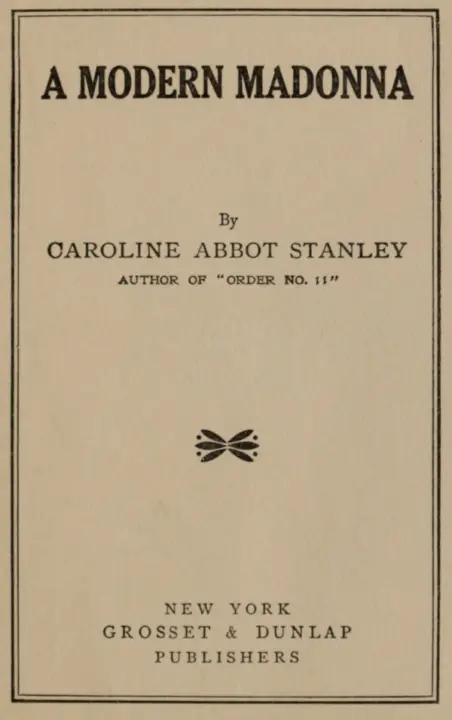
"A Modern Madonna" by Caroline Abbot Stanley is a novel written in the early 20th century. The story revolves around Margaret De Jarnette, who faces the challenges of love, loss, and motherhood after her troubled marriage to Victor De Jarnette. As she navigates her feelings of betrayal and independence, the novel explores themes of fidelity, trust, and the complexities of familial relationships. The opening of the novel introduces readers to Margaret's wedding day, marked by a sense of anticipation and emotional weight as she is given away by Judge Kirtley, her guardian. The scene captures the joy and tension surrounding the nuptials, particularly through the perspective of the judge, who worries about Victor's ability to care for Margaret. This day is intertwined with a foreshadowing of future conflicts, hinted by the presence of Victor’s elder brother Richard, who has reservations about Victor’s readiness for marriage. As the story unfolds, Margaret’s initial happiness turns into a profound struggle with Victor’s infidelity and desertion, setting the stage for her journey toward self-discovery and resilience as she embraces her role as a mother.
Introduction adapted from the source catalogue; source summaries may be automatically generated.
Free to read · English · 114,282 words · No account needed
MAKE TIME FOR A GOOD BOOK
On by default. Untick to stop anonymous reading totals. Each page counts after 10 seconds in view. How this works.
Anonymous counting is on unless you have switched it off.
"I don't want to scold you," Mr. De Jarnette hastened to say, for there were signs of another inundation. "You are going to be a good little boy now and--"
"Is it bad to want my mama?" asked Philip.
"No, but it is foolish to keep on asking for what you can't have."
"Why can't I have my mama?"
"Because she's not here."
"Why ain't she here?"
"Because she is at the hospital."
"What for?"
"She's sick."
"What makes her sick?"
"Philip, if you will go to sleep now, I will bring you some candy in the morning. Will you do it?"
Philip considered.
"Would it be gum dwops?"
"Yes. Or any other obtainable variety. And some peanuts too--and popcorn
balls."
"I'd rather have a jack-knife," said Philip, with faintly-reviving
interest.
"Well, you shall have a jack-knife too--and some--fire-crackers,"--ransacking his memory for childish tastes.
"Is it going to be Christmas?" asked his nephew, beginning to feel that life was still worth living.
"Yes. We have Christmas once a month at Elmhurst--oftener if needed."
"Are you Santa Claus?" asked Philip in an awed voice.
"I'm a friend of his," returned Richard gravely, with an odd sense that this was a plagiarism which would be detected.
But there is nothing like the trustingness of childhood.
"Then can you get anything you want from Santa Claus for little boys?"
"Almost anything," said Mr. De Jarnette cautiously, remembering mothers.
It was a fruitful vein and Philip worked it for all it was worth. When at last his eyelids closed over the bright eyes and the curly head lay still against his uncle's breast, Santa Claus's friend stood committed to a bushel of candy, a bag of peanuts, some pink lemonade, a balloon (showing the connection of ideas), a dog, two white rabbits, a sure enough engine, and a billy goat. He considered peace cheaply purchased at that. He would have impoverished the exchequer rather than have had another two hours of conflict.
"Is he likely to keep this up long?" he asked Mammy Cely whom he met in the hall just as he had laid his young nephew on his bed and tip-toed from the room. He wiped his brow nervously.
"Lord, Marse Richard, sometimes a homesick chile will carry on this way for a month. Yes, sir, they will so."
The drops broke out on Richard's forehead.
"He won't be apt to have a return of it to-night, will he?"
"You can't never tell," said Mammy, cruelly. "He may have another spell inside of an hour. Ef he does I'll call you. Seems lak you can pacify him a heap better than what I can. Yes, sir."
Your reading position is saved on this browser. Take it to another device with a library code. Reading pages adapt to text, rather than matching a printed edition.
BEHIND THE BOOK
This eBook is for the use of anyone anywhere in the United States and most other parts of the world at no cost and with almost no restrictions whatsoever. You may copy it, give it away or re-use it under the terms of the Project Gutenberg License included with this eBook or online at www.gutenberg.org. If you are not located in the United States, you will have to check the laws of the country where you are located before using this eBook. Read the source licence.
The original source file, including credits and licence, is retained by this library. Request an original-format copy at no charge. Please include the book title and Project Gutenberg identifier #57418.
KEEP YOUR CURIOSITY GOING
Coulson Kernahan

Maurice Baring
Frances Wright
Cécile Tormay

Frederic Jesup Stimson

W. H. P. (William Henry Pope) Jarvis