THE CLASSIC COLLECTION✦A dead man’s diaryCLASSIC FREE BOOKS
A dead man’s diary
Coulson Kernahan
THE CLASSIC COLLECTION · 1906
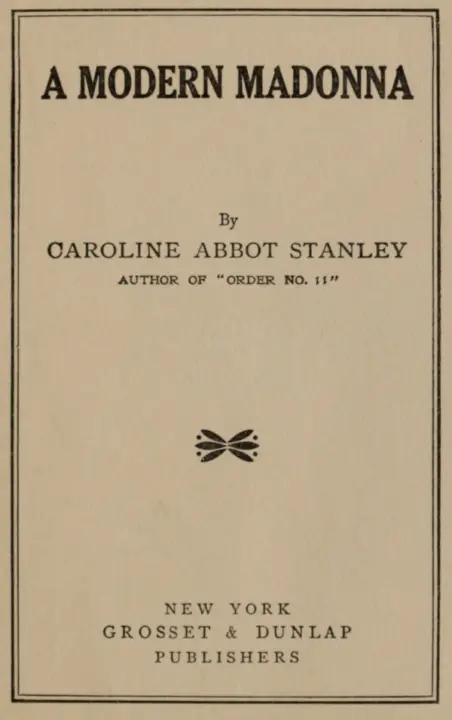
"A Modern Madonna" by Caroline Abbot Stanley is a novel written in the early 20th century. The story revolves around Margaret De Jarnette, who faces the challenges of love, loss, and motherhood after her troubled marriage to Victor De Jarnette. As she navigates her feelings of betrayal and independence, the novel explores themes of fidelity, trust, and the complexities of familial relationships. The opening of the novel introduces readers to Margaret's wedding day, marked by a sense of anticipation and emotional weight as she is given away by Judge Kirtley, her guardian. The scene captures the joy and tension surrounding the nuptials, particularly through the perspective of the judge, who worries about Victor's ability to care for Margaret. This day is intertwined with a foreshadowing of future conflicts, hinted by the presence of Victor’s elder brother Richard, who has reservations about Victor’s readiness for marriage. As the story unfolds, Margaret’s initial happiness turns into a profound struggle with Victor’s infidelity and desertion, setting the stage for her journey toward self-discovery and resilience as she embraces her role as a mother.
Introduction adapted from the source catalogue; source summaries may be automatically generated.
Free to read · English · 114,282 words · No account needed
MAKE TIME FOR A GOOD BOOK
On by default. Untick to stop anonymous reading totals. Each page counts after 10 seconds in view. How this works.
Anonymous counting is on unless you have switched it off.
"Divil a bit wud I moind!" said Norah, with a snap of her brown eyes. "Sure, mem, it wud rej'ice the heart of Norah Brannigan to lie to a vilyan loike that--bad luck to him!--st'alin' women's childer that they have borne--Ah-h! they're a bad lot, mem, is men--a bad lot!--barrin' Michael Callaghan, who is as foine a b'y as ye wud wush to see. There's few loike him--more's the pity! But whisht now, who is this divil you're a-fearin' and what is he loike?"
Margaret described the man as far as she was able.
"I seen him!" cried Norah Brannigan. "I seen him shtandin' on the dock a-talkin' to this blissed child jist as we was castin' off--after the plank was in--and then he took a handspring, he did, over the rail."
"Philip!"
"Mama!... mama!... I didn't say anything--only--only--" It ended in a
burst of weeping.
"Only what, Philip?" She was wild with anxiety. "Tell mama what you
said."
"Only that--that--mama!... I thes told him--I--wasn't--any--girl-l!"
"Oh, Philip! Philip!"
While mother and son were thus reckoning their accounts Norah Brannigan had on her thinking cap, and this article on the head of an Irish girl often covers quick wits.
"You are dead sure, mem, that this man will get the child once we reach
the 'Soo'?"
"Oh, yes, yes! I am perfectly certain of it now."
"Well," said Norah Brannigan, with an encouraging wink of her left eye, "what's the matter wid givin' him the shlip?"
"How can I--away off here in the Lake?" Margaret asked despairingly.
"We are not in the Lake now, mem, nor in the Straits of Mackinac, nayther. We are at this moment enterin' St. Mary's River, mem, and sure it is a good omen that it is named for a mother that had to run off wid her own child. Pray to her, mem! pray to her!" Then, her religious sense appeased, she went on with shrewd acumen, "And wud ye take a chance, now?"
"I would do anything! anything!"
"And cud the gur-l or b'y, whichever it is by that time--" she was looking down sternly at Philip, winking one eye at Margaret meantime--"cud he be depinded on, mem? because," added Norah Brannigan, cruelly, "ef he should turn baby now, and git skeered--and cry--or blab--" she spoke slowly, that he might take it all in, and Philip was regarding her with the closest attention--"why, he wud upset our whole kittle o' fish, mem."
Philip turned to his mother with the most earnest protestation.
"Mama, I won't! I won't cwy--or--or b-blag--or upset any fish!"
Your reading position is saved on this browser. Take it to another device with a library code. Reading pages adapt to text, rather than matching a printed edition.
BEHIND THE BOOK
This eBook is for the use of anyone anywhere in the United States and most other parts of the world at no cost and with almost no restrictions whatsoever. You may copy it, give it away or re-use it under the terms of the Project Gutenberg License included with this eBook or online at www.gutenberg.org. If you are not located in the United States, you will have to check the laws of the country where you are located before using this eBook. Read the source licence.
The original source file, including credits and licence, is retained by this library. Request an original-format copy at no charge. Please include the book title and Project Gutenberg identifier #57418.
KEEP YOUR CURIOSITY GOING
Coulson Kernahan

Maurice Baring
Frances Wright
Cécile Tormay

Frederic Jesup Stimson

W. H. P. (William Henry Pope) Jarvis