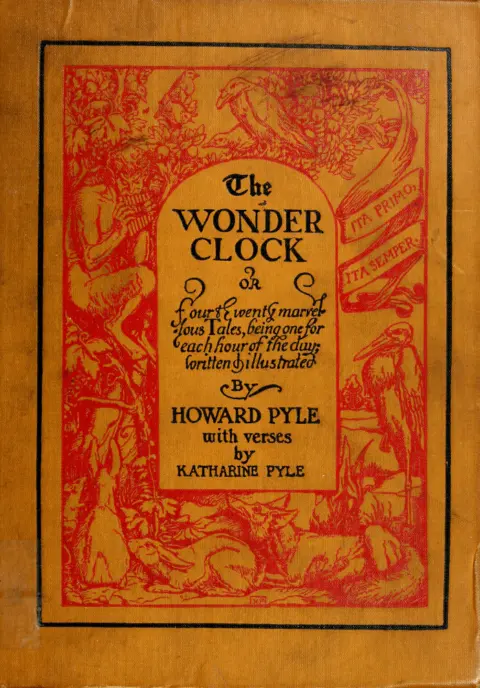
The Wonder Clock; or, four & twenty marvellous Tales being one for each hour of the day
Howard Pyle & Katharine Pyle
THE CLASSIC COLLECTION · 1891
"A Modern Aladdin; or, The Wonderful Adventures of Oliver Munier" by Howard Pyle is an extravaganza written in the late 19th century. The story follows young Oliver Munier, an idle boy in a small town, who suddenly encounters an enigmatic uncle from America, launching him into a series of extraordinary adventures filled with mystery and intrigue." "The opening of the work introduces the historical figure of the Comte de St. Germaine and sets the stage in the little town of Flourens, where Oliver is portrayed as a lazy son lamented by his mother. The arrival of a grand coach heralds the appearance of the mysterious gentleman in black, Oliver's supposed uncle, who claims to be wealthy and introduces Oliver to a new life. The family's nomadic air is quickly punctuated by unsettling occurrences, particularly around Oliver's new uncle and his servant, Gaspard, hinting at darker undertones to their wealth and existence. As the narrative unfolds, Oliver is thrust into an enigmatic world both captivating and terrifying, filled with secrets and danger that promise gripping adventures ahead."
Introduction adapted from the source catalogue; source summaries may be automatically generated.
Free to read · English · 44,139 words · No account needed
MAKE TIME FOR A GOOD BOOK
On by default. Untick to stop anonymous reading totals. Each page counts after 10 seconds in view. How this works.
Anonymous counting is on unless you have switched it off.
"What followed was as unlooked-for to Nicholas Jovus as it would have been to you had you been there, Oliver. That quaint servant of his--what think you he did? He laid Raymond Lulli upon the sand of the sea-shore, and stripped the false body off of him as you might strip off a man's coat. The young student did not know how it was done, but done it was, and as deftly and as cunningly as a fisherman might draw the skin from an eel. Then, as Nicholas Jovus stood aghast watching him, he shouldered what appeared to be the empty skin of Raymond Lulli, turned, and running some distance out along the quay, flung his burden with a splash into the water. It sunk like a stone. The Raymond Lulli that was left behind was an old man of seventy-five years of age, bruised, bleeding, dying. My faith, Oliver! It was a long time before Nicholas Jovus could bear the presence of that odd servant of his without a shudder.
"That is all concerning the story of Raymond Lulli and those rooms that you were in not long ago."
He finished speaking, and Oliver sat gazing at him open-mouthed. He was bewildered--he was stunned. It began to dawn upon his stupefied wits that he was in the very presence of and face to face with a dreadful, grotesque miracle. "And you," said he, in a low voice, and then stopped short, for the question stuck in his throat.
The other smiled. "And I?" said he. "What is it, then, that you would
ask?"
"Are--are you--are you--Nicholas Jovus?"
The other laughed. "What a droll question!" said he. "That thing happened four hundred years ago."
Oliver's skin began to creep; but then he was growing used to that feeling. The two sat watching one another for a little while in silence, the one with dull bewilderment of wonder, the other smiling oddly. Presently the smile broke into a laugh. "You are very droll, Oliver," said he; "you would believe anything that I told you. I have seen and done many strange things in my days, but as for being four hundred years old--Bah! my child, why all this that I have been telling you is only a story, a legend, a tradition, handed down from one to another of us who dabble in alchemy; for I confess to being one of such. No doubt it has grown absurdly as it has been transmitted from man to man. Nevertheless, there are in that story some strange matters--one might almost call them coincidences--that appear to fit in with things that you have seen, and which might, with an irrational mind such as yours, strengthen absurd speculations." He sat watching Oliver smilingly for a while. "That mirror of Nicholas Jovus's," said he, suddenly--"what would you say if I had it in my own possession? Nay, what would you say if it were in this very room?" Oliver looked sharply around, and again the other laughed. "You need not be alarmed," said he; "it is very harmless. But come, I will be perfectly frank; it is in this room, and I will show it to you. It is my intention that we shall thoroughly understand one another, and we must arrive at such understanding now. So understanding one another, we can best be of benefit to each other. But first of all, since we are in the way of being frank, I will begin by making a confession. I confess to you, my dear child--yes, I confess frankly that the ugly suspicions that you have entertained about me have not been entirely without ground. I confess that I had not intended that you should have left that place down yonder, from which you so miraculously escaped. Perhaps this confession may at first shock you, but I am sure, when I explain matters, you will understand that I was not entirely unjustified in seeking to destroy you. I have, I think I may say, very considerable skill in foretelling events by the stars--not foretelling them perfectly, of course, for the science of astrology is not yet perfected, but looking into futurity in a general way. Nevertheless, imperfect as the science of astrology is, my reading of fate was clear enough to teach me who and what you were, and, in a general way, where you were to be found. That reading told me that, unless some heroic remedy were devised, the time drew near when you would be my ruin--" he stopped suddenly, his gaze fixed itself absently above Oliver's head, and Oliver saw his face grow pale and haggard, as if it saw some dreadful vision; he drew in his breath between his shut teeth--"and my death," said he, in a low voice, completing his speech, and shuddering as he spoke the words. Then he passed his hand over his face, and when he drew it away again his expression was as smiling and as debonair as ever. "But we will not speak of such unpleasant things," said he. "I have only mentioned them so far that you might see that I was not altogether inexcusable in seeking to rid myself of you. In conclusion, I will say that about the time that I located with some accuracy the particular spot where you were living, I also discovered that for which I had been seeking for many years--the underground cell in which was Arnold de Villeneuve's laboratory. This house is built upon the ground whereon his stood. It is a wretched tumble-down affair, mean and squalid, yet I have fitted it up for my home; for, as you have discovered, it connects almost directly with that underground vault where the student and the master discovered their great secret.
Your reading position is saved on this browser. Take it to another device with a library code. Reading pages adapt to text, rather than matching a printed edition.
Howard Pyle & Katharine Pyle
Howard Pyle
Howard Pyle
Howard Pyle
BEHIND THE BOOK
This eBook is for the use of anyone anywhere in the United States and most other parts of the world at no cost and with almost no restrictions whatsoever. You may copy it, give it away or re-use it under the terms of the Project Gutenberg License included with this eBook or online at www.gutenberg.org. If you are not located in the United States, you will have to check the laws of the country where you are located before using this eBook. Read the source licence.
The original source file, including credits and licence, is retained by this library. Request an original-format copy at no charge. Please include the book title and Project Gutenberg identifier #48444.
KEEP YOUR CURIOSITY GOING
Cécile Tormay

Moritz Busch
Coulson Kernahan
John L. Ransom

Maurice Baring
Frances Wright