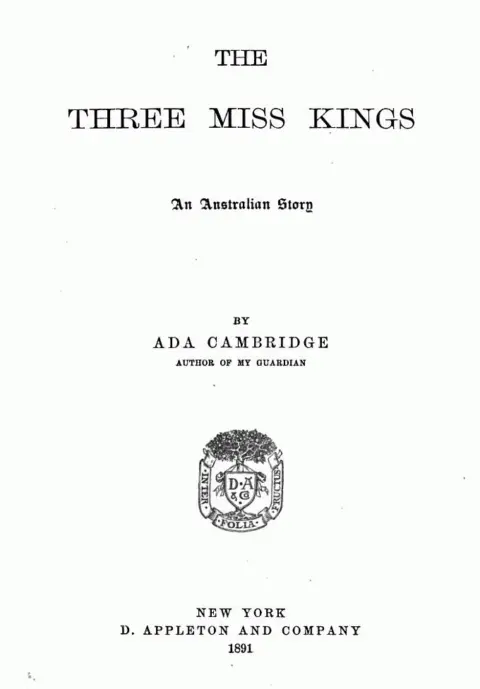
The Three Miss Kings: An Australian Story
Ada Cambridge
THE CLASSIC COLLECTION · 1882
"A Mere Chance: A Novel. Vol. 3" by Ada Cambridge is a romance novel written in the late 19th century. The story revolves around the complex emotional entanglements of Rachel, who struggles with the implications of her marriage to Mr. Kingston amidst lingering feelings for her former fiancé, Roden Dalrymple. As the narrative unfolds, themes of love, sacrifice, and societal expectations come to the forefront, as Rachel navigates her tumultuous feelings toward both her husband and the man she never truly forgot." "The opening of the novel sets the stage about a month after Rachel’s engagement to Mr. Kingston is revived. It depicts her inner turmoil and despondency as she prepares for her impending marriage, highlighting her conflicted emotions and the societal pressures surrounding her. As Rachel grapples with feelings of despair and isolation, Mr. Kingston unexpectedly visits, offering her a sliver of comfort, which ultimately leads her to accept his proposal. The narrative establishes a backdrop of tension as Rachel’s unresolved feelings for Roden and the expectations of her new life weigh heavily on her, foreshadowing the emotional complexities that will ensue as the story progresses."
Introduction adapted from the source catalogue; source summaries may be automatically generated.
Free to read · English · 29,204 words · No account needed
MAKE TIME FOR A GOOD BOOK
On by default. Untick to stop anonymous reading totals. Each page counts after 10 seconds in view. How this works.
Anonymous counting is on unless you have switched it off.
"Aw--what's the matter? Are you dizzy?" asked her partner, feeling a break and a jar in the rhythm of the measure that had been flowing so very harmoniously.
"A little," she whispered. "I should like to sit down for a few minutes--we'll go on again, if you like, presently."
He led her to a retired bench, and while she rested stood beside her, silently watching the people who continued to revolve before them. She had hardly sat down, and was beginning mechanically to fan herself, when the stranger with the eyeglass came up, with a lady, who was also unknown to her, on his arm.
"Here's a seat," said the little stout man; and his partner, an elderly and amiable matron, sat down, bestowing the deprecatory smile of old-fashioned courtesy upon the two already in possession.
He took the end of the bench himself, and chatted away to her--she was his aunt, apparently--leaning a little forward, with an elbow on his knee; and Rachel, dreamily occupied as she was, was quite conscious that his keen eyes dwelt persistently, not upon his neighbour's face, but upon her own.
"Why don't you go and get a partner, James?" said the elderly matron. "You don't want to dance attendance upon me, my dear--I shall do very well here until Lucy wants me. Go and find some pretty young lady, and enjoy yourself like the rest of them."
"I don't believe in pretty young ladies," replied the little man, rather bluntly. "Except Lucy--and she is engaged for the whole night, as far as I can make out."
Here ensued some comments upon Lucy, who appeared to be the lady's daughter, generally favourable to that young person. And the little man then began to inveigh against the abstract girl of the period with trenchant vigour--obviously to the great embarrassment of his companion, who tried her best, but vainly, to divert him to other topics.
"In fact, there are no girls nowadays," he remarked coolly; "they are all calculating, selfish, heartless, worldly women--always excepting Lucy, of course--as soon as they cease to be children. They have only one object in life, and that is to marry a man--no, not a man necessarily, a forked stick will do--who has plenty of money."
"My dear, that is a popular sentiment, I know, and supposed to be full of wit and wisdom, but it always seems to me that it is just a little vulgar," replied his companion, frowning surreptitiously, and giving uneasy sidelong glances at Rachel. "There are girls and girls, of course, just as there are men and men; we see bad and good in every class. How beautifully this place lights up, to be sure!"
Your reading position is saved on this browser. Take it to another device with a library code. Reading pages adapt to text, rather than matching a printed edition.
Ada Cambridge
Ada Cambridge
Ada Cambridge
Ada Cambridge
BEHIND THE BOOK
This eBook is for the use of anyone anywhere in the United States and most other parts of the world at no cost and with almost no restrictions whatsoever. You may copy it, give it away or re-use it under the terms of the Project Gutenberg License included with this eBook or online at www.gutenberg.org. If you are not located in the United States, you will have to check the laws of the country where you are located before using this eBook. Read the source licence.
The original source file, including credits and licence, is retained by this library. Request an original-format copy at no charge. Please include the book title and Project Gutenberg identifier #38085.
KEEP YOUR CURIOSITY GOING
Coulson Kernahan

Maurice Baring
Frances Wright
Cécile Tormay

Frederic Jesup Stimson

W. H. P. (William Henry Pope) Jarvis