THE CLASSIC COLLECTION✦An outlaw’s diary: the CommuneCLASSIC FREE BOOKS
An outlaw’s diary: the Commune
Cécile Tormay
THE CLASSIC COLLECTION · 1899
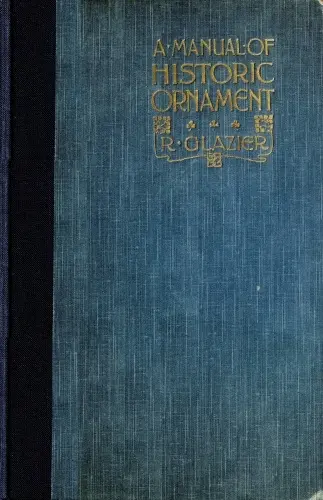
"A Manual of Historic Ornament" by Richard Glazier is a scholarly reference work on the evolution and development of architectural ornamentation and other applied arts, written in the late 19th century. This manual is intended for both students and craftsmen, providing an elementary understanding of architecture and historical ornamentation while emphasizing the beauty and significance of ancient and medieval art forms. It likely serves as an important resource for anyone interested in the aesthetic traditions that have shaped architectural design through the ages. The opening of the manual outlines its primary objectives, which include fostering an appreciation of ancient civilizations' artistic contributions, educating readers on the characteristics of various ornamental styles, and encouraging a deeper understanding of the industrial arts. Glazier explains that the manual features a wide variety of illustrations that represent typical examples of different styles and periods, facilitating a visual understanding of the subject matter. The initial sections focus on regions such as Oceania, Egypt, Assyria, and Greece, highlighting their unique artistic expressions and the intricate relationship of ornamentation with culture and society.
Introduction adapted from the source catalogue; source summaries may be automatically generated.
Free to read · English · 39,465 words · No account needed
MAKE TIME FOR A GOOD BOOK
On by default. Untick to stop anonymous reading totals. Each page counts after 10 seconds in view. How this works.
Anonymous counting is on unless you have switched it off.
At Selinus there are six large Doric temples, five being hexastyle and peripteral, the other octastyle and pseudo-dipteral, 372 by 175 feet. This temple has columns 57 feet in height with an entablature of 19 feet. At Egesta, there is a hexastyle, peripteral, Doric temple with the columns not fluted, and at Pæstum in Southern Italy there are two Doric temples, the temple of Neptune, and the temple of Vesta, of the usual hexastyle and peripteral form, but the Basilica is pseudo-dipteral and is remarkable for its two porticos of nine columns each. All these buildings in Sicily and Pæstum date between B.C. 500 and 430.
Classification of Classic Temples:--
1st. The arrangements of the columns and walls
(a) When the side walls have no colonnade Apteral
(b) When there is a colonnade standing apart from the side walls Peripteral
(c) When the colonnade is attached to the side of the side walls Pseudo-peripteral
(d) When there is a double colonnade standing from the wall Dipteral
2nd. The relation of the ends of the temple
(a) When the columns do not project beyond the walls In Antis
(b) When a portico stood in front of the temple Prostyle
(c) When there was a portico at each end Amphi-prostyle
(d) If the portico was one column in depthMono-prostyle
(e) If the portico was two columns in depth Di-prostyle
3rd. The number of columns in the portico
(a) If of 2 columns Distyle
(b) If of 4 columns Tetrastyle
(c) If of 6 columns exastyle_
(d) If of 8 columns Octastyle
4th. The Intercolumniation
(a) If 1-1/2 diameters apart Pycnostyle
(b) If 2 diameters apart Systyle
(c) If 2-1/4 diameters apart Eustyle
(d) If 3 diameters apart Diastyle
(e) If 4 diameters apart Ærostyle
Greece, or Hellas, consisted of a number of small states, speaking the same language, and worshipping the same gods. Almost the whole of the Ægean coast of Asia Minor was occupied in early times by Greek Colonies, which supplanted those of the Phœnicians of Tyre and Sidon. The southern portion of this seaboard was occupied by the Dorians, and the northern by Ionians. In the course of time other Greek settlements were made on the Black Sea and Mediterranean Coast of Asia Minor; as well as at Syracuse, Gela and Agrigentum, in Sicily, and in Etruria and Magna Grecia in Italy. These colonies appear to have reached a higher state of art at an early period than Greece itself. The ascendency in art in Greece was enjoyed by the Dorians circa, 800 B.C.; after which Sparta took the lead, but was in turn excelled by the Ionians, when Athens became the focus of Greek art, and attained a degree of perfection in that respect that has remained unequalled to this day. Athens was destroyed by the Persians under Xerxes, 480 B.C.; but under Pericles (470-29 B.C.) Greek art reached its culmination.
Your reading position is saved on this browser. Take it to another device with a library code. Reading pages adapt to text, rather than matching a printed edition.
BEHIND THE BOOK
This eBook is for the use of anyone anywhere in the United States and most other parts of the world at no cost and with almost no restrictions whatsoever. You may copy it, give it away or re-use it under the terms of the Project Gutenberg License included with this eBook or online at www.gutenberg.org. If you are not located in the United States, you will have to check the laws of the country where you are located before using this eBook. Read the source licence.
The original source file, including credits and licence, is retained by this library. Request an original-format copy at no charge. Please include the book title and Project Gutenberg identifier #53373.
KEEP YOUR CURIOSITY GOING
Cécile Tormay

Moritz Busch
John L. Ransom
Frances Wright
Cécile Tormay

Mabel Potter Daggett