THE CLASSIC COLLECTION✦An outlaw’s diary: the CommuneCLASSIC FREE BOOKS
An outlaw’s diary: the Commune
Cécile Tormay
THE CLASSIC COLLECTION · 1899
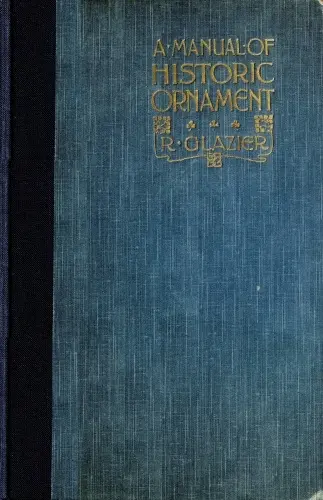
"A Manual of Historic Ornament" by Richard Glazier is a scholarly reference work on the evolution and development of architectural ornamentation and other applied arts, written in the late 19th century. This manual is intended for both students and craftsmen, providing an elementary understanding of architecture and historical ornamentation while emphasizing the beauty and significance of ancient and medieval art forms. It likely serves as an important resource for anyone interested in the aesthetic traditions that have shaped architectural design through the ages. The opening of the manual outlines its primary objectives, which include fostering an appreciation of ancient civilizations' artistic contributions, educating readers on the characteristics of various ornamental styles, and encouraging a deeper understanding of the industrial arts. Glazier explains that the manual features a wide variety of illustrations that represent typical examples of different styles and periods, facilitating a visual understanding of the subject matter. The initial sections focus on regions such as Oceania, Egypt, Assyria, and Greece, highlighting their unique artistic expressions and the intricate relationship of ornamentation with culture and society.
Introduction adapted from the source catalogue; source summaries may be automatically generated.
Free to read · English · 39,465 words · No account needed
MAKE TIME FOR A GOOD BOOK
On by default. Untick to stop anonymous reading totals. Each page counts after 10 seconds in view. How this works.
Anonymous counting is on unless you have switched it off.
PLATE. PAGE. 1 Ornament of Oceania 2 2 Egyptian Ornament 4 3 Assyrian Ornament 6 4 Greek Architecture 8 5 Greek Ornament 12 6 Greek Ornament 18 7 Roman Architecture 20 8 Roman Ornament 24 9 Roman Ornament 26 10 Pompeian Ornament 28 11 Byzantine Ornament 30 12 Scandinavian Ornament 32 13 Celtic Ornament 34 14 The Triforium and Clearstory 41 15 Norman Details 42 16 Early Gothic Details 44 17 Decorated & Perpendicular Gothic Details 46 18 Renascence Ornament 48 19 Renascence Ornament 55 20 Arabian Ornament 62 21 Persian Ornament 64 22 Persian Ornament 67 23 Indian Ornament 68 24 Chinese and Japanese Ornament 70 25 Ivories 72 26 Mosaics 74 27 Greek Ceramics 76 28 Ceramics 78 29 Maiolica 86 30 Glass 94 31 Stained Glass 96 32 Gold and Silver 100 33 Bronzes 102 34 Wrought Iron 104 35 Textile Fabrics 108 36 Sicilian Fabric 111 37 Indian Palampore 112 38 Persian Carpet 114 39 Textile Fabrics 117 40 Peruvian Textiles 119 41 Peruvian Textiles 120 42 Frets 122 43 Polynesian Paddle 124
Illustrations in the Text.
Ornament of Oceania 3
Plan of the Parthenon 9
Plan of the Erectheum 10
The two Fates, from the
Eastern Pediment of the Parthenon 14
Doric Frieze of the Parthenon 14
North Frieze of the Parthenon 15
Frieze from Phigaleia 15
Relief from Nike Apteros 16
Frieze from Pergamos 16
Frieze from Susa 17
Greek Scroll 17
Greek Coins 19
Arch of Septimius Severus 21
Theatre of Marcellus 22
Plan of the Pantheon 22
Plan of the House of Pansa 23
Roman Scroll 25
Coffered Ceiling 25
Frieze from Tivoli 27
Plan of St. Mark’s 31
Plan of St. Sophia 31
Lismore Crosier 35
Gothic Piers 37
Plan of Lincoln Cathedral 37
Early Gothic Window 38
Grisaille Glass, Salisbury 39
Gothic Crockets 45
Gothic Borders 45
Tomb of Ilaria del Carretto 50
Bas-relief, by Donatello 51
Monument to Conte Ugino 51
Italian Velvet 52
Fresco, by Michel-Angelo 52
A Sibyl, by Michel-Angelo 53
Arabesque Decorations 53
Renascence Scroll 54
Renascence Marble Inlay 54
Frieze, by Mantegna 56
An Italian Etching 56
Venetian Well-head 57
Wood Carving, period of Francis I. 58
Decoration, period of Francis II. 58
Relief, by Jean Goujon 59
Wood Carving, by Jean Goujon 59
Frieze, by Le Pautre 59
Wood Carving, period of Louis XV. 59
Elizabethan Frieze 60
Elizabethan Strap-work 60
Ceiling, Audley End 60
Persian Plate 65
Peruvian Pottery 85
Greek Terra Cotta 89
The Annunciation, by Andrea della Robbia 89
Relief, by Andrea della Robbia 90
Painted Enamel by Pierre Raymond 93
Battersea Enamel 93
Early Gothic Glass 97
Early French Glass 98
Late Gothic Glass 98
Chairs 106
Italian Carved Chest 107
Carved Wood Screen 107
Italian Fabrics 115
Flower Vase Pattern 116
Spitalsfield Silk 116
Flemish Fabrics 116
Frets 123
Egyptian Capital 126
Corinthian Capital 127
Early French Capital 127
Composite Capital 127
Byzantine Capital 128
French Romanesque Capital 128
Siculo-Norman Capital 129
Early English Capital 129
Arabian Capital 129
Decorated Gothic Capital 130
Renascence Capital 130
Roman Scroll 130
The ornamentation of the people of the Pacific Isles is full of interest and is remarkable for the evolution and perfecting of an ornamental style by a primitive people, with myths and traditions purely local and in no way influenced by other nations. It is a style of ornament full of meaning and symbolism, yet simple in detail and arrangement, not founded upon the beautiful vegetation and flora of their islands but upon abstract forms derived from the human figure, and arranged with a pleasing geometrical precision remarkable for a primitive people.
Your reading position is saved on this browser. Take it to another device with a library code. Reading pages adapt to text, rather than matching a printed edition.
BEHIND THE BOOK
This eBook is for the use of anyone anywhere in the United States and most other parts of the world at no cost and with almost no restrictions whatsoever. You may copy it, give it away or re-use it under the terms of the Project Gutenberg License included with this eBook or online at www.gutenberg.org. If you are not located in the United States, you will have to check the laws of the country where you are located before using this eBook. Read the source licence.
The original source file, including credits and licence, is retained by this library. Request an original-format copy at no charge. Please include the book title and Project Gutenberg identifier #53373.
KEEP YOUR CURIOSITY GOING
Cécile Tormay

Moritz Busch
John L. Ransom
Frances Wright
Cécile Tormay

Mabel Potter Daggett