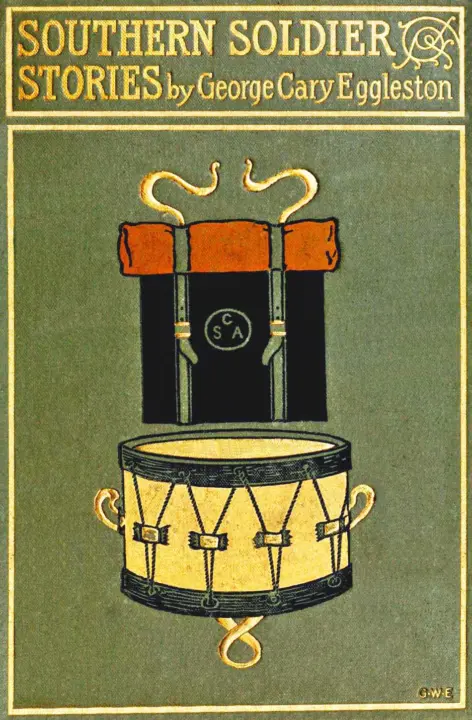
Southern Soldier Stories
George Cary Eggleston
THE CLASSIC COLLECTION · 1873
"A Man of Honor" by George Cary Eggleston is a novel written in the late 19th century. The story centers around Robert Pagebrook, a young man grappling with feelings of depression following a romantic disappointment and the loss of his teaching position. The narrative hints at his journey to overcome these challenges as he embarks on a trip to visit his relatives in Virginia, where he encounters family dynamics, societal norms, and romantic possibilities. The opening of the book introduces Mr. Robert Pagebrook as he reflects on his dismal state of mind one morning. The reader learns that he has recently lost a teaching position and feels heartbroken over a failed romance with a young woman named Miss Nellie. As he considers his uncertain future, he receives news of a potential teaching offer at a New England college. Subsequently, Robert's cousin invites him for a visit to Shirley, the ancestral home, which promises a change of scenery and potential adventures. This establishes the groundwork for Robert's character development and the relationships that will unfold as he navigates life in this new environment.
Introduction adapted from the source catalogue; source summaries may be automatically generated.
Free to read · English · 49,491 words · No account needed
MAKE TIME FOR A GOOD BOOK
On by default. Untick to stop anonymous reading totals. Each page counts after 10 seconds in view. How this works.
Anonymous counting is on unless you have switched it off.
Mr. Robert made a hasty toilet and descended to the great hall, or passage, as they call it in Virginia. As he did so he discovered the origin of the scraping sound which had puzzled him, as it puzzles everybody else who hears it for the first time. Dry "pine tags" (which is Virginian for the needles of the pine) were scattered all over the floors, and several negro women were busy polishing the hard white planks by rubbing them with an indescribable implement made of a section of log, a dozen corn husks ("shucks," the Virginians call them--a "corn husk" in Virginia signifying a cob always), and a pole for handle.
"Good morning, Cousin Robert. You're up soon," said the little woman, coming out of the dining-room and putting a soft, warm little hand in his great palm.
Now to young Pagebrook this was a totally new use of the word "soon," and I dare say he would have been greatly interested in it but for the fact that the trim little woman who stood there, key-basket in hand, interested him more.
"You've caught me in the midst of my housekeeping, but never mind; only be careful, or you'll slip on the pine tags; they're as slippery as glass."
"And is that the reason they are scattered on the floor?"
"Yes, we polish with them. Up North you wax your floors instead, don't
you?"
"Yes, for balls and the like, I believe, but commonly we have carpets."
"What! in summer time, too?"
"O yes! certainly, Why not?"
"Why, they're so warm. We take ours up soon in the spring, and never put them down again until fall."
This time Mr. Robert observed the queer use of the word "soon," but said nothing about it. He said instead:
"What a lovely morning it is! How I should like to ride horseback in
this air!"
"Would you let me ride with you?" asked the little maiden.
"Such a question, Cousin Sudie!"
Now I am free to confess that this last remark was unworthy Mr. Pagebrook. If not ungrammatical, it is at least of questionable construction, and so not at all like Mr. Pagebrook's usage. But the demoralizing effect of Miss Sudie Barksdale's society did not stop here by any means, as we shall see in due time.
"If you'd really like to ride, I'll have the horses brought," said the
little lady.
"And you with me?"
"Yes, if I may."
"I shall be more than happy."
"Dick, run up to the barn and tell Uncle Polidore to saddle Patty for me and Graybeard for your Mas' Robert. Do you hear? Excuse me, Cousin Robert, and I'll put on my habit."
Your reading position is saved on this browser. Take it to another device with a library code. Reading pages adapt to text, rather than matching a printed edition.
George Cary Eggleston
George Cary Eggleston
George Cary Eggleston
George Cary Eggleston
BEHIND THE BOOK
This eBook is for the use of anyone anywhere in the United States and most other parts of the world at no cost and with almost no restrictions whatsoever. You may copy it, give it away or re-use it under the terms of the Project Gutenberg License included with this eBook or online at www.gutenberg.org. If you are not located in the United States, you will have to check the laws of the country where you are located before using this eBook. Read the source licence.
The original source file, including credits and licence, is retained by this library. Request an original-format copy at no charge. Please include the book title and Project Gutenberg identifier #37563.
KEEP YOUR CURIOSITY GOING
Coulson Kernahan

Maurice Baring
Frances Wright
Cécile Tormay

Frederic Jesup Stimson

W. H. P. (William Henry Pope) Jarvis