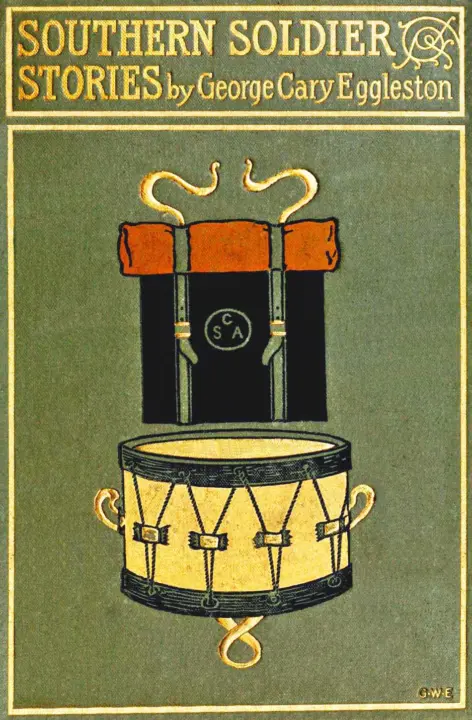
Southern Soldier Stories
George Cary Eggleston
THE CLASSIC COLLECTION · 1873
"A Man of Honor" by George Cary Eggleston is a novel written in the late 19th century. The story centers around Robert Pagebrook, a young man grappling with feelings of depression following a romantic disappointment and the loss of his teaching position. The narrative hints at his journey to overcome these challenges as he embarks on a trip to visit his relatives in Virginia, where he encounters family dynamics, societal norms, and romantic possibilities. The opening of the book introduces Mr. Robert Pagebrook as he reflects on his dismal state of mind one morning. The reader learns that he has recently lost a teaching position and feels heartbroken over a failed romance with a young woman named Miss Nellie. As he considers his uncertain future, he receives news of a potential teaching offer at a New England college. Subsequently, Robert's cousin invites him for a visit to Shirley, the ancestral home, which promises a change of scenery and potential adventures. This establishes the groundwork for Robert's character development and the relationships that will unfold as he navigates life in this new environment.
Introduction adapted from the source catalogue; source summaries may be automatically generated.
Free to read · English · 49,491 words · No account needed
MAKE TIME FOR A GOOD BOOK
On by default. Untick to stop anonymous reading totals. Each page counts after 10 seconds in view. How this works.
Anonymous counting is on unless you have switched it off.
"Return we to our muttons, then," said Billy; "I'll finish the business that brought me here, which is only to be present at the taking of a short deposition, by two or three o'clock. While I'm at it you can get your traps together, send your trunk to the depot, and get back here to dinner by four. Then we must get through the rest of the time the best way we can, and at eleven we'll be off. I'm crazy to see you with Phil once."
"Phil, who is he?"
"Oh! Phil is a character--a colored one. I want to see how his 'dialect' will affect you. I'm half afraid you'll go crazy, though, under it."
"Tell me--"
"No, I won't describe Phil, because I can't, and no more can anybody else. Phil must be seen to be appreciated. But come, I'm off for the notary's, and you must get you gone too, for you mustn't be late at dinner--that's poz."
With this the two young men separated, the Virginian lawyer to attend to the taking of some depositions, and his cousin to surrender his lodgings, pack his trunk, and make such other arrangements as were necessary for his journey.
This opportunity to visit the old homestead where his father had passed his boyhood was peculiarly welcome to Mr. Robert just now. There had always been to him a sort of glamour about the names Virginia and Shirley. His father's stories about his own childhood had made a deep impression on the mind of the boy, and to him Shirley was a palace and Virginia a fairy land. Whenever, in childhood, he was allowed to call a calf or a pig his own, he straightway bestowed upon it one or the other of the charmed names, and fancied that the animal grew stronger and more beautiful as a consequence. He had always intended to go to Shirley, but had never done so; just as you and I, reader, have always meant to do several scores of things that we have never done, though we can hardly say why. Just now, however, Mr. Billy's plan for his cousin was more than ever agreeable to Mr. Robert for various present and unusual reasons. He knew next to nobody in or about Philadelphia outside the precincts of the collegiate institute, and to hunt up acquaintances inside that institution was naturally enough not exactly to his taste. He had several months of time to dispose of in some way, and until Billy suggested the visit to Virginia, the best he had been able to do in the way of devising a time-killer was to plan a solitary wandering among the mountainous districts of Pennsylvania. Ordinarily he would have enjoyed such a journey very much, but just now he knew that Mr. Robert Pagebrook could hardly find a less agreeable companion than Mr. Robert Pagebrook himself. That little affair with Miss Nellie Currier kept coming up in his memory, and if the reader be a man it is altogether probable that he knows precisely how the memory of that story affected our young gentleman. He wanted company, and he wanted change, and he wanted out-door exercise, and where could he find all these quite so abundant as at an old Virginian country house? His love for Miss Nellie, he was sure, was a very genuine one; but he was equally sure that it was hopeless. Indeed, now that he knew the selfish insincerity of the damsel he did not even wish that his suit had prospered. This, at any rate, is what he thought, as you did, my dear sir, when you first learned what the word "Another" means when printed with a big A; and, thinking this, he felt that the first thing to be done in the matter was to forget Miss Nellie and his love for her as speedily as possible. How far he succeeded in doing this we shall probably see in the sequel. At present we have to do with the attempt only. New scenes and new people, Mr. Pagebrook thought, would greatly aid him in his purpose, and so the trip to Virginia seemed peculiarly fitting. It thus comes about that the scene of this young man's story suddenly shifts from Philadelphia to a Virginian country house, in spite of all I can do to preserve the dramatic unity of place. Ah! if I were making this story now, I could confine it to a single room, compress its action into a single day, and do other dramatic and highly proper things; but as Mr. Robert Pagebrook and his friends were not stage people, and, moreover, as they were not aware that their goings and comings would ever weave themselves into the woof of a story at all, they utterly failed to regulate their actions in accordance with critical rules, and went roving about over the country quite in a natural way and without the slightest regard for my convenience.
Your reading position is saved on this browser. Take it to another device with a library code. Reading pages adapt to text, rather than matching a printed edition.
George Cary Eggleston
George Cary Eggleston
George Cary Eggleston
George Cary Eggleston
BEHIND THE BOOK
This eBook is for the use of anyone anywhere in the United States and most other parts of the world at no cost and with almost no restrictions whatsoever. You may copy it, give it away or re-use it under the terms of the Project Gutenberg License included with this eBook or online at www.gutenberg.org. If you are not located in the United States, you will have to check the laws of the country where you are located before using this eBook. Read the source licence.
The original source file, including credits and licence, is retained by this library. Request an original-format copy at no charge. Please include the book title and Project Gutenberg identifier #37563.
KEEP YOUR CURIOSITY GOING
Coulson Kernahan

Maurice Baring
Frances Wright
Cécile Tormay

Frederic Jesup Stimson

W. H. P. (William Henry Pope) Jarvis