
A Little Queen of Hearts: An International Story
Ruth Ogden
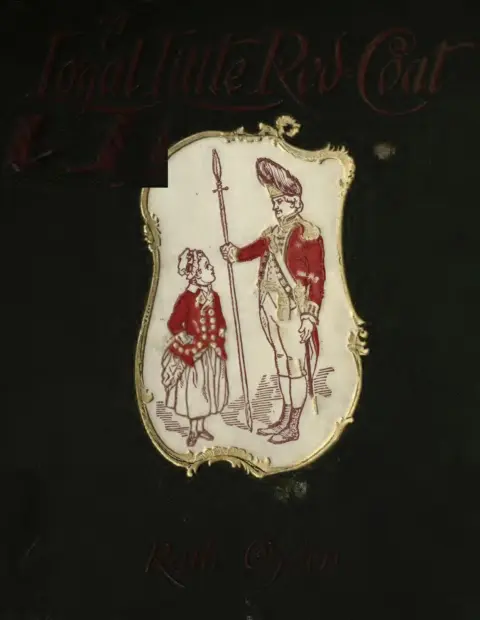
THE CLASSIC COLLECTION · 1890
"A Loyal Little Red-Coat: A Story of Child-life in New York a Hundred Years Ago" by Ruth Ogden is a historical novel written in the late 19th century. The story is set in the backdrop of the American Revolutionary War, focusing on the experiences of a young girl named Hazel Boniface, a Loyalist growing up in New York City during this tumultuous time. The narrative explores her interactions with various characters, including her friendship with Job Ainsworth, a Whig, highlighting the conflicts and camaraderie between those on opposing sides of the political spectrum. The opening of the book introduces Hazel Boniface, born into a Loyalist family, and illustrates her young life against the backdrop of a shifting political landscape in 1783 New York. Hazel is depicted watching boys skating and playing during a winter outing with her father, and soon her thoughts turn to her friend Job, with whom she has a burgeoning friendship despite their differing loyalties. The chapter establishes her deep concern for her friends' rights, particularly her worries about the treatment of a family displaced by British soldiers, and sets the stage for Hazel’s determination to advocate for justice while navigating the complexities of childhood friendships amidst the Revolutionary War's end.
Introduction adapted from the source catalogue; source summaries may be automatically generated.
Free to read · English · 65,375 words · No account needed
MAKE TIME FOR A GOOD BOOK
On by default. Untick to stop anonymous reading totals. Each page counts after 10 seconds in view. How this works.
Anonymous counting is on unless you have switched it off.
Harry was glad to find the Captain in this lighter vein, for life had been too serious and complicated a matter lately for him often to forget its seriousness. As for Mrs. Boniface, she had been both surprised and delighted when she found her husband willing to accept the Van Vleets' invitation, for lately it had been quite impossible to get him to take any interest in anything of the sort, and she feared a kind but absolute refusal. But no sooner had the “Grayling” cleared her dock than the Captain seemed to regain his wonted good spirits, and to leave all his heavy-heartedness behind, and glad indeed was his little family to see him in a cheery mood once more.
As soon as the Bonifaces commenced to ascend the beautiful grass-grown meadow, which swept down to the water's edge, out came all the Van Vleets to meet them and escort them up to the house; and it was a remarkable old dwelling, unlike anything one would see nowadays, if it were not that two or three such homesteads have chanced to survive the ravages of a century, by grace of having once been dignified as “Washington's Headquarters.”
It was a double two-story house, or rather three-story, if you count the little rooms in the gables. It was built of stone, coated with a rough sort of plaster, and faced the river; its large square stoop, flanked with its two benches, being protected by the overhanging eaves of the roof itself. The front door, seldom opened, was ornamented with a huge brass knocker in the shape of a lion's head, and was daily burnished with as much thoroughness as though in constant use. Indeed, it must be confessed that in front everything was severe and prim and painfully stiff, but fortunately at the side things were different. Indeed, the house, in its two entirely different aspects, resembled an old army officer, always stern and arbitrary with his men for the sake of discipline, but 'another fellow altogether' when off duty and in the company of his brother officers. At the side it was as though you surprised it in undress uniform. In the first place, there was always, in the season, a great profusion of flowers; not, however, in conventional flower beds, but parading their blaze of color from painted tubs, mounted here and there on the table-like tops of old tree stumps, which had evidently survived the first clearing of the land. Fortunately for general effectiveness, these tubs were not filled with a promiscuous assortment of plants, but each held the luxurious growth of some single variety--here a hydrangea, with its wealth of heavy-headed blooms, fairly concealing its leaves; there a great cluster of peonies or brilliant scarlet geraniums. As might be expected on the first Saturday of October, many of these plants bore only a few tardy blossoms, and some of them had evidently lost all heart with the first intimation of frost; but in the centre of the old-fashioned grass plot was a contrivance that from June well into November presented a remarkable blaze of color, varying with every month, and always beautiful. This contrivance, called by the Van Vleets “The flower fountain,” was composed of a series of five circular shelves, each shelf a little smaller in circumference than the one below it, and terminating, at the height of about five feet from the ground, in a round flat top. These shelves were constantly crowded with pots of plants in full bloom. Indeed, Hans kept a sort of nursery for no other reason than to supply the fountain, and the moment a plant took it into its head to bloom no longer, or only in a spiritless way, back it was marched to the nursery, and another took its place. What a fine thing it would be if some of the little folk too, who are not blooming out into just the sort of grown folk we could wish, might simply be remanded to the nursery, there to be restarted, after the manner of Hans's plants, and perhaps coaxed into a more satisfying growth than they now, alas! give promise of! But if it had not been for this flower fountain, who knows but Hans might have gone to the war? You can see how it would not be an easy thing for a placid, kind-hearted Dutchman, who loved the training and slipping and potting of plants above everything else in the world, to turn his pruning-knife into a sword.
Your reading position is saved on this browser. Take it to another device with a library code. Reading pages adapt to text, rather than matching a printed edition.
Ruth Ogden
Ruth Ogden
Ruth Ogden
Ruth Ogden
BEHIND THE BOOK
This eBook is for the use of anyone anywhere in the United States and most other parts of the world at no cost and with almost no restrictions whatsoever. You may copy it, give it away or re-use it under the terms of the Project Gutenberg License included with this eBook or online at www.gutenberg.org. If you are not located in the United States, you will have to check the laws of the country where you are located before using this eBook. Read the source licence.
The original source file, including credits and licence, is retained by this library. Request an original-format copy at no charge. Please include the book title and Project Gutenberg identifier #54132.
KEEP YOUR CURIOSITY GOING
Wilfrid Scawen Blunt
Wilfrid Scawen Blunt

E. W. (Edgar Watson) Howe
Cécile Tormay

Moritz Busch
Coulson Kernahan