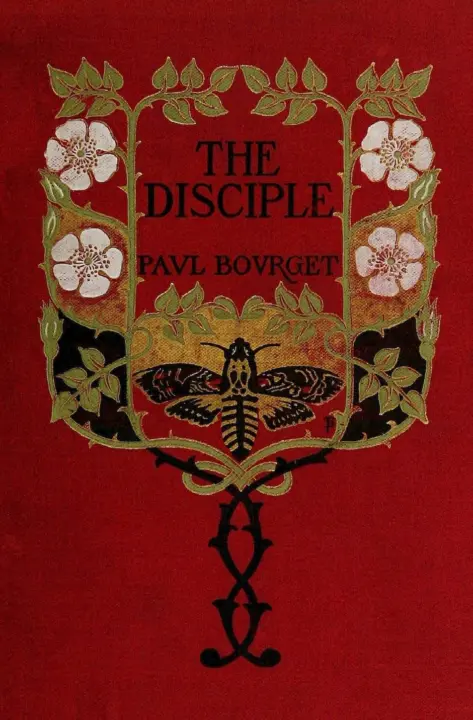
The disciple
Paul Bourget
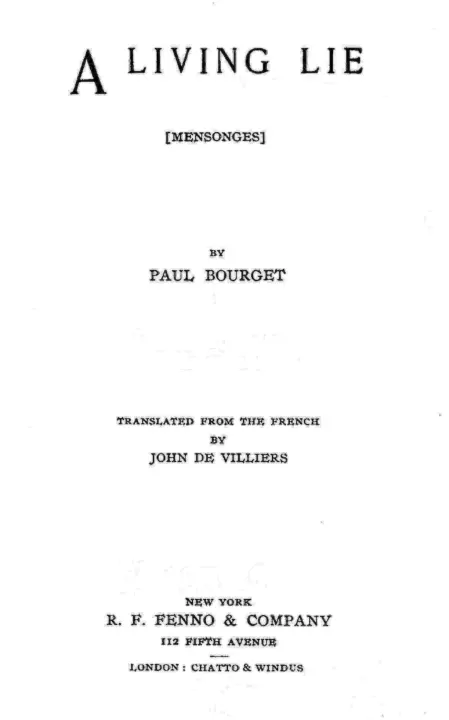
THE CLASSIC COLLECTION · 1896
"A Living Lie" by Paul Bourget is a novel written in the late 19th century. The story delves into the complexities of Parisian society, exploring themes of ambition, self-deception, and the intricate dynamics of human relationships. Central to the narrative are two writers: Claude Larcher, who navigates the world of high society with a mix of cynicism and introspection, and René Vincy, a young poet on the cusp of success seeking acceptance and validation in a glamorous yet superficial world. The beginning of the novel introduces Claude Larcher, a seasoned writer reflecting on his past and present as he journeys through a quaint corner of Paris to attend a soirée hosted by the fashionable Comtesse Komof. He is on his way to fetch René Vincy, his young colleague who has just achieved sudden fame with his play "Sigisbée." As Claude arrives at René's modest home, the narrative reveals the tension between their contrasting lives; Claude, a man deeply entrenched in society's frivolities, grapples with feelings of emptiness, while René's naiveté exposes him to the alluring dangers of their literary ambitions. The opening sets the stage for a poignant exploration of the interplay between artistic aspirations and societal expectations.
Introduction adapted from the source catalogue; source summaries may be automatically generated.
Free to read · English · 107,662 words · No account needed
MAKE TIME FOR A GOOD BOOK
On by default. Untick to stop anonymous reading totals. Each page counts after 10 seconds in view. How this works.
Anonymous counting is on unless you have switched it off.
The image of his mistress had probably flashed across Claude's brain, and the happy frame of mind called forth by his last visit had immediately yielded to sudden rage--rage which he would have satisfied at that moment by no matter what outrageous paradox. He fell headlong into the trap laid for him by his friend, and, grasping the arm of the latter tightly, he said with a sickly laugh: 'What has she been doing to-day? . . . Are you anxious to know the depth of this keen analyst of women's hearts, this subtle psychologist as the papers call me, this unmitigated ass as I call myself? Alas! my wits have never served for aught else than to convince me of my folly! . . . Have I told you,' he added, dropping his voice, 'that I have grown to be jealous of Salvaney? . . . I forgot, you don't know Salvaney--an up-to-date gallant who goes about his love affairs cheque-book in hand! . . . With a nose like a beetroot, a bald pate, eyes starting from their sockets, and a colour like a drover! . . . But there you are--he is an anglomane, anglomane to such an extent that the Prince of Wales is a Frenchman by the side of him. . . . Last year he spent three months in Florence, and I myself heard him boast that in those three months he had never worn a shirt that had not been washed in London. You must take my word for it that in Society, which has such a fascination for you, one fact like that gives a man more prestige than if he had written the "Nabab" or "L'Assommoir." Well! this individual pleases Colette. He is to be found in her dressing-room as often as I am, and gazes at her with his whisky-drinker's eyes. It was he who introduced the custom of going to a bar filled with jockeys and bookmakers, in order to sip most abominable spirits after the Opera; I will take you there some evening, and you will see the beauty for yourself. . . . Colette lets him take her even there, and goes about everywhere with him in a brougham. . . . "Get out!" she says, "you are not going to be jealous of a man like that, are you? He smells of gin, to begin with." . . . Such women will tell you these things without any ado, and pull to pieces in the most shameless manner their lovers of yesterday. . . . To cut a long story short, I was at her house this morning. Yes, yes--I knew all about these things, but I didn't believe them. A fellow like Salvaney! If you were to see him you would understand how incredible it seems, and as for her--well, you know her with that soft look in her eyes, with her mouth à la Botticelli and her exquisite grace. What a pity it seems! Well, I was with her when the servant, a fresh importation, who didn't know her business, brought a letter in, saying, "It's from Monsieur Salvaney--his man is waiting for an answer." In one of her fits of affection Colette had just sworn to me that nothing, absolutely nothing, not even the shadow of a shade of a flirtation had ever passed between them. As she held the letter in her hand I was foolish enough to think, "She is going to show me the letter, and I shall have written proofs that she has not told me a lie--and proof positive, for Salvaney could not have known that I should see this letter." She held the letter in her hand, and, looking at me, said to the girl, "Very well, I'll answer it at once. You will excuse me, won't you?" she added, passing into the other room--with her letter! I suppose you think I took my hat and stick and left the house for good with an oath on my lips? No, I stayed, mon cher ami. She came back, rang the bell, gave the servant a note, and then, coming towards me, said, "Are you angry?" Silence on my part. "Did you want to read that letter?" I was still silent. "No, you sha'n't read it," she continued, with a pretty little frown; "I have burnt it. He only asked for the pattern of some stuff for a fancy dress; but I want you to believe me on my bare word." All this was said as coolly as possible; I have never seen her act better. Don't ask me what I said in reply. I treated her as the vilest thing on earth. I flung into her teeth all the disgust, hatred, and contempt I felt for her; and then, as she sat there sobbing, I took her in my arms, and on the very spot where she had lied to me, and I had treated her like the common thing she was, we kissed and made it up. Do you think I have fallen low enough?'
Your reading position is saved on this browser. Take it to another device with a library code. Reading pages adapt to text, rather than matching a printed edition.
Paul Bourget
Paul Bourget
Paul Bourget

Paul Bourget
BEHIND THE BOOK
This eBook is for the use of anyone anywhere in the United States and most other parts of the world at no cost and with almost no restrictions whatsoever. You may copy it, give it away or re-use it under the terms of the Project Gutenberg License included with this eBook or online at www.gutenberg.org. If you are not located in the United States, you will have to check the laws of the country where you are located before using this eBook. Read the source licence.
The original source file, including credits and licence, is retained by this library. Request an original-format copy at no charge. Please include the book title and Project Gutenberg identifier #65887.
KEEP YOUR CURIOSITY GOING
Coulson Kernahan

Maurice Baring
Frances Wright
Cécile Tormay

Frederic Jesup Stimson

W. H. P. (William Henry Pope) Jarvis