Mighty Mikko: A Book of Finnish Fairy Tales and Folk Tales
Parker Fillmore
THE CLASSIC COLLECTION · 1911
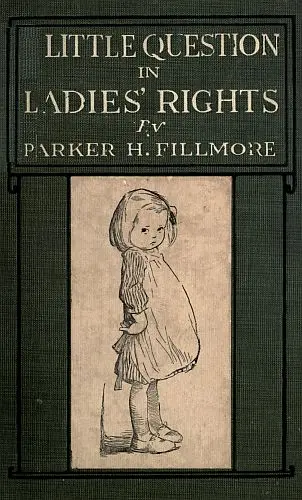
"A Little Question in Ladies' Rights" by Parker H. Fillmore is a humorous tale written in the early 20th century. This novella explores themes of childhood innocence, gender dynamics, and social class through the eyes of a young girl named Margery. The work is set in a typical American neighborhood, where the interactions between Margery, her friend Willie Jones, and their hired girl Effie showcase the nuances of their relationships and the intrigue of childhood adventures. The story revolves around Margery's reflections on the title of "hired girl" as she contemplates her companion Effie's role in her life. The narrative is largely driven by a series of events spurred by a bag of bananas Margery sneaks, leading to a colorful adventure with Willie, including blackberry picking and playful disputes over rights and ownership. Throughout the charming escapades, Margery comes to appreciate Effie's place in her life as more than just a servant and recognizes the complexities of social roles as she navigates her childhood friendships. Ultimately, the story leaves readers with insights into gender relations and the value of our connections with those we may overlook in their day-to-day roles.
Introduction adapted from the source catalogue; source summaries may be automatically generated.
Free to read · English · 9,336 words · No account needed
MAKE TIME FOR A GOOD BOOK
On by default. Untick to stop anonymous reading totals. Each page counts after 10 seconds in view. How this works.
Anonymous counting is on unless you have switched it off.
"Ha, ha! Don't you think I know 'em?" The 'em of Janet's acquaintance were, of course, Willie Jones and his kind. "Oh, I tell you, I know 'em just as well! They're all the same, every last one of them, always getting the best of us, and then going off by themselves and having a good time! I tell you, if I had my way, things'd be different! Oh, I tell you, if we'd all just get together and treat 'em like they ought to be treated, it--it--it--it'd be just good for 'em--it would!"
Of course, everything Janet said was gospel truth, and there was no gainsaying it; but even truth is sometimes depressing, and not the thing one wishes forever to have dinned into one's ears.
"And I know just as well as I know my own name, Margery, that now, after he's acted this way, he'll be coming back trying to make friends with you. You needn't tell me! I know him! But listen here, Margery, don't have a thing to do with him! Don't ever speak to him again, and pretend you don't even see him. He's not worth it--honestly he's not!"
When Margery parted from them later in the afternoon Janet made her solemnly promise that henceforward she would consider Willie Jones as dirt beneath her feet. It was neither the time nor the place for Margery to ask herself whether she really wished to make such a promise, for, in the presence of so fiery an apostle of female rights, her private inclinations simply shriveled to fine ashes and blew away.
"Of course," murmured Margery meekly, "of course I'll never speak to him
again."
"That's right!" Janet declared. "He don't deserve it."
"And say, Margery," Rosie O'Brien begged, in parting, "come down to East Maplewood again some afternoon, won't you? I start on my paper route at half past three--you know where. I'd love to have you come again."
"I'll come if I can, Rosie--honest, I will. Both of you have been just
as nice to me! Good-by."
Margery trudged homeward, feeling tired and a little down-hearted. Janet McFadden was entirely right: Willie Jones was a villain and a rogue. But, even so, wasn't it rather a pity to end things forever, after all the good times they had once had together? Dear, dear! In a maleless world, justice to ladies would no doubt prevail; but, alas, alas, in such a world the ladies who enjoy male society would probably feel a bit lonesome.
"Say, Margery, hold on a minute!"
The voice was unmistakable, but Margery did not turn her head.
"Say, Margery, I'm awfully sorry--honest, I am. I was only fooling."
Your reading position is saved on this browser. Take it to another device with a library code. Reading pages adapt to text, rather than matching a printed edition.
BEHIND THE BOOK
This eBook is for the use of anyone anywhere in the United States and most other parts of the world at no cost and with almost no restrictions whatsoever. You may copy it, give it away or re-use it under the terms of the Project Gutenberg License included with this eBook or online at www.gutenberg.org. If you are not located in the United States, you will have to check the laws of the country where you are located before using this eBook. Read the source licence.
The original source file, including credits and licence, is retained by this library. Request an original-format copy at no charge. Please include the book title and Project Gutenberg identifier #31451.
KEEP YOUR CURIOSITY GOING
Coulson Kernahan

Maurice Baring
Frances Wright
Cécile Tormay

Frederic Jesup Stimson

W. H. P. (William Henry Pope) Jarvis