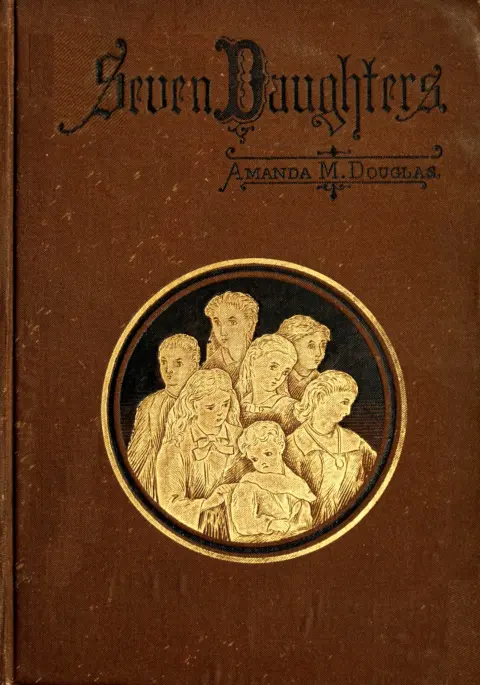
Seven daughters
Amanda M. Douglas
THE CLASSIC COLLECTION · 1903
"A Little Girl in Old St. Louis" by Amanda M. Douglas is a historical novel written in the early 20th century. The story revolves around a young girl named Renée de Longueville, who finds herself in the company of her grandfather in Old St. Louis after being brought over from France, where her life took a drastic turn following her mother’s death. The narrative showcases Renée's struggles to adapt to her new home, her longing for belonging, and her relationships with her uncle Gaspard Denys and other local characters. The opening of the novel introduces the reader to the rugged yet vibrant backdrop of Old St. Louis in the late 18th century. Renée's arrival, carried in by Gaspard after a long journey from Canada, sets the stage for her new life. The tension between Renée and her grandfather, who harbors a grudging acceptance of his granddaughter, begins to emerge as Gaspard's protective instincts come to the forefront. As the girl interacts with her new surroundings, including the local Indigenous community and the bustling market, the narrative hints at themes of family, identity, adaptation, and the complexity of human relationships in a developing frontier town. Through Renée's youthful perspective, readers are invited to experience her journey toward finding a place she can call home amidst the challenges that come with change.
Introduction adapted from the source catalogue; source summaries may be automatically generated.
Free to read · English · 91,988 words · No account needed
MAKE TIME FOR A GOOD BOOK
On by default. Untick to stop anonymous reading totals. Each page counts after 10 seconds in view. How this works.
Anonymous counting is on unless you have switched it off.
“I suppose it is being busy every day. At that time you know there was a
holiday between.”
“But there is no business now until spring opens,” in a pleading tone.
“Except for the householder, the shopkeeper. Oh, you have no idea how ingenious I have become. And the men drop in to talk over plans and berate the Governor because things are not in better shape. We would fare badly in an attack.”
“Are we in any danger from the British?”
“One can never tell. Perhaps they may take up Pontiac’s wild dream of driving us over the mountains into the sea. No,” with a short laugh, “I am not much afraid. And our Indians are friendly also.”
“Come, Barbe,” counselled Madame Renaud, but she took her husband’s arm and marched on ahead like an astute general.
Barbe clung closely to her attendant, for in some places it was
slippery.
“Next time you will transfer your attentions,” she said with a touch of regret. “I wonder who will be your queen for a night?”
“The prettiest girl,” he said gayly.
“Madame Marchand is beautiful.”
“But she is no longer a girl.”
“Oh, no. You see a good deal of her, though?”
“They are over often. We are excellent friends.”
“Renée is quite bewitched with her.”
“Yes, they are very fond of each other.”
And somehow she, Barbe, was no more fond of the child than the child was
of her.
Madame Renaud studied her sister’s face as they were unwinding their wraps. It was rather pale, not flushed and triumphant as she hoped.
Gaspared Denys stirred the fire in his shop and threw himself on a pile of skins and was asleep in five minutes. It had been a long while since he had danced all night.
They all slept late. There was no need of stirring early in the morning. They made no idol of industry, as the energetic settlers on the eastern coast did. Pleasure and happiness were enough for them. It ran in the French blood.
When Gaspard woke he heard a sound of an eager chattering voice. He rubbed his limbs and stretched himself, looked down on his red sash and then saw a withered red rose that he tossed in the fire.
“Ah, little one, you are as blithe as a bee,” was his greeting.
“Oh, Uncle Gaspard, you have on your ball clothes. When did you come
home?” she asked.
“I dropped asleep in them. I am old and stiff this morning. I tumbled down on a pile of skins and stayed there.”
“You don’t look very old. And—are you a king now?” rather curiously.
Your reading position is saved on this browser. Take it to another device with a library code. Reading pages adapt to text, rather than matching a printed edition.
Amanda M. Douglas

Amanda M. Douglas
Amanda M. Douglas
Amanda M. Douglas
BEHIND THE BOOK
This eBook is for the use of anyone anywhere in the United States and most other parts of the world at no cost and with almost no restrictions whatsoever. You may copy it, give it away or re-use it under the terms of the Project Gutenberg License included with this eBook or online at www.gutenberg.org. If you are not located in the United States, you will have to check the laws of the country where you are located before using this eBook. Read the source licence.
The original source file, including credits and licence, is retained by this library. Request an original-format copy at no charge. Please include the book title and Project Gutenberg identifier #41526.
KEEP YOUR CURIOSITY GOING
Cécile Tormay

Moritz Busch
Coulson Kernahan
John L. Ransom

Maurice Baring
Frances Wright