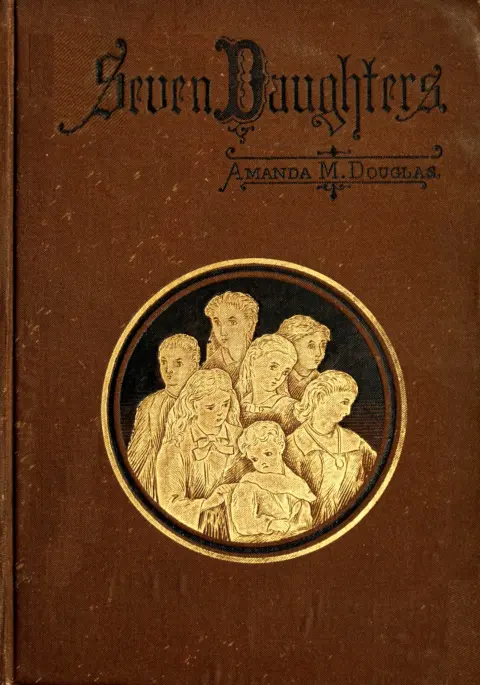
Seven daughters
Amanda M. Douglas
THE CLASSIC COLLECTION · 1903
"A Little Girl in Old St. Louis" by Amanda M. Douglas is a historical novel written in the early 20th century. The story revolves around a young girl named Renée de Longueville, who finds herself in the company of her grandfather in Old St. Louis after being brought over from France, where her life took a drastic turn following her mother’s death. The narrative showcases Renée's struggles to adapt to her new home, her longing for belonging, and her relationships with her uncle Gaspard Denys and other local characters. The opening of the novel introduces the reader to the rugged yet vibrant backdrop of Old St. Louis in the late 18th century. Renée's arrival, carried in by Gaspard after a long journey from Canada, sets the stage for her new life. The tension between Renée and her grandfather, who harbors a grudging acceptance of his granddaughter, begins to emerge as Gaspard's protective instincts come to the forefront. As the girl interacts with her new surroundings, including the local Indigenous community and the bustling market, the narrative hints at themes of family, identity, adaptation, and the complexity of human relationships in a developing frontier town. Through Renée's youthful perspective, readers are invited to experience her journey toward finding a place she can call home amidst the challenges that come with change.
Introduction adapted from the source catalogue; source summaries may be automatically generated.
Free to read · English · 91,988 words · No account needed
MAKE TIME FOR A GOOD BOOK
On by default. Untick to stop anonymous reading totals. Each page counts after 10 seconds in view. How this works.
Anonymous counting is on unless you have switched it off.
So that night Renée slipped out from the supper table and sped like a little sprite along the Rue Royale, and then up the Rue de Rive. The moon was coming over the river with a pale light, as if she was not quite ready for full burning. She heard the sounds of hammering, and rushed in the open doorway.
“Well, little one! Your eyes are so bright that if you were an Indian girl I should call you Evening Star.”
“I wanted to see you so,” in a breathless fashion.
“What has happened?”
“Why, nothing. Only the day seemed so long.”
“You went to the father’s?”
“Oh, yes,” rather indifferently.
“Why didn’t you run over then? You might have taken supper with me.”
“Because—there were Elise and Sophie.”
“But there was supper enough to go round. We had some fine broiled fish. Mère Lunde is an excellent cook.”
“Oh, when can I come to stay?” Her tone was full of entreaty, and her eyes soft with emotion.
“But—you won’t have any little girls to play with.”
“I don’t want any one but you.”
He had paused from his work, and now she sprang to him and encircled him as far as she could with her small arms.
“You are not homesick?” It would be strange, indeed, since she had never
had a true home.
“I don’t know. That,” giving her head a turn, “is not my real home.”
“Oh, no. But they have all been good to you. Ma’m’selle Barbe is very
fond of you.”
“Oh, everybody is good and kind. Even Louis, though he teases. And Père Renaud. But not one of them is you—you.”
“My little girl!” He stooped over and hugged her, kissed her fondly. The child’s love was so innocent, so sincere, that it brought again the hopes of youth.
“And you will always keep me—always?” There was a catch in her breath
like a sob.
“Why, yes. What has any one said to you?” with a slight touch of
indignation.
“Sophie said you were not my own uncle. What would make you so? Can you
never be?”
There was a pathos in her tone that touched him to the heart, even as he smiled at her childish ignorance, and was wild to have the past undone.
“My dear, you can hardly understand. I must have been your mother’s
brother.”
“Oh, then you would have belonged to that hateful old man!” and she gave her foot a quick stamp. “No, I should not want you to.”
Your reading position is saved on this browser. Take it to another device with a library code. Reading pages adapt to text, rather than matching a printed edition.
Amanda M. Douglas
Amanda M. Douglas
Amanda M. Douglas
Amanda M. Douglas
BEHIND THE BOOK
This eBook is for the use of anyone anywhere in the United States and most other parts of the world at no cost and with almost no restrictions whatsoever. You may copy it, give it away or re-use it under the terms of the Project Gutenberg License included with this eBook or online at www.gutenberg.org. If you are not located in the United States, you will have to check the laws of the country where you are located before using this eBook. Read the source licence.
The original source file, including credits and licence, is retained by this library. Request an original-format copy at no charge. Please include the book title and Project Gutenberg identifier #41526.
KEEP YOUR CURIOSITY GOING
Cécile Tormay

Moritz Busch
Coulson Kernahan
John L. Ransom

Maurice Baring
Frances Wright