THE CLASSIC COLLECTION✦Hurrell Froude: Memoranda and CommentsCLASSIC FREE BOOKS
Hurrell Froude: Memoranda and Comments
Louise Imogen Guiney
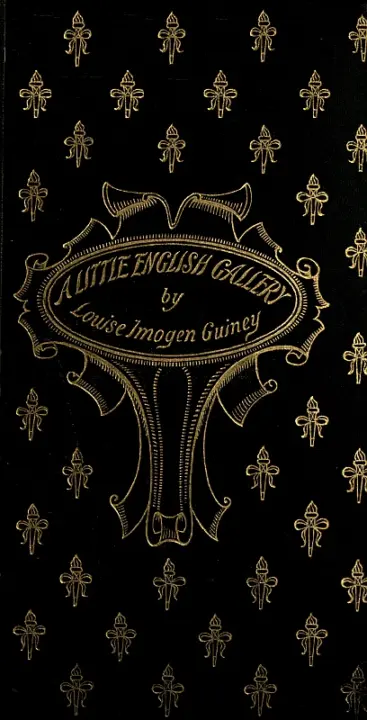
THE CLASSIC COLLECTION · 1894
"A Little English Gallery" by Louise Imogen Guiney is a collection of biographical sketches written in the late 19th century. It explores the lives and contributions of notable figures from English history, focusing on their literary and cultural significance. Through her detailed portraits, Guiney aims to illuminate the legacy of these individuals, particularly women who have made lasting impacts on literature. The opening of the book introduces Lady Danvers, a significant figure of the late 16th and early 17th centuries, highlighting her connections with prominent literary figures such as John Donne and her son, poet George Herbert. The narrative delves into her life as a mother and her role in supporting and guiding her children, emphasizing her virtuous character and influence. Guiney provides a comprehensive view of Lady Danvers's lineage, personal attributes, and legacy, establishing her as a figure worthy of remembrance in English literary history.
Introduction adapted from the source catalogue; source summaries may be automatically generated.
Free to read · English · 51,651 words · No account needed
MAKE TIME FOR A GOOD BOOK
On by default. Untick to stop anonymous reading totals. Each page counts after 10 seconds in view. How this works.
Anonymous counting is on unless you have switched it off.
It is very difficult to be severe with William Hazlitt, who was towards himself so outspokenly severe. Every stricture upon him, as well as every defence to be urged for it, may be taken out of his own mouth. Even the Liber Amoris, as must always have been discerned, demonstrates not only his weakness, but his essential uprightness and innocence. His vindication is written large in Depth and Superficiality, in The Pleasures of Hating, in The Disadvantage of Intellectual Superiority. His “true Hamlet” is as faithful a sketch of the author as is Newman’s celebrated definition of a gentleman. Hazlitt says a tender word for Dr. Johnson’s prejudices which covers and explains many of his own. Who can call him irritable, recalling the splendid exposition of merely selfish content, in the opening paragraphs of the essay on Good Nature? Yet, with all his lofty and endearing qualities, he had a warped and soured mind, a constitutional disability to find pleasure in persons or in conditions which were quiescent. He would have every one as mettlesome and gloomily vigilant as he was himself. His perfectly proper apostrophe to the lazy Coleridge at Highgate to “start up in his promised likeness, and shake the pillared rottenness of the world,” is somewhat comic. Hazlitt’s nerves never lost their tension; to the last hour of his last sickness he was ready for a bout. Much of his personal grief arose from his refusal to respect facts as facts, or to recognize in existing evil, including the calamitous perfumed figure of Turveydrop gloriously reigning, what Vernon Lee calls “part of the mechanism for producing good.” He bit at the quietist in a hundred ways, and with choice venom. “There are persons who are never very far from the truth, because the slowness of their faculties will not suffer them to make much progress in error. These are ‘persons of great judgment.’ The scales of the mind are pretty sure to remain even when there is nothing in them.” He was a natural snarler at sunshiny people with full pockets and feudal ideas, like Sir Walter, who got along with the ogre What Is, and even asked him to dine. In fact, William Hazlitt hated a great many things with the utmost enthusiasm, and he was impolite enough to say so, in and out of season. The Established Church and all its tenets and traditions were only less monstrous in his eyes than legendry, mediævalism, and “the shoal of friars.” He knew, from actual experience, the loyalty and purity of the early Unitarians, and he praised these with all his heart and tongue. As far as one can make out, he had not the remotest conception of the breadth and texture of Christianity as a whole. His theory, for he practised no creed except the cheap one of universal dissent, was a faint-colored local Puritanism; and that, as the Merry Monarch (an excellent judge of what was not what!) reminds us, is “no religion for a gentleman.” But more than this, Hazlitt had no apprehension of the supernatural in anything; he was very unspiritual. It is curious to see how he sidles away from the finer English creatures whom he had to handle. Sidney almost repels him, and he dismisses Shelley, on one occasion, with an inadequate but apt allusion to the “hectic flutter” of his verse. Living in a level country with no outlook upon eternity, and no deep insight into the human past, nor fully understanding those who had wider vision and more instructed utterance than his own, it follows that beside such men as those just named, then as now, Hazlitt has a crude villageous mien. He had his refined sophistications; chief among them was a surpassing love of natural beauty. But he relished, on the whole, the beef and beer of life. The normal was what he wrote of with “gusto”; a word he never tired of using, and which one must use in speaking of himself. While he is an admirable arbiter of what is or is not truly intellectual, he is all at sea when he has to discuss, for instance, emotional poetry, or, what is yet more difficult to him, poetry purely poetic; its inevitable touch of the fantastic, the mystical, puts his wits completely to rout. The stern, lopsided, and magnificent article on Shelley’s Posthumous Poems in the Edinburgh Review for July, 1824, and his impatience with Coleridge at his best, perfectly exemplify this limitation. Despite his partiality for Rousseau and certain of the early Italian painters, most of the men whose genius he seizes upon and exalts with unerring success are the men who display, along with enormous acumen and power, nothing which betokens the morbid and exquisite thing we have learned to call modern culture. Hazlitt, fortunately for us, was not over-civilized, had no cinque-cento instincts, and would have groaned aloud over such hedonism as Mr. Pater’s. Homespun and manly as he is, who can help feeling that his was but an imperfect development? that, as Mr. Arnold said so paternally of Byron, “he did not know enough”? He lacked both mental discipline and moral governance. He has the wayward and appealing Celtic utterance; the manner made of largeness and simpleness, all shot and interwoven with the hues of romanticism. Prodigal that he is, he cannot stoop to build up his golden piecemeal, or to clinch his generalizations, thrown down loosely, side by side. Esoteric thrift is not in him, nor the spirit of co-operation, nor the sweetest of artistic anxieties, that of marching in line. He has a knight-errant pen; his glad and chivalrous services to literature resemble those of an outlaw to the commonwealth. Despite his personal value, he stands detached; he is episodic, and represents nothing.
Your reading position is saved on this browser. Take it to another device with a library code. Reading pages adapt to text, rather than matching a printed edition.
Louise Imogen Guiney
Louise Imogen Guiney
Louise Imogen Guiney

Louise Imogen Guiney
BEHIND THE BOOK
This eBook is for the use of anyone anywhere in the United States and most other parts of the world at no cost and with almost no restrictions whatsoever. You may copy it, give it away or re-use it under the terms of the Project Gutenberg License included with this eBook or online at www.gutenberg.org. If you are not located in the United States, you will have to check the laws of the country where you are located before using this eBook. Read the source licence.
The original source file, including credits and licence, is retained by this library. Request an original-format copy at no charge. Please include the book title and Project Gutenberg identifier #54219.
KEEP YOUR CURIOSITY GOING
Cécile Tormay

Moritz Busch
John L. Ransom
Frances Wright
Cécile Tormay

Mabel Potter Daggett