THE CLASSIC COLLECTION✦Hurrell Froude: Memoranda and CommentsCLASSIC FREE BOOKS
Hurrell Froude: Memoranda and Comments
Louise Imogen Guiney
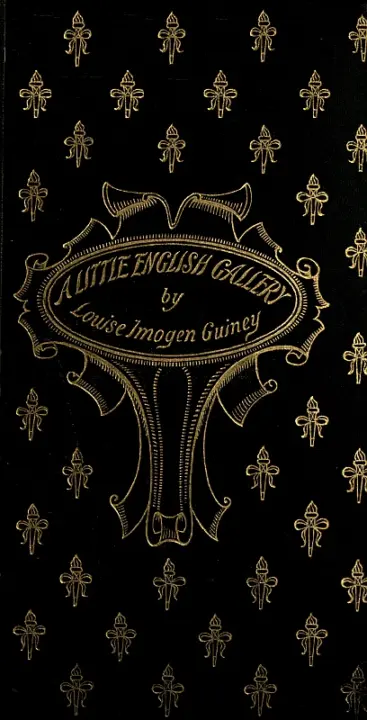
THE CLASSIC COLLECTION · 1894
"A Little English Gallery" by Louise Imogen Guiney is a collection of biographical sketches written in the late 19th century. It explores the lives and contributions of notable figures from English history, focusing on their literary and cultural significance. Through her detailed portraits, Guiney aims to illuminate the legacy of these individuals, particularly women who have made lasting impacts on literature. The opening of the book introduces Lady Danvers, a significant figure of the late 16th and early 17th centuries, highlighting her connections with prominent literary figures such as John Donne and her son, poet George Herbert. The narrative delves into her life as a mother and her role in supporting and guiding her children, emphasizing her virtuous character and influence. Guiney provides a comprehensive view of Lady Danvers's lineage, personal attributes, and legacy, establishing her as a figure worthy of remembrance in English literary history.
Introduction adapted from the source catalogue; source summaries may be automatically generated.
Free to read · English · 51,651 words · No account needed
MAKE TIME FOR A GOOD BOOK
On by default. Untick to stop anonymous reading totals. Each page counts after 10 seconds in view. How this works.
Anonymous counting is on unless you have switched it off.
In the winter of 1785, Langton came from the country, and took lodgings in Fleet Street, in order to sit beside Johnson as he lay dying, and hold his hand. Nor was he alone in his pious offices: the Hooles, Mr. Sestre, and several others were there, to keep constant vigil. Miss Burney met Langton in the passage December 11th, two days before the end: “He could not,” she wrote in her journal, “look at me, nor I at him.” But through the foggy and restless nights when Johnson tried to cheer himself, like More and Master William Lilly, by translating into Latin some epigrams from the Anthologia, the true Grecian beside him must have been his chief comfort. One can picture the old eyes turning to him for sympathy, perhaps with that same murmured “Lanky!” on awaking, which Boswell laughed to hear from him one merry Hebridean morning, twelve years before. The last summons did not come in Langton’s presence. Hurrying over to Bolt Court at eight of the fatal evening, he was told that all was over three-quarters of an hour ago. That large soul had gone away, as Leigh Hunt so beautifully said of Coleridge, “to an infinitude hardly wider than his thoughts.” Then Langton, who was wont to shape his words with grace and ease, went up-stairs, and tried to pen a letter to Boswell, which is more touching than tears: “I am now sitting in the room where his venerable remains exhibit a spectacle, the interesting solemnity of which, difficult as it would be in any sort to find terms to express, so to you, my dear sir, whose sensations will paint it so strongly, it would be of all men the most superfluous to”—and there, hopelessly choked and confused, it broke off.
Langton bore Johnson’s pall; and he succeeded him as Professor of Ancient Literature in the Royal Academy, as Gibbon had replaced Goldsmith in the chair of Ancient History. He survived many years, the delight of his company to the last. He, like others, was given in his later years to detailing anecdotes of his great friend, with an approximation to that friend’s manner. One lady critic, at least, thought that these explosive imitations did not become “his own serious and respectable character.” On December 18, 1801, in Anspach Place, Southampton, a venerable nook “between the walls and the sea,” when Wordsworth, Scott, and Coleridge were yet in their unheralded prime, when Charles Lamb was twenty-six, Byron a dreaming boy on the Cotswold hills, and Keats and Shelley little fair-eyed children, gentle Bennet Langton, known to none of these, and somewhat forgotten as a loiterer from the march of a glorious yesterday, slipped out of life. “I am persuaded,” wrote one who knew him well, “that all his inactivity, all the repugnance he showed to putting on the harness of this world’s toil, arose from the spirituality of his frame of mind . . . I believe his mind was in Heaven, wheresoever he corporeally existed.” He was laid under the chancel of ancient St. Michael’s at Southampton, with Johnson’s fond benison, “Be my soul with Langton’s!” inscribed on the marble tablet above him.[57] The Rev. John Wooll of Midhurst, Joseph Warton’s editor, was one of the few present at the funeral ceremony, and he leaves us to infer that it had a rather neglectful privacy, not, indeed, out of keeping with the “godly, righteous, and sober life” it closed. Langton’s will, drawn up in the June of 1800, and preserved in Somerset House, devised to the sole executrix, his “dear wife,” who outlived him by nearly twenty years, his real and personal estate, his books, his wines, his prints, his horses, and, as a gift particularly pretty, his right of navigation in the river Wey. George Langton was separately provided for, but there were some £8000 for the eight younger children. The document is crowded with technical details, and very long; and the manifest inference, on the whole, is that the dear squire’s affairs were in a prodigious tangle. There is no wish expressed concerning his burial, and, what is more curious, there are no Christian formulas for the committal of the animula vagula blandula: a lack perhaps not to be wondered at in Beauclerk’s concise testament, but somewhat notable in the case of a person who certainly had a soul.
Your reading position is saved on this browser. Take it to another device with a library code. Reading pages adapt to text, rather than matching a printed edition.
Louise Imogen Guiney
Louise Imogen Guiney
Louise Imogen Guiney

Louise Imogen Guiney
BEHIND THE BOOK
This eBook is for the use of anyone anywhere in the United States and most other parts of the world at no cost and with almost no restrictions whatsoever. You may copy it, give it away or re-use it under the terms of the Project Gutenberg License included with this eBook or online at www.gutenberg.org. If you are not located in the United States, you will have to check the laws of the country where you are located before using this eBook. Read the source licence.
The original source file, including credits and licence, is retained by this library. Request an original-format copy at no charge. Please include the book title and Project Gutenberg identifier #54219.
KEEP YOUR CURIOSITY GOING
Cécile Tormay

Moritz Busch
John L. Ransom
Frances Wright
Cécile Tormay

Mabel Potter Daggett