THE CLASSIC COLLECTION✦Hurrell Froude: Memoranda and CommentsCLASSIC FREE BOOKS
Hurrell Froude: Memoranda and Comments
Louise Imogen Guiney
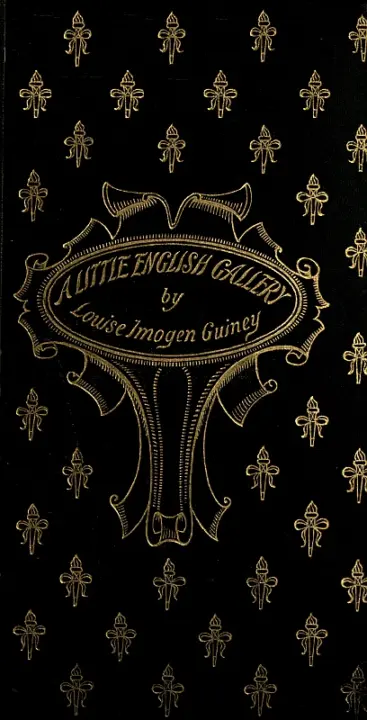
THE CLASSIC COLLECTION · 1894
"A Little English Gallery" by Louise Imogen Guiney is a collection of biographical sketches written in the late 19th century. It explores the lives and contributions of notable figures from English history, focusing on their literary and cultural significance. Through her detailed portraits, Guiney aims to illuminate the legacy of these individuals, particularly women who have made lasting impacts on literature. The opening of the book introduces Lady Danvers, a significant figure of the late 16th and early 17th centuries, highlighting her connections with prominent literary figures such as John Donne and her son, poet George Herbert. The narrative delves into her life as a mother and her role in supporting and guiding her children, emphasizing her virtuous character and influence. Guiney provides a comprehensive view of Lady Danvers's lineage, personal attributes, and legacy, establishing her as a figure worthy of remembrance in English literary history.
Introduction adapted from the source catalogue; source summaries may be automatically generated.
Free to read · English · 51,651 words · No account needed
MAKE TIME FOR A GOOD BOOK
On by default. Untick to stop anonymous reading totals. Each page counts after 10 seconds in view. How this works.
Anonymous counting is on unless you have switched it off.
“Queens hereafter shall be glad to live
Upon the alms of thy superfluous praise.”
Yet in these eulogies, as in most of the graver contemporaneous poems of the sort, there is little personality to be detected; the homage has rather a floating outline, an unapproaching music, exquisite and awed. Donne gives, sometimes, the large Elizabethan measure:
“Is there any good which is not she?”
In the so-called Elegy, The Autumnal, written on leaving Oxford, he starts off with a well-known cherishable strophe:
“No spring nor summer beauty hath such grace
As I have seen in one autumnal face.”
The entire poem is a monody on the encroachments of years, and neatly
chronological:
“If we love things long-sought, age is a thing
Which we are fifty years in compassing;
If transitory things, which soon decay,
Age must be loveliest at the latest day.”
It strikes the modern ear as maladroit enough that a woman in her yet sunshiny forties, and a most comely woman to boot, should have required prosody’s ingenious excuses for wrinkles and kindred damages. Was life so hard as that in “the spacious days”? Shakespeare, in agreement with Horace, had already reminded his handsome “Will” of the pitiless and too expeditious hour,
“When forty winters shall besiege thy brow, And dig deep trenches in thy beauty’s field!”
which also seems, to a nice historical sense, somewhat staggering. The close of Donne’s little homily is perfect, and full of the winning melancholy which was part of his birthright in art, whenever he allowed himself direct and homely expression:
“May still
My love descend! and journey down the hill,
Not panting after growing beauties; so
I shall ebb on with them who homeward go.”
Such was John Donne’s first known tribute to his friend. She must have been early and thoroughly familiar with his manuscripts, which were passed about freely, Dr. Grosart thinks, prior to 1613, and which burned what Massinger would call “no adulterate incense” to herself. Her bays are to be gleaned off many a tree, and she must have cast a frequent influence on Donne’s work, which is not traceable now. He seems to have had a Crashaw-like devotion to the Christian saint whose inheritance
“Bethina was, and jointure Magdalo,”
not unconnected with the fact that some one else was Magdalen also; never does he tire of dwelling on the coincidence and the difference. In one of his quaintly moralizing songs, he goes seeking a “true-love” primrose, where but on Montgomery Hill! for he is hers, by all chivalrous tokens, as much as he may be. Again he cites, and almost with humor:
“that perplexing eye
Which equally claims love and reverence.”
Your reading position is saved on this browser. Take it to another device with a library code. Reading pages adapt to text, rather than matching a printed edition.
Louise Imogen Guiney
Louise Imogen Guiney
Louise Imogen Guiney

Louise Imogen Guiney
BEHIND THE BOOK
This eBook is for the use of anyone anywhere in the United States and most other parts of the world at no cost and with almost no restrictions whatsoever. You may copy it, give it away or re-use it under the terms of the Project Gutenberg License included with this eBook or online at www.gutenberg.org. If you are not located in the United States, you will have to check the laws of the country where you are located before using this eBook. Read the source licence.
The original source file, including credits and licence, is retained by this library. Request an original-format copy at no charge. Please include the book title and Project Gutenberg identifier #54219.
KEEP YOUR CURIOSITY GOING
Cécile Tormay

Moritz Busch
John L. Ransom
Frances Wright
Cécile Tormay

Mabel Potter Daggett