THE CLASSIC COLLECTION✦Hurrell Froude: Memoranda and CommentsCLASSIC FREE BOOKS
Hurrell Froude: Memoranda and Comments
Louise Imogen Guiney
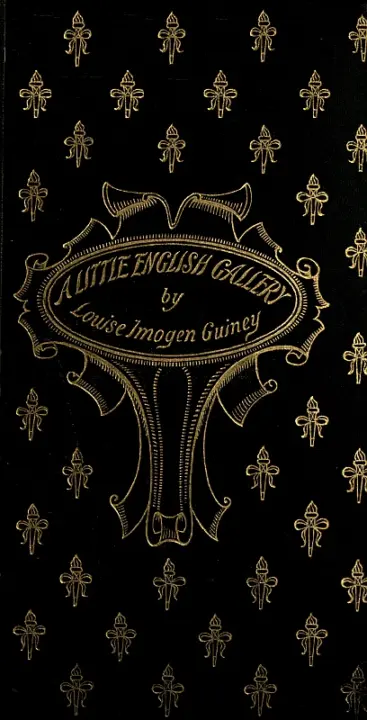
THE CLASSIC COLLECTION · 1894
"A Little English Gallery" by Louise Imogen Guiney is a collection of biographical sketches written in the late 19th century. It explores the lives and contributions of notable figures from English history, focusing on their literary and cultural significance. Through her detailed portraits, Guiney aims to illuminate the legacy of these individuals, particularly women who have made lasting impacts on literature. The opening of the book introduces Lady Danvers, a significant figure of the late 16th and early 17th centuries, highlighting her connections with prominent literary figures such as John Donne and her son, poet George Herbert. The narrative delves into her life as a mother and her role in supporting and guiding her children, emphasizing her virtuous character and influence. Guiney provides a comprehensive view of Lady Danvers's lineage, personal attributes, and legacy, establishing her as a figure worthy of remembrance in English literary history.
Introduction adapted from the source catalogue; source summaries may be automatically generated.
Free to read · English · 51,651 words · No account needed
MAKE TIME FOR A GOOD BOOK
On by default. Untick to stop anonymous reading totals. Each page counts after 10 seconds in view. How this works.
Anonymous counting is on unless you have switched it off.
In 1702, Farquhar issued a charming and little-known miscellany, called Love and Business, “a collection of occasionary verse and epistolary prose.” The poetic exercises are of small importance; but the other data (which survive as a hindrance, rather than as a help, to biographers) come near being of very definite value. All manner of futile guesses have been expended upon the identification of his Penelope. It is given to no mouser to name her with certainty; but, despite the gossip of the greenroom, now as ever too ready to weave romances about the name of George Farquhar, internal evidence is strongly against her having been Anne Oldfield. Yet this is the supposition of most of his editors. Commenting upon one passage touching some villanous stratagem from which Farquhar says he was able to rescue a friend in the Low Countries, a friend with whom he afterwards condoles upon a robbery she had undergone, Leigh Hunt adds that this may have been the woman whom Farquhar subsequently made his wife. A widow, whose Christian name was Margaret, but of whom we know so little else that we cannot say whether she was English, or whether her age considerably exceeded his, conceived a passionate attachment for him, and managed to have it represented to him from several quarters not only that she was kindly disposed towards him, but that it would be well for his opening career if he should seek her hand, as she had estates and revenues. Eventually, after we know not what hesitations natural to a fastidious temperament, he proposed to her and was accepted, and it soon transpired that the bride was quite as penniless as himself. Hunt does not follow out his own hint in the matter of the robbery, though the question, when carefully considered, has a vital import. If the victim were indeed the lady whom Farquhar married later, and if she were indeed robbed, it should signify that she must then have been possessed of some wealth, so that the report given to Farquhar could not have been, up to that time at least, a lie. On the other hand, casuists must decide whether, again in the event of the victim having been correctly identified by Hunt, the robbery itself may not have been an invention meant, after Farquhar had declared his allegiance, to quicken his sympathy, and to soften the coming revelation that the robbery could never have resulted, owing to a defect in the premises! There is very much else about the Letters which is confusing and inconsistent. They are so disconnected, and they vary so in tone and manner, as to suggest a doubt whether, if not altogether imaginary, they could have been meant for any one person. A lady is announced as having returned them for publication; she dresses in mourning, and resides now on the Continent, now in London or in the country; her suitor very explicitly states that he had long solicited in vain the honor of her hand; and, in the end, with farewells and an abrupt and unexplained severing, he gives up the quest, with his own admission that he has lost her and that her heart “had no room for him.” Now that the recipient of this correspondence, Anne Oldfield or another, should have returned it for commercial purposes, not having been won by the very real passion exhibited in parts of it, seems somewhat peculiar; but to accept as fact that Farquhar himself actually asked these letters back from her, and printed them as they stood, is, under the conditions, absurd, and irreconcilable with our knowledge of his character from other and prior sources. Hunt further suggests that the Miscellany was gathered together in some press of pecuniary trouble; and its title, indeed, may hint at a whimsical expectation that Love, being harnessed and sent abroad to arouse curiosity among readers, may return in the way of Business to headquarters. But Farquhar, in his bachelor days, had a fair income, and would not have been so likely to hear the wolf at the door as he was later, when that sound would awake in him a dread not ominous to himself alone. It is possible that the undiscovered register of his marriage bears the date of 1702 or even of 1701; if it were so, that might explain the issue of his only book not in dramatic dress, and the emergency which called it forth. It is difficult indeed to suppose, although modern delicacy in these matters was just then a somewhat unknown quantity, that we have between its covers genuine love-letters hot from the pen. Steele, of an August morning nine years later, inserted in The Spectator as the communication of a third person, six of his own notes to his comely and noble fiancée, Mary Scurlock. But Farquhar had not Steele’s earnestness and love of circumstantial truth, nor his zest for pointing a moral. Or was this publication the sort of thing he would be likely, for a not unworthy purpose, to do? Was he, in reality, a shade more obtuse and misguided than Miss Fanny Brawne? Rather let us believe the Letters a work of fiction, and only founded largely upon various bygone moods and incidents of the foregoing two years, which for one reason or another might interest buyers. Such is the description to “dear Sam” of Dryden’s erratic funeral, which is almost too keenly rhetorical a summing-up to have been written the next day, or the thoughtful and sensible surveys of the Dutch. The amatory epistles, with their leaven of reality, are presumably edited out of all recognition. They make no defined impression; they do not move forward; they veil impenetrably the traits of the person addressed, who is made to appear as a vanishing unrelenting goddess, deaf and blind to George Farquhar pleading his best. Whatever were the facts, the report of them is chivalrous. Assume for a moment that his wife stands behind the whole of this correspondence, or even behind the latter part of it, and what seemed to constitute a little betrayal in the very worst taste turns out to be an innocent joke. Of course the “lady” (or one of the ladies) lent the manuscripts to the printers; of course Farquhar originated, in order to give color to Mistress Farquhar’s known pretence of riches, and their joint subsequent poverty, the magnificent thieving practised upon the never-thieved and the unthievable! One can fancy them both, in their hard chairs in the bare room, laughing well and long, between tears of anxious hope that the more personal element in the Miscellany might fetch them from the Covent Garden book-stalls a parcel of fagots and a dinner.
Your reading position is saved on this browser. Take it to another device with a library code. Reading pages adapt to text, rather than matching a printed edition.
Louise Imogen Guiney
Louise Imogen Guiney
Louise Imogen Guiney

Louise Imogen Guiney
BEHIND THE BOOK
This eBook is for the use of anyone anywhere in the United States and most other parts of the world at no cost and with almost no restrictions whatsoever. You may copy it, give it away or re-use it under the terms of the Project Gutenberg License included with this eBook or online at www.gutenberg.org. If you are not located in the United States, you will have to check the laws of the country where you are located before using this eBook. Read the source licence.
The original source file, including credits and licence, is retained by this library. Request an original-format copy at no charge. Please include the book title and Project Gutenberg identifier #54219.
KEEP YOUR CURIOSITY GOING
Cécile Tormay

Moritz Busch
John L. Ransom
Frances Wright
Cécile Tormay

Mabel Potter Daggett