THE CLASSIC COLLECTION✦Hurrell Froude: Memoranda and CommentsCLASSIC FREE BOOKS
Hurrell Froude: Memoranda and Comments
Louise Imogen Guiney
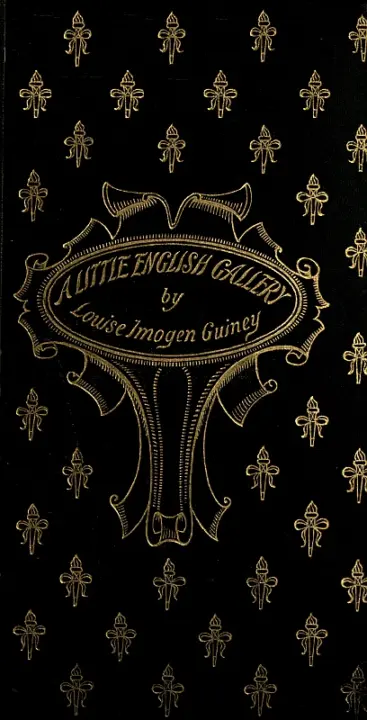
THE CLASSIC COLLECTION · 1894
"A Little English Gallery" by Louise Imogen Guiney is a collection of biographical sketches written in the late 19th century. It explores the lives and contributions of notable figures from English history, focusing on their literary and cultural significance. Through her detailed portraits, Guiney aims to illuminate the legacy of these individuals, particularly women who have made lasting impacts on literature. The opening of the book introduces Lady Danvers, a significant figure of the late 16th and early 17th centuries, highlighting her connections with prominent literary figures such as John Donne and her son, poet George Herbert. The narrative delves into her life as a mother and her role in supporting and guiding her children, emphasizing her virtuous character and influence. Guiney provides a comprehensive view of Lady Danvers's lineage, personal attributes, and legacy, establishing her as a figure worthy of remembrance in English literary history.
Introduction adapted from the source catalogue; source summaries may be automatically generated.
Free to read · English · 51,651 words · No account needed
MAKE TIME FOR A GOOD BOOK
On by default. Untick to stop anonymous reading totals. Each page counts after 10 seconds in view. How this works.
Anonymous counting is on unless you have switched it off.
The major blot on the literature of the English stage of the period is not its libertinism, but rather its concomitant utter heartlessness. “Arrogance” (so, according to Erasmus, that ascetic scholar Dean Colet used to remind his clergy) “is worse than a hundred concubines.” The slight sporadic touches of tenderness, of pity, of disinterested generosity, to be found by patient search in Congreve, come in boldly with Farquhar, and boldly overrun his prompter’s books. Vanbrugh’s scenes stand on nothing but their biting and extravagant sarcasm. As Congreve’s characters are indiscriminately witty, so Vanbrugh’s are universally and wearisomely cynical, and at the expense of themselves and all society. His women in high life have no individuality; they wear stings of one pattern. The genial conception of the shrewd, material Mrs. Amlet, however, in The Confederacy, is worthy of Farquhar, and certainly Congreve himself could not have bettered her in the execution. Etherege’s typical Man of Mode is a tissue of untruth, hardness, and scorn, all in impeccable attire; a most mournful spectacle. Thinking of such dainty monsters, Macaulay let fly his famous invective against their creators: “Foreheads of bronze, hearts like the nether millstone, and tongues set on fire of hell!” George Farquhar may be exempted altogether from this too-deserved compliment. There is honest mirth in his world of fiction, there is dutifulness, there is true love, there are good women; there is genuine friendship between Roebuck and Lovewell, between Trueman and Hermes Wouldbe, between Aimwell and Archer, and between the green Tummas of The Recruiting Officer and his Costar, whom he cannot leave behind. Sylvia, Angelica, Constance, Leanthe, Oriana, Dorinda, free-spoken as they are, how they shine, and with what morning freshness, among the tiger-lilies of that evil garden of the Restoration drama! These heroines are an innovation, for they are maids, not wedded wives. As to the immortal periwigged young bloods their suitors, they are “real gentlemen,” as Hazlitt, who loved Farquhar, called them, “and only pretended impostors;” or, to quote Farquhar’s latest editor, Mr. A. C. Ewald, they are “always men and never yahoos.” Their author had no interest in “preferring vice, and rendering virtue dull and despicable.” Their praise may be negative, but it establishes a wide wall of difference between them and the fops and cads with whom they have been confounded. In their conversations, glistening with epigram and irony, malevolence has no part; they sneer at no virtue, they tamper with none; and at every turn of a selfish campaign they find opportunity for honorable behavior. From the mouths of these worldlings comes satire, hot and piping, against worldliness; for Farquhar is as moralizing, if not as moral, as he dares be. Some of the least attractive of them, the most greedy and contriving, have moments of sweetly whimsical and optimistic speech. Thus Benjamin Wouldbe, the plotter against his elder brother in The Twin Rivals, makes his adieu after the fashion of a true gallant: “I scorn your beggarly benevolence! Had my designs succeeded, I would not have allowed you the weight of a wafer, and therefore will accept none.” The same person soars again into a fine Aurelian speculation: “Show me that proud stoic that can bear success and champagne! Philosophy can support us in hard fortune, but who can have patience in prosperity?” Over his men and women in middle life Farquhar lingers with complacence entirely foreign to his colleagues, to whom mothers, guardians, husbands, and other apple-guarding dragons were uniformly ridiculous and odious. Justice Balance is as attractive as a hearth-fire on a December night; so is Lady Bountiful. Over Fairbank, the good goldsmith, Farquhar gets fairly sentimental, and permits him to drop unaware into decasyllabics, like the pastoral author of Lorna Doone. His rogues are merely roguish, in the softened sense of the word; in his panorama, though black villains come and go, it is only for an instant, and to further some one dramatic effect. He has eulogy for his heroes when they deserve it, and when they do not you may trust him to find a compassionate excuse; as when poor Leanthe feelingly says of her lover that “his follies are weakly founded upon the principles of honor, where the very foundation helps to undermine the structure.” Even Squire Sullen, for his lumpishness, is divorced without derision, and in a peal of harmless laughter. Farquhar, indeed, is all gentleness, all kindness. He had the pensive attitude of the true humorist towards the world he laughed at; his characters let slip words too deep for their living auditors. It is curious that to a Restoration dramatist, “a nether millstone,” we should owe a perfect brief description of ideal married life. In the scene of the fourth act of Sir Harry Wildair, where Lady Lurewell, with her “petrifying affectation,” is trying to tease Sir Harry out of all endurance on the subject of his wife (whom he believes to be lost or dead), and the degree of affection he had for her, he makes reply: “My own heart whispered me her desires, ’cause she herself was there; no contention ever rose but the dear strife of who should most oblige—no noise about authority, for neither would stoop to command, where both thought it glory to obey.” This is meant to be spoken rapidly, and not without its tantalizing lack of emphasis; but what a pearl it is, set there in the superlatively caustic dialogue! English chivalry and English literature have no such other golden passage in their rubrics, unless it be the famous tribute to the Lady Elizabeth Hastings that “to love her was a liberal education,” or Lovelace’s unforgettable song:
Your reading position is saved on this browser. Take it to another device with a library code. Reading pages adapt to text, rather than matching a printed edition.
Louise Imogen Guiney
Louise Imogen Guiney
Louise Imogen Guiney

Louise Imogen Guiney
BEHIND THE BOOK
This eBook is for the use of anyone anywhere in the United States and most other parts of the world at no cost and with almost no restrictions whatsoever. You may copy it, give it away or re-use it under the terms of the Project Gutenberg License included with this eBook or online at www.gutenberg.org. If you are not located in the United States, you will have to check the laws of the country where you are located before using this eBook. Read the source licence.
The original source file, including credits and licence, is retained by this library. Request an original-format copy at no charge. Please include the book title and Project Gutenberg identifier #54219.
KEEP YOUR CURIOSITY GOING
Cécile Tormay

Moritz Busch
John L. Ransom
Frances Wright
Cécile Tormay

Mabel Potter Daggett