THE CLASSIC COLLECTION✦Hurrell Froude: Memoranda and CommentsCLASSIC FREE BOOKS
Hurrell Froude: Memoranda and Comments
Louise Imogen Guiney
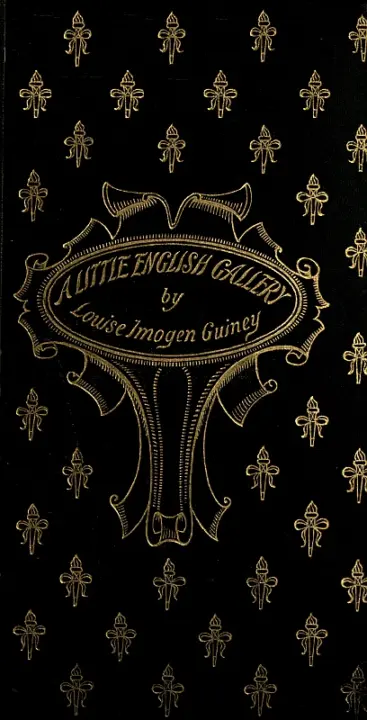
THE CLASSIC COLLECTION · 1894
"A Little English Gallery" by Louise Imogen Guiney is a collection of biographical sketches written in the late 19th century. It explores the lives and contributions of notable figures from English history, focusing on their literary and cultural significance. Through her detailed portraits, Guiney aims to illuminate the legacy of these individuals, particularly women who have made lasting impacts on literature. The opening of the book introduces Lady Danvers, a significant figure of the late 16th and early 17th centuries, highlighting her connections with prominent literary figures such as John Donne and her son, poet George Herbert. The narrative delves into her life as a mother and her role in supporting and guiding her children, emphasizing her virtuous character and influence. Guiney provides a comprehensive view of Lady Danvers's lineage, personal attributes, and legacy, establishing her as a figure worthy of remembrance in English literary history.
Introduction adapted from the source catalogue; source summaries may be automatically generated.
Free to read · English · 51,651 words · No account needed
MAKE TIME FOR A GOOD BOOK
On by default. Untick to stop anonymous reading totals. Each page counts after 10 seconds in view. How this works.
Anonymous counting is on unless you have switched it off.
It was during this stay that she contracted the chivalrous friendship which has embalmed her tranquil memory. Dr. John Donne (not ordained until 1614, and indeed not Dr. Donne then at all, but “Jack Donne,” his profaner self) had been at Cadiz with Essex, and had wandered over the face of Europe; and he came back, accidentally, to Oxford during the most troubled year of his early prime. It was no strange place to him,[2] who had been, at eleven, the Pico della Mirandola of Hart Hall, and whose relatives seem to have resided always in the town. There and then, however, he cast his bright eye upon Excellence, and in his own phrase,
“—dared love that, and say so, too,
And forget the He and She.”
We can do no better than cite a celebrated and beautiful passage, once more from Walton: “This amity, begun at this time and place, was not an amity that polluted their souls, but an amity made up of a chain of suitable inclinations and virtues; an amity like that of St. Chrysostom to his dear and virtuous Olympias, whom, in his letters, he calls his saint; or an amity, indeed, more like that of St. Hierom to his Paula, whose affection to her was such that he turned poet in his old age, and then made her epitaph, wishing all his body were turned into tongues that he might declare her just praises to posterity.” How these words remind one of the sweet historic mention which Condivi gives to the relations between Vittoria Colonna and Michelangelo! The little English idyl of friendship and the great Italian one run parallel in much.
Donne’s trenchant Satires, some of the earliest and very best in the language, were already written, and he was not without the hint of fame. Born in 1573, he was but eight years the senior of Edward Herbert, and not more than a dozen years the junior of Edward Herbert’s mother. To her two sons, also, who were to figure as men of letters, he was sincerely attached from the first, and had a marked and lasting influence on their minds. Donne had the superabundance of mental power which Mr. Minto has pointed out as the paradoxical cause of his failure to become a great poet. He was a three-storied soul, as the French say: a spirit of many sides and moods, a life-long dreamer of good and bad dreams. To his restless, incisive intelligence his contemporaries, with Jonson and Carew at their head, bowed in hyperboles of acclaim. He had a changeful conscience, often antagonized and often appeased. There was a strain in him of strong joy, for he was descended through his mother from pleasant John Heywood the dramatist, and from the father of that great and merry-hearted gentleman, Sir Thomas More. If ever man needed vitality to buoy him over sorrows heavy and vast, it was Donne in his “yeasting youth.” Thrown, through no fault but his own, from his old footholds of religion and occupation, and unable, despite his versatile and alert genius, to grind a steady living from the hard mills of the world, he was in the midst of a bitter plight when the friends worthy of him found a heavenly opportunity which they did not let go by, and made his acceptance of their favor a rich gift unto themselves. Foremost among these, besides Lady Herbert, were Sir Robert Drury of Drury Lane, and a kinsman, Sir Francis Woolly, of Pirford, Surrey, fated to die in his youth, both of whom gave the Donnes, for some nine consecutive years, the use of their princely houses. John Donne had been in the service of the Chancellor, Lord Ellesmere, and lost place and purse by the opposition to his marriage with his “lectissima dilectissimaque,” Anne More, who was Lady Ellesmere’s niece, the daughter of Sir George More of Loxly, Lieutenant of the Tower, and probably a distant cousin of his own. No reverses, however, could beat the pathetic cheer out of him. “Anne Donne,[3] undone,” was one of his inveterate teary jests over the state of things at home. He wrote once, with sickness, poverty, and despair at his elbow: “If God should ease us with burials, I know not how to perform even that. But I flatter myself that I am dying, too, for I cannot waste faster than by such griefs.” Five of his twelve children passed before their father to the grave, the good domestic daughter Constance upholding him always, and keeping the house together. But just as hope dawned with his appointment to the Lectureship of Lincoln’s Inn, heavenward suddenly, with her youngest-born, in 1617, went his dear and faithful wife, whom he laid to rest in St. Clement Danes.
Your reading position is saved on this browser. Take it to another device with a library code. Reading pages adapt to text, rather than matching a printed edition.
Louise Imogen Guiney
Louise Imogen Guiney
Louise Imogen Guiney

Louise Imogen Guiney
BEHIND THE BOOK
This eBook is for the use of anyone anywhere in the United States and most other parts of the world at no cost and with almost no restrictions whatsoever. You may copy it, give it away or re-use it under the terms of the Project Gutenberg License included with this eBook or online at www.gutenberg.org. If you are not located in the United States, you will have to check the laws of the country where you are located before using this eBook. Read the source licence.
The original source file, including credits and licence, is retained by this library. Request an original-format copy at no charge. Please include the book title and Project Gutenberg identifier #54219.
KEEP YOUR CURIOSITY GOING
Cécile Tormay

Moritz Busch
John L. Ransom
Frances Wright
Cécile Tormay

Mabel Potter Daggett