THE CLASSIC COLLECTION✦Hurrell Froude: Memoranda and CommentsCLASSIC FREE BOOKS
Hurrell Froude: Memoranda and Comments
Louise Imogen Guiney
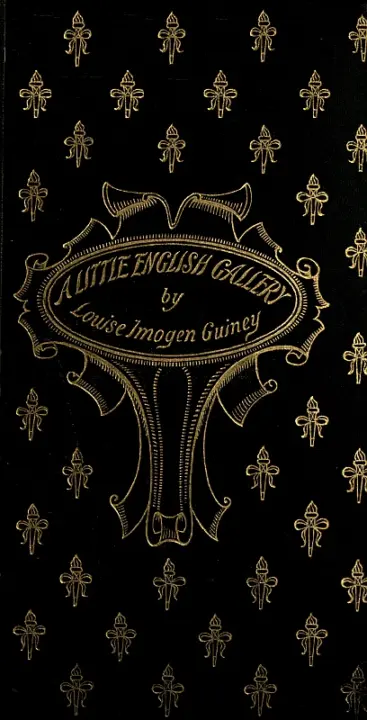
THE CLASSIC COLLECTION · 1894
"A Little English Gallery" by Louise Imogen Guiney is a collection of biographical sketches written in the late 19th century. It explores the lives and contributions of notable figures from English history, focusing on their literary and cultural significance. Through her detailed portraits, Guiney aims to illuminate the legacy of these individuals, particularly women who have made lasting impacts on literature. The opening of the book introduces Lady Danvers, a significant figure of the late 16th and early 17th centuries, highlighting her connections with prominent literary figures such as John Donne and her son, poet George Herbert. The narrative delves into her life as a mother and her role in supporting and guiding her children, emphasizing her virtuous character and influence. Guiney provides a comprehensive view of Lady Danvers's lineage, personal attributes, and legacy, establishing her as a figure worthy of remembrance in English literary history.
Introduction adapted from the source catalogue; source summaries may be automatically generated.
Free to read · English · 51,651 words · No account needed
MAKE TIME FOR A GOOD BOOK
On by default. Untick to stop anonymous reading totals. Each page counts after 10 seconds in view. How this works.
Anonymous counting is on unless you have switched it off.
Eight little books, if we count the two parts of Silex Scintillans as one,[31] enclose all of the Silurist’s original work. He began to publish in 1646, and he practically ceased in 1655, reappearing but in 1678 with Thalia Rediviva, which was not issued under his own supervision. It is commonly supposed that his verses were forgotten up to the date (1847) of the faulty but timely Aldine edition of the Rev. H. F. Lyte, thrice reprinted and revised since then, and until the appearance of Dr. Grosart’s four inestimable quartos; but Mr. Carew Hazlitt has been fortunate enough to discover the advertisement of an eighteenth-century reprint of Vaughan. As the results of Dr. Grosart’s patient service to our elder writers are necessarily semi-private, it may be said with truth that the real Vaughan is still debarred from the general reader, who is, indeed, the identical person least concerned about that state of affairs. His name is not irrecoverable nor unfamiliar to scholars.[32] His mind, on the whole, might pass for the product of yesterday; and he, who needs no glossary, may handsomely cede the honors of one to Mr. William Morris. It is at least certain that had Vaughan lately lifted up his sylvan voice out of Brecknockshire, he would not so readily be accused of having modelled himself unduly upon George Herbert.[33] He has gone into eclipse behind that gracious name.
Henry Vaughan was a child of thirteen when Herbert, a stranger to him, died at Bemerton, and he read him first in the sick-chamber to which the five years’ distresses of his early manhood confined him. The reading could not have been prior to 1647, for Olor Iscanus, Vaughan’s second volume, was lying ready for the press that year, as we know from the date of its dedication to Lord Kildare Digby. As no novice poet, therefore, he fell under the spell of a sweet and elect soul, who was also a lover of vanquished royalty, a convert who had looked upon the vanities of the court and the city, a Welshman born, and not unconnected with Vaughan’s own ancient and patrician house. These were slight coincidences, but they served to strengthen a forming tie. The Silurist somewhere thanks Herbert’s “holy ever-living lines” for checking his blood; and it was, perhaps, the only service rendered of which he was conscious. But his endless iambics and his vague allegorical titles are cast thoroughly in the manner of Herbert, and he takes from the same source the heaped categorical epithets, the didactic tone, and the introspectiveness which are his most obvious failings. Vaughan’s intellectual debt to Herbert resolves itself into somewhat less than nothing; for in following him with zeal to the Missionary College of the Muses, he lost rather than gained, and he is altogether delightful and persuasive only where he is altogether himself. Nevertheless, a certain spirit of conformity and filial piety towards Herbert has betrayed Vaughan into frequent and flagrant imitations. It seems as if these must have been voluntary, and rooted in an intention to enforce the same truths in all but the same words; for the moment Vaughan breaks into invective, or comes upon his distinctive topics, such as childhood, natural beauty (for which Herbert had an imperfect sense), friendship, early death, spiritual expectation, he is off and away, free of any predecessor, thrilling and unforgettable. Comparisons will not be out of place here, for Vaughan can bear, and even invoke them. Dryden said in Jonson’s praise that he was “a learned plagiary,” and nobody doubts nowadays that Shakespeare and Milton were the bandit kings of their time. There was, indeed, in English letters, up to Queen Anne’s reign, an open communism of ideas and idioms astonishing to look upon; there is less confiscation at present, because, outside the pale of the sciences, there is less thinking. If any one thing can be closer to another, for instance, than even Drummond’s sonnet on Sleep is to Sidney’s, it is the dress of Vaughan’s morality to that of George Herbert’s. Mr. Simcox is the only critic who has taken the trouble to contrast them, and he does so in so random a fashion as to suggest that his scrutiny, in some cases, has been confined to the rival titles. It is certain that no other mind, however bent upon identifications, can find a likeness between The Quip and The Queer, or between The Tempest and Providence. Vaughan’s Mutiny, like The Collar, ends in a use of the word “child,” after a scene of strife; and if ever it were meant to match Herbert’s poem, distinctly falls behind it, and deals, besides, with a much weaker rebelliousness. Rules and Lessons is so unmistakably modelled upon The Church Porch that it scarcely calls for comment. Herbert’s admonitions, however, are continued, but nowhere repeated; and Vaughan’s succeed in being poetic, which the others are not. Beyond these replicas, Vaughan’s structural genius is in no wise beholden to Herbert’s. But numerous phrases and turns of thought descend from the master to the disciple, undergoing such subtle and peculiar changes, and given back, as Coleridge would say, with such “usurious interest,” that it may well be submitted whether, in this casual list, every borrowing, save two, be not a bettering.
Your reading position is saved on this browser. Take it to another device with a library code. Reading pages adapt to text, rather than matching a printed edition.
Louise Imogen Guiney
Louise Imogen Guiney
Louise Imogen Guiney

Louise Imogen Guiney
BEHIND THE BOOK
This eBook is for the use of anyone anywhere in the United States and most other parts of the world at no cost and with almost no restrictions whatsoever. You may copy it, give it away or re-use it under the terms of the Project Gutenberg License included with this eBook or online at www.gutenberg.org. If you are not located in the United States, you will have to check the laws of the country where you are located before using this eBook. Read the source licence.
The original source file, including credits and licence, is retained by this library. Request an original-format copy at no charge. Please include the book title and Project Gutenberg identifier #54219.
KEEP YOUR CURIOSITY GOING
Cécile Tormay

Moritz Busch
John L. Ransom
Frances Wright
Cécile Tormay

Mabel Potter Daggett