THE CLASSIC COLLECTION✦Hurrell Froude: Memoranda and CommentsCLASSIC FREE BOOKS
Hurrell Froude: Memoranda and Comments
Louise Imogen Guiney
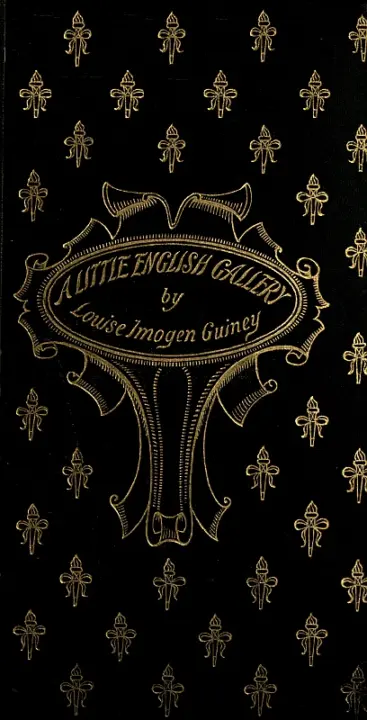
THE CLASSIC COLLECTION · 1894
"A Little English Gallery" by Louise Imogen Guiney is a collection of biographical sketches written in the late 19th century. It explores the lives and contributions of notable figures from English history, focusing on their literary and cultural significance. Through her detailed portraits, Guiney aims to illuminate the legacy of these individuals, particularly women who have made lasting impacts on literature. The opening of the book introduces Lady Danvers, a significant figure of the late 16th and early 17th centuries, highlighting her connections with prominent literary figures such as John Donne and her son, poet George Herbert. The narrative delves into her life as a mother and her role in supporting and guiding her children, emphasizing her virtuous character and influence. Guiney provides a comprehensive view of Lady Danvers's lineage, personal attributes, and legacy, establishing her as a figure worthy of remembrance in English literary history.
Introduction adapted from the source catalogue; source summaries may be automatically generated.
Free to read · English · 51,651 words · No account needed
MAKE TIME FOR A GOOD BOOK
On by default. Untick to stop anonymous reading totals. Each page counts after 10 seconds in view. How this works.
Anonymous counting is on unless you have switched it off.
and it takes another to give the only faithful and ideal report of a warbling which every schoolboy of the race had heard before him:
“That’s the wise thrush: he sings each song twice over, Lest you should think he never could recapture The first fine careless rapture.”
That Vaughan’s pages should furnish this patient specification is remarkable in a man whose mind was set upon things invisible. His gaze is upon the inaccessible ether, but he seems to detect everything between himself and heaven. He sighs over the inattentive rustic, whom, perhaps, he catches scowling by the pasture-bars of the wild Welsh downs:
“O that he would hear
The world read to him!”
Whatever is in that pleasant world he himself hears and sees; and his interrupted chronicle is always terse, graphic, straight from life. He has the inevitable phrase for every phenomenon, a little low-comedy phrase, sometimes, such as Shakespeare and Carew had used before him:
“Deep snow
Candies our country’s woody brow.”
It seems never to have entered the primitive mind of Vaughan to love, or serve, art and nature for themselves. His cue was to walk abroad circumspectly and with incessant reverence, because in all things he found God. He marks, at every few rods in the thickets, “those low violets of Thine,” and the “breathing sacrifice” of earth-odors which the “parched and thirsty isle” gratefully sends back after a shower.[28] His prayer is that he may not forget that physical beauty is a great symbol, but only a symbol; a “hid ascent” through “masks and shadows” to the divine; or, as Mr. Lowell said in one of his last poems,
“a tent
Pitched for an Inmate far more excellent.”
A humanist of the school of Assisi, Vaughan was full of out-of-door meeknesses and pieties, nowhere sweeter in their expression than in this all-embracing valedictory:
“O knowing, glorious Spirit! when
Thou shalt restore trees, beasts, and men,
Give him among Thy works a place
Who in them loved and sought Thy face.”
He muses in the garden, at evenfall:
“Man is such a marigold
As shuts, and hangs the head.”
Clouds, seasons, and the eternal stars are his playfellows; he apostrophizes our sister the rainbow, and reminds her of yesterday, when
“Terah, Nahor, Haran, Abram, Lot,
The youthful world’s grey fathers, in one knot,”
lifted anxious looks to her new splendor. He is familiar with the depression which comes from boding weather, when
“a pilgrim’s eye,
Far from relief,
Measures the melancholy sky.”
He has an artist’s feeling, also, for the wrath of the elements, which inevitably hurry him on to the consummation
Your reading position is saved on this browser. Take it to another device with a library code. Reading pages adapt to text, rather than matching a printed edition.
Louise Imogen Guiney
Louise Imogen Guiney
Louise Imogen Guiney

Louise Imogen Guiney
BEHIND THE BOOK
This eBook is for the use of anyone anywhere in the United States and most other parts of the world at no cost and with almost no restrictions whatsoever. You may copy it, give it away or re-use it under the terms of the Project Gutenberg License included with this eBook or online at www.gutenberg.org. If you are not located in the United States, you will have to check the laws of the country where you are located before using this eBook. Read the source licence.
The original source file, including credits and licence, is retained by this library. Request an original-format copy at no charge. Please include the book title and Project Gutenberg identifier #54219.
KEEP YOUR CURIOSITY GOING
Cécile Tormay

Moritz Busch
John L. Ransom
Frances Wright
Cécile Tormay

Mabel Potter Daggett