THE CLASSIC COLLECTION✦Hurrell Froude: Memoranda and CommentsCLASSIC FREE BOOKS
Hurrell Froude: Memoranda and Comments
Louise Imogen Guiney
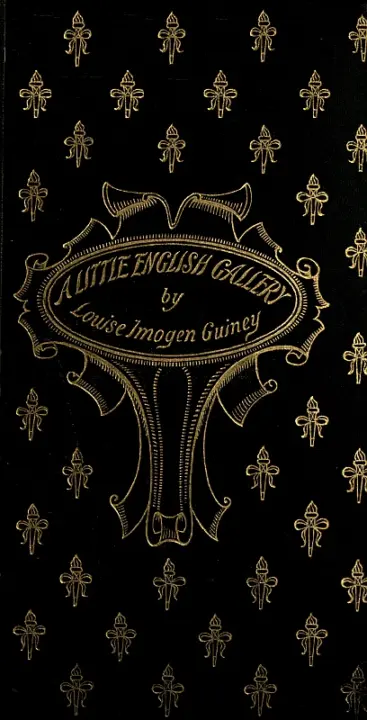
THE CLASSIC COLLECTION · 1894
"A Little English Gallery" by Louise Imogen Guiney is a collection of biographical sketches written in the late 19th century. It explores the lives and contributions of notable figures from English history, focusing on their literary and cultural significance. Through her detailed portraits, Guiney aims to illuminate the legacy of these individuals, particularly women who have made lasting impacts on literature. The opening of the book introduces Lady Danvers, a significant figure of the late 16th and early 17th centuries, highlighting her connections with prominent literary figures such as John Donne and her son, poet George Herbert. The narrative delves into her life as a mother and her role in supporting and guiding her children, emphasizing her virtuous character and influence. Guiney provides a comprehensive view of Lady Danvers's lineage, personal attributes, and legacy, establishing her as a figure worthy of remembrance in English literary history.
Introduction adapted from the source catalogue; source summaries may be automatically generated.
Free to read · English · 51,651 words · No account needed
MAKE TIME FOR A GOOD BOOK
On by default. Untick to stop anonymous reading totals. Each page counts after 10 seconds in view. How this works.
Anonymous counting is on unless you have switched it off.
Of the gracious figure of Sir John Danvers we may be said to lose sight; for he seems less gracious, as by a Hindoo trick, as soon as it is written that his wife departed unto her reward. Comment on his character is equal comment upon hers, and adds new force to the classic episode of a lady philanthropist espousing a ne’er-do-weel and a featherbrain. Aubrey, always happy over a little ultra-contemporary gossip, calls it “a disagreeable match,” disappointing to the bridegroom’s kindred; but adds that “he married her for love of her wit.” Now, wit is an admirable magnet, but it is to be suspected that there was also, and in the immediate vicinity, “metal more attractive,” as Hamlet says. In the Chelsea parish-books is an entry, the first of its kind, certifying that Sir John Danvers had settled his account with “the poore,” a matter of thirty pounds’ loan (in which the vicar must have connived), for the year ending in January of 1628. If the payment were, by any hap, in advance, it may have fallen in Lady Danvers’s own lifetime; and if so, it is quite as likely that she paid it, with an admonition! Her “high tides of melancholy,” of whose true cause she certainly would not have complained to Dr. Donne, had something to do with this young spendthrift, who must have had his wheedling way, sooner or later, with such of her ample revenues as were yet extant. Perhaps Lord Herbert of Cherbury was both shrewd and charitable, in suppressing mention of his new relative.[15] The longer one looks into the matter, the less curious seems his unexplained silence concerning this late graft of a family hitherto always respectable and always loyal.
There are gleams of subsequent private history in the tell-tale records at Chelsea. We are not incurably astonished to learn that as early as May of 1629 was christened Elizabeth, daughter of Sir John Danvers and Elizabeth his wife. This Lady Elizabeth, arriving providentially with her Dauntsey wealth, having borne him four children, died, as did his mother, in 1636; and left him even as she found him, none too monogamous. In 1648 Sir John Danvers again appeared at the venerable altars where his first saint never had a memorial, loving, honoring, and cherishing a Mrs. Grace Hewes, Hawes, or Hewet, of Kemerton in Gloucestershire, and, as it is to be surmised, leading her tame fortune by a ribbon. His debts and difficulties, not of one but of all time, sprout perennially in the registers. His indefatigable name, oftener than any rival’s whatsoever, figures as borrowing and paying interest on a forty-pound note, which, like a Hydra-head, was always forthcoming so soon as it was demolished. This disgraceful business was the man’s chief concern: for the older he grew the deeper and deeper he sank into entanglements, particularly after the death of the King. It was never doubted, in his day, but that this was a judgment on the former Gentleman Usher who affixed hand and seal to the warrant of his sovereign’s execution.[16] His own family, it is said, as well as the royalist Herberts and Newports, dropped his acquaintance; and who knows whether Mrs. Grace Hewet was faithful? At his favorite Chelsea, in the April of 1655, and in about the seventy-fourth year of his age, Sir John Danvers ended his career by more conventional agencies than the rope and the knife, which might have befallen him in the Stuart triumph of the morrow. His manor fell an immediate forfeit to the crown. In 1661, the dead republican was attainted, and all of his estate which was unprotected was declared regal booty. The year before his own burial at Dauntsey he laid there, “to the great grief of all good men,” the body of his elder son Henry, who had just attained his majority. The Earl of Danby had died, “full of honors, wounds, and days,” in 1643, while this Henry, his nephew, was still a hopeful child; and on him alone he had taken pains to settle his possessions. But Henry, in turn, was persuaded to bequeath the major part of them to his father’s ever-gaping pocket, the remainder reverting to one of his two surviving sisters. The third Lady Danvers, who lived until 1678, had also a son Charles,[17] who petitioned the crown for his paternal rights, but died in old age, with neither income nor issue.
Your reading position is saved on this browser. Take it to another device with a library code. Reading pages adapt to text, rather than matching a printed edition.
Louise Imogen Guiney
Louise Imogen Guiney
Louise Imogen Guiney

Louise Imogen Guiney
BEHIND THE BOOK
This eBook is for the use of anyone anywhere in the United States and most other parts of the world at no cost and with almost no restrictions whatsoever. You may copy it, give it away or re-use it under the terms of the Project Gutenberg License included with this eBook or online at www.gutenberg.org. If you are not located in the United States, you will have to check the laws of the country where you are located before using this eBook. Read the source licence.
The original source file, including credits and licence, is retained by this library. Request an original-format copy at no charge. Please include the book title and Project Gutenberg identifier #54219.
KEEP YOUR CURIOSITY GOING
Cécile Tormay

Moritz Busch
John L. Ransom
Frances Wright
Cécile Tormay

Mabel Potter Daggett