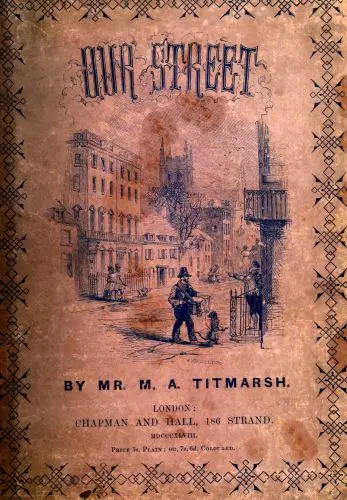
“Our Street”
William Makepeace Thackeray
THE CLASSIC COLLECTION · 1857
"A Little Dinner at Timmins's" by William Makepeace Thackeray is a satirical novella written during the Victorian era. This work exemplifies the comedic examination of social aspirations and pretensions among the middle class of London society in the 19th century. At its core, the book illustrates the consequences of attempting to impress one's social peers through extravagant entertaining despite one's actual financial limitations. The narrative centers around Mr. and Mrs. Fitzroy Timmins, a newlywed couple eager to host a grand dinner to showcase their genteel status and connections. Mrs. Timmins, enthusiastic and naïve about their financial constraints, insists on inviting an array of notable guests, including the Earl and Countess of Bungay and several wealthy neighbors. Mr. Timmins, a barrister with overdrawn accounts, faces mounting anxiety as the dinner planning spirals out of control. In their attempts to impress, the couple neglects the practical details, leading to comedic disasters and social faux pas during the dinner party itself. The evening culminates in chaos, revealing the futility and absurdity of their social competition, and leaves them in dire financial straits, questioning the costs of their aspirations.
Introduction adapted from the source catalogue; source summaries may be automatically generated.
Free to read · English · 10,607 words · No account needed
MAKE TIME FOR A GOOD BOOK
On by default. Untick to stop anonymous reading totals. Each page counts after 10 seconds in view. How this works.
Anonymous counting is on unless you have switched it off.
“Rosa! Mrs. Gashleigh!” cried out Timmins, “come down and speak to this
gentl--this--”
“Truncheon, sir,” said the man.
The women descended from the drawing-room. “Look and see, ladies,” he said, inducting them into the dining-room: “there's the room, there's the table laid for heighteen, and I defy you to squeege in more.”
“One person in a party always fails,” said Mrs. Gashleigh, getting
alarmed.
“That's nineteen,” Mr. Truncheon remarked. “We must knock another hoff, Ma'm.” And he looked her hard in the face.
Mrs. Gashleigh was very red and nervous, and paced, or rather squeezed round the table (it was as much as she could do). The chairs could not be put any closer than they were. It was impossible, unless the convive sat as a centre-piece in the middle, to put another guest at that table.
“Look at that lady movin' round, sir. You see now the difficklty. If my men wasn't thinner, they couldn't hoperate at all,” Mr. Truncheon observed, who seemed to have a spite to Mrs. Gashleigh.
“What is to be done?” she said, with purple accents.
“My dearest mamma,” Rosa cried out, “you must stop at home--how sorry I am!” And she shot one glance at Fitzroy, who shot another at the great Truncheon, who held down his eyes. “We could manage with heighteen,” he said, mildly.
Mrs. Gashleigh gave a hideous laugh.
She went away. At eight o'clock she was pacing at the corner of the street, and actually saw the company arrive. First came the Topham Sawyers, in their light-blue carriage with the white hammercloth and blue and white ribbons--their footmen drove the house down with the knocking.
Then followed the ponderous and snuff-colored vehicle, with faded gilt wheels and brass earl's coronets all over it, the conveyance of the House of Bungay. The Countess of Bungay and daughter stepped out of the carriage. The fourteenth Earl of Bungay couldn't come.
Sir Thomas and Lady Gulpin's fly made its appearance, from which issued the General with his star, and Lady Gulpin in yellow satin. The Rowdys' brougham followed next; after which Mrs. Butt's handsome equipage drove up.
The two friends of the house, young gentlemen from the Temple, now
arrived in cab No. 9996. We tossed up, in fact, which should pay the
fare.
Mr. Ranville Ranville walked, and was dusting his boots as the Templars drove up. Lord Castlemouldy came out of a twopenny omnibus. Funnyman, the wag, came last, whirling up rapidly in a hansom, just as Mrs. Gashleigh, with rage in her heart, was counting that two people had failed, and that there were only seventeen after all.
Your reading position is saved on this browser. Take it to another device with a library code. Reading pages adapt to text, rather than matching a printed edition.
William Makepeace Thackeray
William Makepeace Thackeray
Charles Dickens & William Makepeace Thackeray
William Makepeace Thackeray
BEHIND THE BOOK
This eBook is for the use of anyone anywhere in the United States and most other parts of the world at no cost and with almost no restrictions whatsoever. You may copy it, give it away or re-use it under the terms of the Project Gutenberg License included with this eBook or online at www.gutenberg.org. If you are not located in the United States, you will have to check the laws of the country where you are located before using this eBook. Read the source licence.
The original source file, including credits and licence, is retained by this library. Request an original-format copy at no charge. Please include the book title and Project Gutenberg identifier #2859.
KEEP YOUR CURIOSITY GOING
Coulson Kernahan

Maurice Baring
Frances Wright
Cécile Tormay

Frederic Jesup Stimson

W. H. P. (William Henry Pope) Jarvis