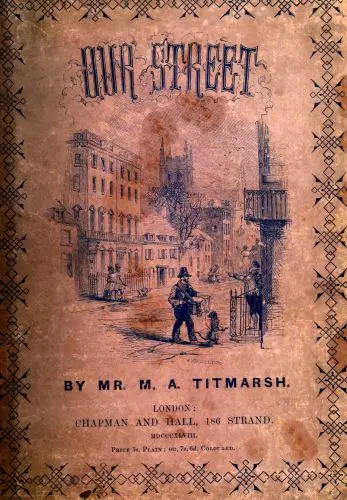
“Our Street”
William Makepeace Thackeray
THE CLASSIC COLLECTION · 1857
"A Little Dinner at Timmins's" by William Makepeace Thackeray is a satirical novella written during the Victorian era. This work exemplifies the comedic examination of social aspirations and pretensions among the middle class of London society in the 19th century. At its core, the book illustrates the consequences of attempting to impress one's social peers through extravagant entertaining despite one's actual financial limitations. The narrative centers around Mr. and Mrs. Fitzroy Timmins, a newlywed couple eager to host a grand dinner to showcase their genteel status and connections. Mrs. Timmins, enthusiastic and naïve about their financial constraints, insists on inviting an array of notable guests, including the Earl and Countess of Bungay and several wealthy neighbors. Mr. Timmins, a barrister with overdrawn accounts, faces mounting anxiety as the dinner planning spirals out of control. In their attempts to impress, the couple neglects the practical details, leading to comedic disasters and social faux pas during the dinner party itself. The evening culminates in chaos, revealing the futility and absurdity of their social competition, and leaves them in dire financial straits, questioning the costs of their aspirations.
Introduction adapted from the source catalogue; source summaries may be automatically generated.
Free to read · English · 10,607 words · No account needed
MAKE TIME FOR A GOOD BOOK
On by default. Untick to stop anonymous reading totals. Each page counts after 10 seconds in view. How this works.
Anonymous counting is on unless you have switched it off.
“You are dying to get a lord into the house,” Timmins said (HE had not altered his name in Fig-tree Court yet, and therefore I am not so affected as to call him TYMMYNS).
“Law, my dear, they are our cousins, and must be asked,” Rosa said.
“Let us put down my sister and Tom Crowder, then.”
“Blanche Crowder is really so VERY fat, Fitzroy,” his wife said, “and our rooms are so VERY small.”
Fitz laughed. “You little rogue,” he said, “Lady Bungay weighs two of Blanche, even when she's not in the f--”
“Fiddlesticks!” Rose cried out. “Doctor Crowder really cannot be admitted: he makes such a noise eating his soup, that it is really quite disagreeable.” And she imitated the gurgling noise performed by the Doctor while inhausting his soup, in such a funny way that Fitz saw inviting him was out of the question.
“Besides, we mustn't have too many relations,” Rosa went on. “Mamma, of course, is coming. She doesn't like to be asked in the evening; and she'll bring her silver bread-basket and her candlesticks, which are very rich and handsome.”
“And you complain of Blanche for being too stout!” groaned out Timmins.
“Well, well, don't be in a pet,” said little Rosa. “The girls won't come to dinner; but will bring their music afterwards.” And she went on with the list.
“Sir Thomas and Lady Kicklebury, 2. No saying no: we MUST ask them, Charles. They are rich people, and any room in their house in Brobdingnag Gardens would swallow up OUR humble cot. But to people in OUR position in SOCIETY they will be glad enough to come. The city people are glad to mix with the old families.”
“Very good,” says Fitz, with a sad face of assent--and Mrs. Timmins went on reading her list.
“Mr. and Mrs. Topham Sawyer, Belgravine Place.”
“Mrs. Sawyer hasn't asked you all the season. She gives herself the airs of an empress; and when--”
“One's Member, you know, my dear, one must have,” Rosa replied, with much dignity as if the presence of the representative of her native place would be a protection to her dinner. And a note was written and transported by the page early next morning to the mansion of the Sawyers, in Belgravine Place.
The Topham Sawyers had just come down to breakfast; Mrs. T. in her large dust-colored morning-dress and Madonna front (she looks rather scraggy of a morning, but I promise you her ringlets and figure will stun you of an evening); and having read the note, the following dialogue passed:--
Your reading position is saved on this browser. Take it to another device with a library code. Reading pages adapt to text, rather than matching a printed edition.
William Makepeace Thackeray
William Makepeace Thackeray
Charles Dickens & William Makepeace Thackeray
William Makepeace Thackeray
BEHIND THE BOOK
This eBook is for the use of anyone anywhere in the United States and most other parts of the world at no cost and with almost no restrictions whatsoever. You may copy it, give it away or re-use it under the terms of the Project Gutenberg License included with this eBook or online at www.gutenberg.org. If you are not located in the United States, you will have to check the laws of the country where you are located before using this eBook. Read the source licence.
The original source file, including credits and licence, is retained by this library. Request an original-format copy at no charge. Please include the book title and Project Gutenberg identifier #2859.
KEEP YOUR CURIOSITY GOING
Coulson Kernahan

Maurice Baring
Frances Wright
Cécile Tormay

Frederic Jesup Stimson

W. H. P. (William Henry Pope) Jarvis