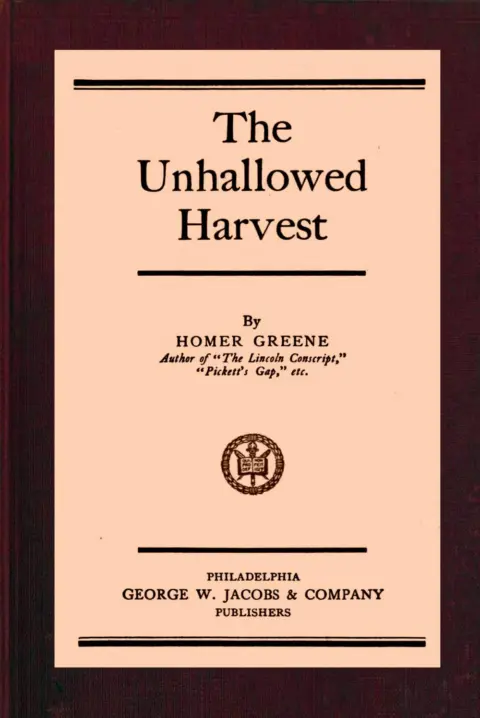
The unhallowed harvest
Homer Greene
THE CLASSIC COLLECTION · 1909
"A Lincoln Conscript" by Homer Greene is a historical novel written in the early 20th century. The narrative is set during the American Civil War, capturing the divided sentiments of families and communities regarding loyalty and duty. The story centers around Bob Bannister, a boy caught between his love for his father, Rhett Bannister, an outspoken opponent of the war and a suspected "copperhead," and his own fervent patriotism. At the start of the book, we are introduced to the tumultuous atmosphere of July 1863, with tensions high as the Battle of Gettysburg rages. Young Bob struggles with the dishonor that comes from his father's anti-war stance, leading to his exclusion from local patriot groups. The chapter reveals the complex dynamics within Bob's family, highlighting the contrasting beliefs held by his father and the community and setting the stage for a conflict rooted in familial loyalty versus patriotic duty. As societal pressures mount, Bob finds himself torn between the ideals of loyalty to his father and his desire to serve and uphold the Union cause.
Introduction adapted from the source catalogue; source summaries may be automatically generated.
Free to read · English · 47,615 words · No account needed
MAKE TIME FOR A GOOD BOOK
On by default. Untick to stop anonymous reading totals. Each page counts after 10 seconds in view. How this works.
Anonymous counting is on unless you have switched it off.
“It seems to me, my friend, that the South can afford to do as Seth Mills did, swallow her pride, be generous to us, get back with us into the Union, and help us build it bigger and broader and deeper, and wall it up, and put in a pipe big enough to supply us all with prosperity and happiness and peace. Maybe it’ll cost two or three dollars, but I believe it’s worth it.”
It was not until the story and its moral were nearly finished that Bannister realized that it was about his own old Seth Mills that the President was talking.
“I know that man, Mr. Lincoln,” he said. “I know Seth Mills, and I can well believe and appreciate the story. He has been, for years, my next and most valued neighbor, a good citizen, an honest man, and a worshiper at the shrine of Abraham Lincoln.”
“Well, now, I’m glad to hear from Seth; I’m glad to hear from him. I knew he went East somewhere. You tell him, when you see him, if you ever do, that Abe Lincoln sends him greeting and good wishes in memory of the old days in Sangamon County.”
Then the light of reminiscent memory died out from the President’s face, and the old strained, haggard, weary look came back into it. He straightened up his long body and said:--
“Let’s see. You’re a fugitive, ain’t you? a deserter?”
“Something like that, I believe, Mr. Lincoln.”
The President rose and went out into the telegraph office and gave some orders. When he came back he said:--
“I’ve sent for Lieutenant Forsythe. I’ll turn you over to him. He’ll see that you get to the right place. Tell me again about that boy of yours, will you?”
So Bannister again told Bob’s story, and again expressed his willingness and eagerness to take the boy’s place in the ranks.
“I do not feel quite as I did when I came in here, Mr. Lincoln,” he said. “I am ready now to concede that the quickest way to permanent peace is by the subjugation of the Southern armies. But, Mr. President, when the South is beaten, I am sure--I am sure you will be charitable.”
The President did not reply. He had turned to the table, taken a pen, and begun to write. When he had finished he again faced Bannister, and read to him what he had written. It was as follows:--
“WAR DEPARTMENT, WASHINGTON, D. C., October 26, 1863.
“MAJOR-GENERAL MEADE,
Army of Potomac:--
Your reading position is saved on this browser. Take it to another device with a library code. Reading pages adapt to text, rather than matching a printed edition.
Homer Greene
Homer Greene
Homer Greene
Homer Greene
BEHIND THE BOOK
This eBook is for the use of anyone anywhere in the United States and most other parts of the world at no cost and with almost no restrictions whatsoever. You may copy it, give it away or re-use it under the terms of the Project Gutenberg License included with this eBook or online at www.gutenberg.org. If you are not located in the United States, you will have to check the laws of the country where you are located before using this eBook. Read the source licence.
The original source file, including credits and licence, is retained by this library. Request an original-format copy at no charge. Please include the book title and Project Gutenberg identifier #49677.
KEEP YOUR CURIOSITY GOING
Cécile Tormay

Moritz Busch
Coulson Kernahan
John L. Ransom

Maurice Baring
Frances Wright