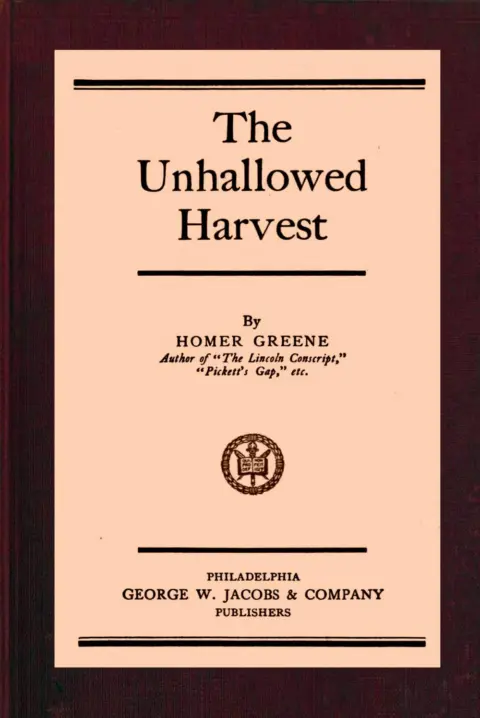
The unhallowed harvest
Homer Greene
THE CLASSIC COLLECTION · 1909
"A Lincoln Conscript" by Homer Greene is a historical novel written in the early 20th century. The narrative is set during the American Civil War, capturing the divided sentiments of families and communities regarding loyalty and duty. The story centers around Bob Bannister, a boy caught between his love for his father, Rhett Bannister, an outspoken opponent of the war and a suspected "copperhead," and his own fervent patriotism. At the start of the book, we are introduced to the tumultuous atmosphere of July 1863, with tensions high as the Battle of Gettysburg rages. Young Bob struggles with the dishonor that comes from his father's anti-war stance, leading to his exclusion from local patriot groups. The chapter reveals the complex dynamics within Bob's family, highlighting the contrasting beliefs held by his father and the community and setting the stage for a conflict rooted in familial loyalty versus patriotic duty. As societal pressures mount, Bob finds himself torn between the ideals of loyalty to his father and his desire to serve and uphold the Union cause.
Introduction adapted from the source catalogue; source summaries may be automatically generated.
Free to read · English · 47,615 words · No account needed
MAKE TIME FOR A GOOD BOOK
On by default. Untick to stop anonymous reading totals. Each page counts after 10 seconds in view. How this works.
Anonymous counting is on unless you have switched it off.
And so he passed on. When he came to the cot where Rhett Bannister was lying, he gave him a word of simple greeting and would have gone by had not something in the man’s face attracted his attention and caused him to stop.
“Have I ever seen you before?” he inquired.
“Yes, Mr. President. I am Rhett Bannister from Pennsylvania. I spent a half-hour with you one morning in the Secretary’s room in the War Department, in the fall of ’63. I was an escaped conscript that morning.”
A smile of recognition lit up the face of the President, and his gnarled hand grasped the hand of the wounded man.
“I remember,” he said. “I remember very well. And have you been in the service ever since?”
Some one across the aisle, who had heard the conversation, replied that
time for Bannister.
“Yes, Mr. President, he has. And he’s been the bravest and the best soldier in the ranks, bar none. I’m the adjutant of his battalion, and I know.”
“Good!” exclaimed the President. “Oh, that’s very good. I felt that we’d make a good soldier of him in the end. And, let’s see! There was a boy whose place you took. The boy went home.”
“No, Mr. President, he wouldn’t go, so we both stayed.”
“The boy wouldn’t go home? What became of him?”
“He’s here, Mr. President, on the next cot. We were both clipped at
Five Forks.”
The President turned half round and looked incredulously on the pale face of the youth at his side. Then he took the boy’s two hands in both of his, and bent over him. There was no grace in the movement, there was no beauty of face or smoothness of diction to add charm to the incident; but Bob Bannister will remember to his last hour on earth how the great War President leaned over him and spoke.
“My boy, of such stuff are patriots and heroes made.”
Then, glancing at the wall where Bob’s frayed and dusty coat hung at the head of his cot, with the shoulder-straps of a first lieutenant half showing, he said, inquiringly:--
“That coat’s not yours?”
“It is mine, Mr. President.”
Lincoln looked down again at the boyish face beneath him.
“It’s hard to believe,” he said.
And then the adjutant across the aisle spoke up for the second time.
“It’s quite true, Mr. President. And he has splendidly earned every step of his promotion.”
Still holding the boy’s hands and looking down into his face, the
President said:--
Your reading position is saved on this browser. Take it to another device with a library code. Reading pages adapt to text, rather than matching a printed edition.
Homer Greene
Homer Greene
Homer Greene
Homer Greene
BEHIND THE BOOK
This eBook is for the use of anyone anywhere in the United States and most other parts of the world at no cost and with almost no restrictions whatsoever. You may copy it, give it away or re-use it under the terms of the Project Gutenberg License included with this eBook or online at www.gutenberg.org. If you are not located in the United States, you will have to check the laws of the country where you are located before using this eBook. Read the source licence.
The original source file, including credits and licence, is retained by this library. Request an original-format copy at no charge. Please include the book title and Project Gutenberg identifier #49677.
KEEP YOUR CURIOSITY GOING
Cécile Tormay

Moritz Busch
Coulson Kernahan
John L. Ransom

Maurice Baring
Frances Wright