Botticelli
Henry Bryan Binns
THE CLASSIC COLLECTION · 1905
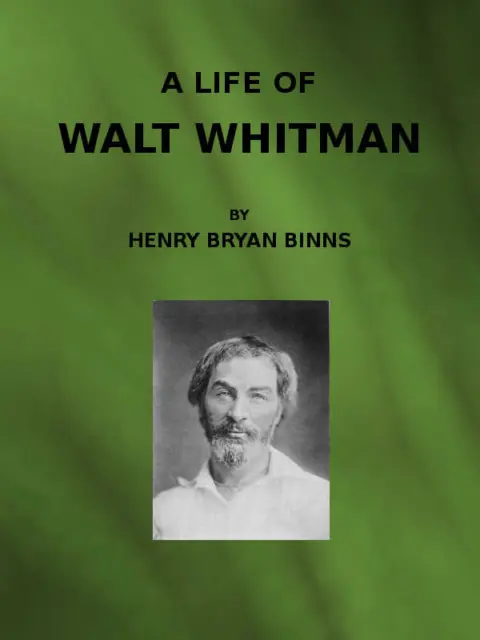
"A Life of Walt Whitman" by Henry Bryan Binns is a biographical study written in the early 20th century. This work delves into the life of the iconic American poet Walt Whitman, exploring his upbringing, his influences, and the context of his literary contributions. It seeks to provide insights into Whitman's character and the philosophy that shaped his poetry without claiming to be a definitive biography. The opening of the narrative introduces Binns's intent to create a personal interpretation of Whitman's life from an English perspective, setting the stage for a comprehensive examination of the poet's complexities. The preface outlines his consideration of Whitman's American roots and hints at the various influences—both personal and historical—on Whitman throughout his life. He acknowledges the challenge of accurately capturing Whitman's essence, arguing that a full understanding requires a grasp of the poet's relationship with his time and his country. Near the beginning, Binns expresses gratitude toward those who aided in the creation of this book and gives an overview of the sources he's drawn from, suggesting a thoughtful and well-researched approach to Whitman's life story.
Introduction adapted from the source catalogue; source summaries may be automatically generated.
Free to read · English · 149,520 words · No account needed
MAKE TIME FOR A GOOD BOOK
On by default. Untick to stop anonymous reading totals. Each page counts after 10 seconds in view. How this works.
Anonymous counting is on unless you have switched it off.
-- Louisa (van Velsor), 4, 65, 103, 112;
described, 6-7;
and W., 12-3;
illness, 19-20;
and L. of G., 88;
letters of W. to, 202, 233, 247, etc.;
age and failing health, 210;
a link with W.'s youth, 233;
goes to Camden, 246;
death, 248;
effect on W., 249, 250, 252, 258;
her tomb, 341.
-- Louisa (Mrs. George W.), 250, 269.
-- Mahala, 280.
-- Martha, 248.
-- Mary, 11, 86.
-- Walt, Dutch element in, 3;
born, 6;
at West Hills, 7-9;
at Brooklyn, 10-3;
hears Hicks, 15-8;
amusements and education, 19;
as a lad, 19-20;
sees Booth, 22;
and politics, 22, 33;
at seventeen, 28;
as a teacher, 28-33;
games, 30;
his idleness, 20, 30-1;
and Long Islander, 31-2;
wholesomeness, 32;
a journalist, 33-7;
Franklin Evans, 35;
an editor, 37;
political views, 39, 40, 44;
love of society, 40;
and of New York, 20, 41-2;
the Eagle, 42-4;
public work, 43;
goes to New Orleans, 46, 49-53;
returns via St. Louis, 54;
his idea of America, 55;
becomes a carpenter, 56;
his reading, 57-61;
attitude to American writers, 59-60;
and to science, etc., 60-2;
passion for America, 63;
inner development, 65, 69-78;
W. at 35, 66-8, 83;
in N.Y., 82-6;
hears Alboni, 86;
indifference to money, 87;
begins L. of G., 87;
publishes it, 88;
daily habits, 65, 88;
holidays, 86, 89;
power of joy, 91;
compared with Emerson, 94;
view of the poet, 95-7;
describes his childhood, 103-4;
religious quality of W., 105-6;
relation to Emerson, Rousseau, Shelley, 106-8;
reviews L. of G., 109;
visit from Conway, 110-2;
appearance in '55, 111;
visit from Alcott and Thoreau, 112-5;
love of city-life, 114;
publishes second edition L. of G., 116;
symbolism of W., 117-22;
W. as the American poet, 123;
W. and evil, 124-5;
and women, 126-7;
in danger of prosecution, 127;
publishes Emerson's letter, 127-8;
his letter to E., 128;
idea of lecturing, 129-31;
and of political life, 131-2;
need for comrades, 132-3;
becomes a Republican, 134;
W. and J. Brown, 136;
W.'s N.Y. friends, 137;
in N.Y., 138-40;
appearance in 1860, 140;
rarely laughs, 142;
at Boston, 142-3;
with Emerson, 143-7;
his optimism, 151;
humility, 154;
mystic experience, 155;
pride, 156;
evil qualities, 156;
attitude toward sex, 159-62;
his temperance, 160;
as Adam, 162;
on comradeship, 163;
W. and Jesus, 167-8;
and death, 169;
W. in N.Y., 172;
and P. of Wales, 173;
sees Lincoln, 175-6;
W. and the outbreak of war, 178-81;
goes to front, 183-4;
home-troubles, 185-6, 193;
life in Washington, 190, 193, 201;
friends there, 190-2;
appearance, 192;
occupation, 192-3;
health, 193;
thinks of lecturing, 193-4;
in hospitals, 194-200;
meets Lincoln, 201;
first illness, 202, 203-4;
willing to share in war, 203;
in Brooklyn, 203-5, 209;
prepares Drum-taps, 205;
attitude to war, 205-9;
seeks release of George W., 209-10;
clerk in Indian Bureau, 210
W. and Lincoln's death, 211-2;
Harlan incident, 213-4;
as a clerk, 216;
gentler, 217;
decreasing vitality, 218;
visits Mrs. Price, 219-20;
relations with W. M. Rossetti, 223;
with Symonds, 223-5;
Mrs. Gilchrist's letters, 225;
W. and sex, 226;
legendary element in story of W., 227;
outcome of his personality, 228-9;
W. and P. Doyle, 231-3;
W.'s solitude, 233;
W. and women, 234;
supports Grant, 235;
quarrel with O'Connor, 236;
his Democratic Vistas, 236-42;
publishes fifth edition of L. of G., 242;
W. a careful writer, 244;
public recitation of poems, 245;
illness, 247-57;
goes to Camden, 248;
effect of mother's death, 249;
loneliness in Camden, 250;
poems at this juncture, 253-5;
his residence, 256;
discharged from post, 257;
poverty and help from England, 258-9;
visits Timber Creek, 260-2;
Mrs. Gilchrist comes to Phila., 263-5;
W. sits for bust, 265;
Carpenter's visit and account of W., 267-9;
Dr. Bucke's do., 270;
W.'s journey West, 271-4;
and to Canada, 274-7;
goes to Boston, 278-82;
sees Emerson, 282;
L. of G. troubles, 284-6;
W. and other prophetic writers, 289-300;
puts himself into his rhythm, 291;
universality of W., 295;
and vital power, 298;
his friendship with Pearsall Smith, 301-4;
W. takes the Mickle St. house, 305;
second visit of Carpenter, 305-7;
W. and labour problems, 306-13;
was he a Socialist? 311-2;
W. a "mugwump," 314;
his household, 317-9;
visitors, 319-24;
his politico-social views, 323-4;
serious illness, 326;
more querulous, 327;
Swinburne's attack, 327;
increased need for silence, 331;
birthday dinners, 331-2;
Ingersoll's lecture, 333-5;
W. and L. of G., 335-6;
his views of health, 338-40;
his tomb, 341;
last illness, 341-4;
last letter, 342;
death, 344;
funeral, 344-6;
note on visit to New Orleans, etc., 349-50.
Your reading position is saved on this browser. Take it to another device with a library code. Reading pages adapt to text, rather than matching a printed edition.
Henry Bryan Binns
BEHIND THE BOOK
This eBook is for the use of anyone anywhere in the United States and most other parts of the world at no cost and with almost no restrictions whatsoever. You may copy it, give it away or re-use it under the terms of the Project Gutenberg License included with this eBook or online at www.gutenberg.org. If you are not located in the United States, you will have to check the laws of the country where you are located before using this eBook. Read the source licence.
The original source file, including credits and licence, is retained by this library. Request an original-format copy at no charge. Please include the book title and Project Gutenberg identifier #56536.
KEEP YOUR CURIOSITY GOING
John L. Ransom

Herman W. Mudgett

Harriet Monroe
Daniel Dulany Addison
Charles Lanman

Harold Rosher