
Botticelli
Henry Bryan Binns
THE CLASSIC COLLECTION · 1905
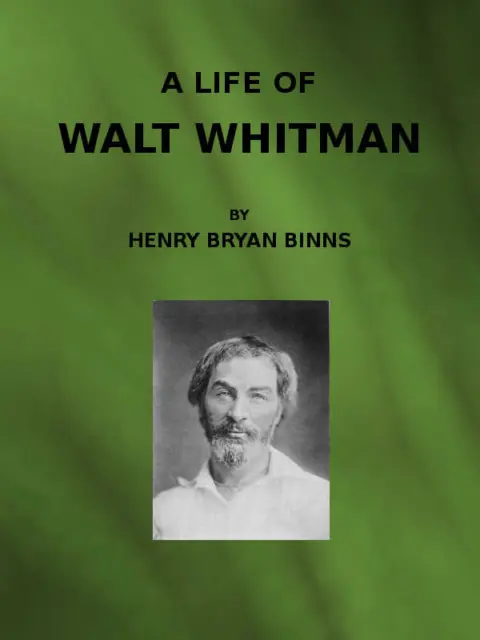
"A Life of Walt Whitman" by Henry Bryan Binns is a biographical study written in the early 20th century. This work delves into the life of the iconic American poet Walt Whitman, exploring his upbringing, his influences, and the context of his literary contributions. It seeks to provide insights into Whitman's character and the philosophy that shaped his poetry without claiming to be a definitive biography. The opening of the narrative introduces Binns's intent to create a personal interpretation of Whitman's life from an English perspective, setting the stage for a comprehensive examination of the poet's complexities. The preface outlines his consideration of Whitman's American roots and hints at the various influences—both personal and historical—on Whitman throughout his life. He acknowledges the challenge of accurately capturing Whitman's essence, arguing that a full understanding requires a grasp of the poet's relationship with his time and his country. Near the beginning, Binns expresses gratitude toward those who aided in the creation of this book and gives an overview of the sources he's drawn from, suggesting a thoughtful and well-researched approach to Whitman's life story.
Introduction adapted from the source catalogue; source summaries may be automatically generated.
Free to read · English · 149,520 words · No account needed
MAKE TIME FOR A GOOD BOOK
On by default. Untick to stop anonymous reading totals. Each page counts after 10 seconds in view. How this works.
Anonymous counting is on unless you have switched it off.
But he was a poor man himself, judged by modern standards, and he had a profoundly human and practical sympathy with the lives of the poor. He knew exactly where their shoe pinched. And thus, whatever his dislike of Unionism, he was an admirable administrator of charity. His delight in giving made him the willing almoner of at least one wealthy Philadelphia magnate,[673] and during severe winters he was enabled to supply his friends, the drivers of the street cars, with warm overcoats. In his diary, alongside of the addresses of those who purchased his books, are long lists of these driver friends, dimly reminiscent of the hospital lists which he used to keep in Washington.
Walt was always an incurable giver of gifts, and these, one may be sure, never weakened the manly independence of their recipients. His admiration for generous men of wealth, like George Peabody, has found a place in Leaves of Grass.[674] For he saw that to love is both to give and to receive, and in that holy commerce both actions alike are blessed.
His interest in social work is shown in a hitherto unpublished letter written about this time to Mary Whitall Smith, who had married and gone to England, and who sent him accounts of the work being done among the poor of the East End through the agency of Toynbee Hall. Of this he writes at noon on the 20th of July, 1885: "The account of the Toynbee Hall doings and chat [is] deeply interesting to me. I think much of all genuine efforts of the human emotions, the soul and bodily and intellectual powers, to exploit themselves for humanity's good: the efforts in themselves I mean (sometimes I am not sure but they are the main matter)--without stopping to calculate whether the investment is tip-top in a business or statistical point of view.
"These libations, ecstatic life-pourings as it were of precious wine or rose-water on vast desert-sands or great polluted river--taking chances for returns or no returns--what were they (or are they) but the theory and practice of the beautiful God Christ? or of all Divine personality?"[675]
[652] Comp. Prose, 183, 186.
[653] MSS. Diary; MSS. Berenson (a).
[654] MSS. Berenson (a).
[655] Cf. In re, 315.
[656] Kennedy, 11; MSS. Diary.
[657] In re, 45, 141, 382; and Johnston.
[658] Donaldson, 69.
[659] Carpenter (a), (b).
[660] Comp. Prose, 247, 325; Camb. Mod. Hist., 707.
[661] W. Cunningham, Western Civilisation (ii.), 258-60.
[662] Camb. Mod. Hist., 712; En. Brit. Suppt.
[663] Comp. Prose, 215.
[664] Kirkup, Hist. of Socialism, 286.
[665] Marshall, Principles of Economics, 64.
[666] Kirkup.
[667] Morris and Bax, Socialism, 321.
[668] Kirkup, 162.
[669] See supra, 240.
[670] In re, 379, 380; Carpenter (b), etc.
[671] See supra, 277.
[672] In re, 379.
[673] MSS. Diary and Donaldson.
[674] L. of G., 294; fuller in 1876 ed.
[675] MSS. Berenson.
Your reading position is saved on this browser. Take it to another device with a library code. Reading pages adapt to text, rather than matching a printed edition.
Henry Bryan Binns
BEHIND THE BOOK
This eBook is for the use of anyone anywhere in the United States and most other parts of the world at no cost and with almost no restrictions whatsoever. You may copy it, give it away or re-use it under the terms of the Project Gutenberg License included with this eBook or online at www.gutenberg.org. If you are not located in the United States, you will have to check the laws of the country where you are located before using this eBook. Read the source licence.
The original source file, including credits and licence, is retained by this library. Request an original-format copy at no charge. Please include the book title and Project Gutenberg identifier #56536.
KEEP YOUR CURIOSITY GOING
John L. Ransom

Herman W. Mudgett

Harriet Monroe
Daniel Dulany Addison
Charles Lanman

Harold Rosher