Botticelli
Henry Bryan Binns
THE CLASSIC COLLECTION · 1905
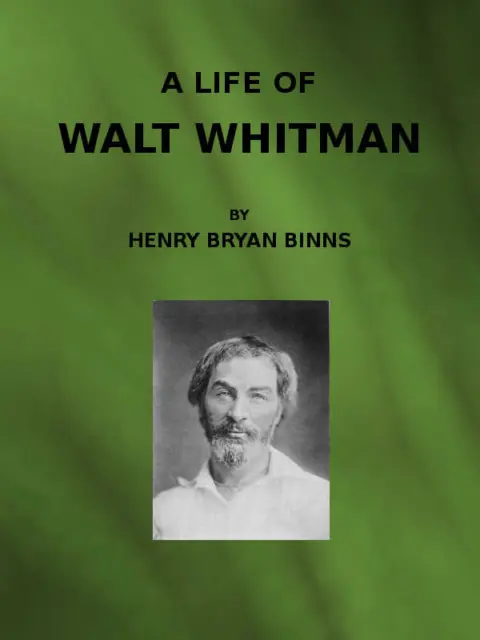
"A Life of Walt Whitman" by Henry Bryan Binns is a biographical study written in the early 20th century. This work delves into the life of the iconic American poet Walt Whitman, exploring his upbringing, his influences, and the context of his literary contributions. It seeks to provide insights into Whitman's character and the philosophy that shaped his poetry without claiming to be a definitive biography. The opening of the narrative introduces Binns's intent to create a personal interpretation of Whitman's life from an English perspective, setting the stage for a comprehensive examination of the poet's complexities. The preface outlines his consideration of Whitman's American roots and hints at the various influences—both personal and historical—on Whitman throughout his life. He acknowledges the challenge of accurately capturing Whitman's essence, arguing that a full understanding requires a grasp of the poet's relationship with his time and his country. Near the beginning, Binns expresses gratitude toward those who aided in the creation of this book and gives an overview of the sources he's drawn from, suggesting a thoughtful and well-researched approach to Whitman's life story.
Introduction adapted from the source catalogue; source summaries may be automatically generated.
Free to read · English · 149,520 words · No account needed
MAKE TIME FOR A GOOD BOOK
On by default. Untick to stop anonymous reading totals. Each page counts after 10 seconds in view. How this works.
Anonymous counting is on unless you have switched it off.
Quakerism has not unfairly been spoken of as a spiritual aristocracy; there seems to be something essentially exclusive about it. On the other hand, it is essentially democratic and would exclude none; but the methods necessary to its conception of truth do not appeal to the many.
Similarly, the Fellowship of Whitman's Comrades must be an aristocracy of overmen--if the words can be divested of all sinister association and read in their most literal sense.
Whitman recognised that his inner teachings could only be accepted by the few, and for them he set them forth. But for the many also, he had a message. And though the actual comrades of Whitman must be able to rise to his breadth of view and depth of purpose, that purpose embraces the whole world.
For the possibility of Comradeship is implicit in every soul; and there is none--no, not the most foolish or perverted or conventionally good--who is ultimately incapable of entering into it. The fellowship must be as essentially attractive as was the personality of Whitman himself; and if few should be chosen to be its members, yet all would be called.
Once realised as the one end of all individual and social life, such a Comradeship would transform our institutions and theories whether of ethics, politics, education or religion. In a word, it would change life into a fine art. For it could be no Utopian theory, but the most practicable of gospels. The seed has been already sown, and we may now await with confidence the growth of a tree through whose branches all the stars of faith will yet shine, and in whose embracing roots all the rocks of science will be held together.[651]
[636] W. M. Rossetti in Anne Gilchrist.
[637] Cf. Saintsbury's Nineteenth Century Lit., and Stephen's English Thought in Eighteenth Century, ch. xii.
[638] Camden's Compliment, 73.
[639] Cf. W. H. Hudson's Rousseau, 245, 246.
[640] Comp. Prose, 287; Guthrie, op. cit., 100, 101.
[641] G. Gilchrist, op. cit.
[642] Kennedy, 106, 178.
[643] Cf. Triggs' Browning and Whitman.
[644] Mazzini's Duties of Man, etc.; cf. Bolton King's Mazzini.
[645] See supra, 113-6, etc.
[646] Triggs, op. cit.; Prof. Jones's Browning.
[647] Note added to My Confession in 1882.
[648] A Dream of John Ball, and Life of William Morris, by J. W.
Mackail.
[649] In re, 244; Comp. Prose, 168, 169, 245; Camden, ix., 172.
[650] See supra, ch. i., ii.
[651] Horace Traubel, of Camden, New Jersey, editor of The Conservator, is the secretary of the Walt Whitman Fellowship (International), which meets annually in New York and issues papers. A file of these may now be consulted in the British Museum Library.
Your reading position is saved on this browser. Take it to another device with a library code. Reading pages adapt to text, rather than matching a printed edition.
Henry Bryan Binns
BEHIND THE BOOK
This eBook is for the use of anyone anywhere in the United States and most other parts of the world at no cost and with almost no restrictions whatsoever. You may copy it, give it away or re-use it under the terms of the Project Gutenberg License included with this eBook or online at www.gutenberg.org. If you are not located in the United States, you will have to check the laws of the country where you are located before using this eBook. Read the source licence.
The original source file, including credits and licence, is retained by this library. Request an original-format copy at no charge. Please include the book title and Project Gutenberg identifier #56536.
KEEP YOUR CURIOSITY GOING
John L. Ransom

Herman W. Mudgett

Harriet Monroe
Daniel Dulany Addison
Charles Lanman

Harold Rosher